Mathematics · Ch 5 — Vectors
Three Dimensional (3-D) Coordinate System
Three Dimensional (3-D) Coordinate System
A single point in a plane needs only an ordered pair (its signed distances from the Y- and X-axes).
Locating a point in space, however, needs three numbers: three mutually perpendicular coordinate axes
through a common origin are set up, with the positive direction of the Z-axis fixed by the
right-hand rule -- curl the fingers of the right hand from the positive X-axis towards the positive
Y-axis, and the thumb then points along the positive Z-axis. A point in space is written as an ordered triple
.
For a point : dropping perpendiculars from to the three coordinate planes lands at feet
(in the XY-plane), (in the YZ-plane), (in the XZ-plane); the origin is ; points on the
coordinate axes look like ; and points on the coordinate planes look like
.
Distances. The distance of from the XY-plane is , from the YZ-plane is , from the
XZ-plane is . Repeated use of the Pythagorean theorem (first in right triangle , then in right
triangle ) gives the distance of from the origin as , and the distance
between two points and as
. The distance of from the X-axis works out to
by the same method (and similarly from the Y-axis, from the
Z-axis).
Octants. The three coordinate planes cut space into eight regions called octants, each with its own fixed
sign pattern for : Octant I , II , III , IV , V , VI
, VII , VIII -- octants II, III, IV are reached by rotating anticlockwise around
the positive Z-axis, and V is directly below I, with VI, VII, VIII obtained the same way around the negative
Z-axis. …
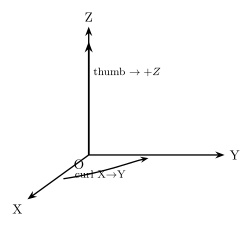
Drawn by us to help you understand the concept clearly, and verified to make sure it's accurate. For exams, practice from your textbook's own diagram.
What this figure shows. Shows a right hand with the fingers curling from the positive X-axis towards the positive Y-axis while the thumb stands up along the positive Z-axis, which is the standard convention used throughout the chapter to decide which of the two directions perpendicular to the XY-plane counts as "positive" Z. Getting this handedness right matters later for the direction of a times b, since the vector (cross) product is also defined using the right-hand rule and a left-handed sketch would flip eve …
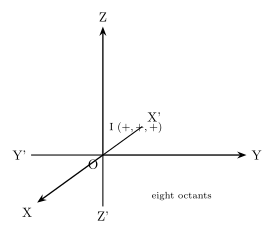
Drawn by us to help you understand the concept clearly, and verified to make sure it's accurate. For exams, practice from your textbook's own diagram.
What this figure shows. Shows the three coordinate planes cutting space into eight boxed regions (octants), labelled I through VIII, each carrying a distinct triple of plus/minus signs for (x,y,z) -- for instance octant I (all positive) sits where all three axes are positive, while stepping across the YZ-plane into octant II flips only the sign of x to negative. The figure is a quick lookup for deciding which octant a given point such as (-2,3,5) falls into just by reading the signs of its …