Physics · Ch 8 — Electrostatics
Electric Field due to a Charged Infinite Plane Sheet
Electric Field due to a Charged Infinite Plane Sheet
Consider an infinite, thin, flat plane sheet carrying a uniform surface charge density (units C/m). Let P be a field point at perpendicular distance from the sheet on one side.
To find the field at P, imagine a Gaussian PILL-BOX: a short cylinder of cross-sectional area , oriented with its axis perpendicular to the sheet, positioned so the sheet passes through the exact midpoint of the cylinder's own length, giving two flat end caps P and P' sitting at the SAME distance on opposite sides of the sheet. By the sheet's own symmetry (it is identical when viewed from either side, and infinite in extent so there is no preferred direction along it), the field points directly AWAY from the sheet on both sides (assuming ), has EXACTLY the same magnitude at P and P', and is everywhere exactly PARALLEL to the two flat end caps' own outward normals ( at both), while being purely TANGENTIAL to the pill-box's curved side surface (which therefore contributes zero flux, just as the end caps did for the charged wire in the previous sub-section, only with the roles of curved-surface and flat-cap reversed).
The flux is entirely due to the two end caps: . The enclosed charge is (the portion of the infinite sheet's charge lying directly "inside" the pill-box's cross-section), so Gauss' law gives , and the area cancels from both sides -- another confirmation that the answer cannot depend on the arbitrary size chosen for the pill-box's cross-section. The result is . …
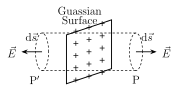
Drawn by us to help you understand the concept clearly, and verified to make sure it's accurate. For exams, practice from your textbook's own diagram.
What this figure shows. An infinite flat sheet carrying uniform surface charge density , shown edge-on as a vertical line/plane, with a cylindrical Gaussian surface (pill-box) of cross-sectional area drawn straddling it symmetrically, its axis perpendicular to the sheet. Two flat end caps, labelled P and P', sit at equal perpendicular distance on opposite sides of the sheet, with outward field arrows drawn at both P and P' pointing directly away from the sheet (away from each other), of equal length/magnitude on both sides -- establishing visually that the field is the same strength on either face of the sheet and …
Worked out. A large flat charged sheet has surface charge density . Using -- computed just next to the sheet's surface, measured from its midpoint, and independent of exactly how close (or far) the point is, since the infinite-sheet field is distance-indepen …