Q.Soft iron is used to make the core of a transformer because of its (A) low coercivity and low retentivity (B) low coercivity and high retentivity (C) high coercivity and high retentivity (D) high coercivity and low retentivity
Concept understanding — Hysteresis
Hysteresis: The Memory of a Magnet
Imagine you push a heavy box across a rough floor. You shove it forward — it moves. You stop pushing — it stays where it is, not sliding back. To return it to the starting point, you have to push it backward, and even then it resists. The box "remembers" where it was last pushed, and the path you take to move it forward is not the same as the path you take to bring it back.
That lag — the dependence of where the box is on its history, not just on the force you apply right now — is the core of hysteresis.
The Intuition: Why a Ferromagnet Lags Behind
A ferromagnetic material (like iron) is made of tiny magnetic domains — regions where atomic magnetic moments are already aligned. In an unmagnetised state, these domains point in random directions, so the net magnetic field B inside the material is zero.
Now you apply an external magnetic field H (say, from a solenoid). The domains that are already aligned with H grow; the others shrink and rotate. The material becomes magnetised — B rises. But the domains do not move freely. They are pinned by impurities, grain boundaries, and internal stresses. They resist change.
When you increase H to a large value, all domains align — the material is saturated. Now you reduce H back to zero. Do the domains return to random directions? No. Many stay locked in their new alignment because the pinning forces hold them. The material retains a net magnetisation even with no external field. That leftover B is called retentivity (or remanence).
To force the domains back to randomness — to bring B to zero — you must apply a field in the opposite direction. The magnitude of that reverse field needed to demagnetise the material is called coercivity.
The B–H Loop: The Precise Picture
Plot B (magnetic flux density inside the material) against H (applied magnetic field). Start from an unmagnetised sample at the origin.
- Rise to saturation: Increase H from zero. B rises steeply at first (domains grow easily), then flattens as saturation approaches. Call this point S.
- Reduce H to zero: B does not retrace the rising curve. It falls more slowly, and at H=0, B=Br — the retentivity.
- Reverse H: Apply H in the opposite direction. B continues to fall, crossing zero at H=−Hc — the coercivity.
- Reverse saturation: Continue increasing reverse H until the material saturates in the opposite direction (point −S).
- Return to H=0: Reduce reverse H to zero. B now sits at −Br.
- Back to forward H: Increase H again. B crosses zero at +Hc and eventually rejoins the original saturation curve at S.
The curve does not close on itself on the first cycle. But after a few cycles, it traces a closed, symmetric loop — the hysteresis loop.
Area of B–H loop=∮HdB=Energy lost per cycle per unit volume
This energy is dissipated as heat inside the material — the work done to move domain walls against pinning forces.
Key Parameters at a Glance
| Parameter | Symbol | Meaning |
|---|---|---|
| Retentivity | Br | Remaining B when H=0 after saturation |
| Coercivity | Hc | Reverse H needed to bring B to zero |
| Saturation magnetisation | Bs | Maximum B achievable |
| Loop area | — | Energy loss per cycle per unit volume |
Why It Matters
- Soft ferromagnets (e.g., pure iron, silicon steel) have narrow loops — low Hc, small area. They are easy to magnetise and demagnetise, ideal for transformers and motors where you want low energy loss.
- Hard ferromagnets (e.g., alnico, ferrites) have wide loops — high Hc, large Br. They resist demagnetisation, making them permanent magnets.
A common mistake: thinking the B–H loop is a plot of B vs H for a vacuum. It is not. It describes the material's response. In vacuum, B=μ0H — a straight line through the origin, no hysteresis.
The One-Sentence Takeaway
Hysteresis is the lag between cause (H) and effect (B) in a ferromagnet, arising from the irreversible motion of magnetic domains, and the area of its B–H loop measures the energy wasted as heat each cycle.
[!TLDR] A transformer core is magnetised and demagnetised every AC half-cycle, so it needs a thin hysteresis loop -- LOW coercivity (easy to demagnetise) and LOW retentivity (no leftover magnetism). [!ANSWER] (A) low coercivity and low retentivity
A transformer's core is continuously taken through a hysteresis cycle as the alternating current reverses direction many times per second. The area enclosed by the core material's hysteresis loop equals the energy dissipated as heat per unit volume, per cycle (section 11.6) -- so a core with a WIDE loop would waste a large amount of energy as heat on every single AC cycle. Soft iron has a thin, tall hysteresis loop: LOW coercivity (only a small reversed field is needed to bring B back to zero, so the material follows the rapidly alternating current easily) and LOW retentivity (very little magnetism is left behind at any instant, so there is little energy locked into -- and then dissipated from -- the domain structure each cycle), together with high permeability (a large B for a comparatively small H, giving an efficiently strong field). This combination minimises the hysteresis loss in continuous AC operation, which is exactly why soft iron, not a hard ferromagnetic material, is used for transformer cores. [!ANSWER] (A) low coercivity and low retentivity
Recall that hysteresis loss per AC cycle is proportional to the loop area, and that soft iron's thin loop (low coercivity and low retentivity) minimises this loss -- the opposite requirement to a permanent magnet.
Confusing the requirement for a transformer/electromagnet core (soft material: LOW coercivity and LOW retentivity) with the requirement for a permanent magnet (hard material: HIGH coercivity and HIGH retentivity) -- the two applications need opposite hysteresis-loop shapes.
- CBSE 2026Set ANNUAL1 markMCQQ.Which of the following materials is most suitable for making a permanent magnet?(a) Soft iron(b) Nickel(c) Copper(d) Steel
›Reveal solutionSolution
A good permanent-magnet material needs BOTH high retentivity (keeps a strong magnetisation) and high coercivity (hard to demagnetise); steel has both.
A permanent magnet must retain its magnetism over time and resist being demagnetised by stray fields, knocks, or heat. This needs a material with:
- High retentivity: it keeps a large magnetisation even after the magnetising field is removed.
- High coercivity: a large reverse field is needed to bring its magnetisation back to zero (the material is magnetically 'hard').
Soft iron has high retentivity but very LOW coercivity (it demagnetises easily) - that's exactly why soft iron is used for electromagnets, not permanent magnets. Nickel and copper are comparatively poor choices (copper isn't even ferromagnetic). Steel, on the other hand, is magnetically 'hard' - once magnetised it holds its magnetism well - so it is the standard choice for permanent magnets.
✓Final answer(d) Steel.
- CBSE 2025Set ANNUAL1 markQ.What is value of B called, when H = 0 is in the hysteresis loop?
›Reveal solutionSolution
On the hysteresis loop, the B-value left behind after H is reduced to zero is the retentivity of the material.
In the B–H hysteresis loop of a ferromagnetic material, as the magnetising field H is reduced from its maximum value back to zero, the magnetic induction B does not fall to zero but retains a finite value because of hysteresis (lag). This residual value of B when H=0 is called the retentivity or residual magnetism, denoted Br. It is a measure of how well the material retains magnetism after the external field is removed.
✓Final answerRetentivity (Br), the residual magnetic induction at H=0.
- CBSE 2024Set A1 markMCQQ.Which of the following shows hysteresis? (A) Paramagnetic materials (B) Ferromagnetic materials (C) Diamagnetic materials (D) None of these
›Reveal solutionSolution
Hysteresis (the B–H loop, with retentivity and coercivity) is a property of ferromagnetic materials.
Hysteresis is the phenomenon in which the magnetisation B of a material lags behind the applied field H, so that when H is cycled the B–H curve traces a closed loop. This lag arises from the irreversible motion of magnetic domains, which exist only in ferromagnetic materials (iron, cobalt, nickel and their alloys).
The loop shows retentivity (residual B at H = 0) and coercivity (the reverse H needed to demagnetise), both hallmarks of ferromagnets. Paramagnetic and diamagnetic materials have no domains and their weak magnetisation is single-valued and reversible — they show no hysteresis loop.
✓Final answer(B) Ferromagnetic materials.
- CBSE 2024Set ANNUAL1 markQ.Why do we prefer steel for making permanent magnets ?
›Reveal solutionSolution
A good permanent-magnet material needs both high retentivity and high coercivity — steel has both.
A permanent magnet should (i) retain a strong magnetic field even after the magnetising field is removed (high retentivity), and (ii) not lose its magnetism easily due to stray fields, mechanical shocks or temperature changes (high coercivity, i.e. it resists demagnetisation). Steel has both high retentivity and high coercivity (unlike soft iron, which has high retentivity but very low coercivity — it loses magnetism as soon as the field is removed). This combination makes steel well-suited for permanent magnets, even though its retentivity is somewhat lower than soft iron's.
✓Final answerSteel has high retentivity and high coercivity, so it stays strongly and permanently magnetised.
- CBSE 2023Set ANNUAL1 markQ.Write two characteristics of a material to produce a permanent magnet.
›Reveal solutionSolution
A good permanent-magnet material must retain a strong magnetisation after the magnetising field is removed AND resist being demagnetised - i.e. it needs both high retentivity and high coercivity.
Retentivity (residual magnetism) is the magnetisation that remains in the material after the external magnetising field is switched off to zero - it must be HIGH so the magnet stays strongly magnetised. Coercivity is the reverse field needed to bring the magnetisation back to zero - it must also be HIGH so that stray fields, heat, or mechanical shocks cannot easily demagnetise it. Materials like steel and alnico alloys, which have broad hysteresis loops (high retentivity and high coercivity), are therefore used for permanent magnets.
✓Final answerHigh retentivity and high coercivity.
- CBSE 2023Set ANNUAL1 markMCQQ.Soft iron is used to make the core of transformer because of its ______.(a) low coercivity and low retentivity(b) low coercivity and high retentivity(c) high coercivity and high retentivity(d) high coercivity and low retentivity
›Reveal solutionSolution
A transformer core must remagnetise every AC half-cycle with minimal hysteresis loss.
A transformer core is driven around its hysteresis loop 50 times a second, and the hysteresis-loss per cycle is proportional to the loop's area. Soft iron has a narrow hysteresis loop: low coercivity (needs very little reverse field to demagnetise, so little energy is wasted reversing the field) and low retentivity (loses most of its magnetisation as soon as the field is removed, tracking the AC current faithfully instead of lagging). Both properties together minimise hysteresis loss, which is why soft iron (and not a hard magnetic material) is used for transformer cores and electromagnets.
✓Final answerlow coercivity and low retentivity — option (a).
- CBSE 2018Set ANNUAL1 markMCQQ.The material of a permanent magnet should have(a) high retentivity and low coercivity(b) low retentivity and high coercivity(c) low retentivity and low coercivity(d) high retentivity and high coercivity.
›Reveal solutionSolution
A good permanent magnet needs BOTH high retentivity (keeps its magnetism) and high coercivity (resists demagnetization) — steel is the classic example.
Retentivity is the residual magnetization (B or M) that remains in a material after the external magnetizing field is reduced to zero. A permanent magnet must retain as much magnetism as possible once magnetized, so it needs high retentivity.
Coercivity is the reverse magnetic field required to bring the residual magnetization down to zero. A permanent magnet should not lose its magnetism easily when exposed to stray external fields, vibrations, or moderate temperature changes, so it needs high coercivity as well.
Materials such as steel and alnico, which have both high retentivity and high coercivity (a "fat", tall hysteresis loop), are used for permanent magnets. (By contrast, soft iron — high retentivity but low coercivity — is used for electromagnets, where the field must be switched off easily.)
✓Final answer(d) high retentivity and high coercivity
- CBSE 2018Set ANNUAL1 markQ.Draw hysteresis curve (B-H curve) for a ferromagnetic substance.
›Reveal solutionSolution
The hysteresis curve is a closed B–H loop showing that B lags behind H, with retentivity and coercivity marking the loop's intercepts.
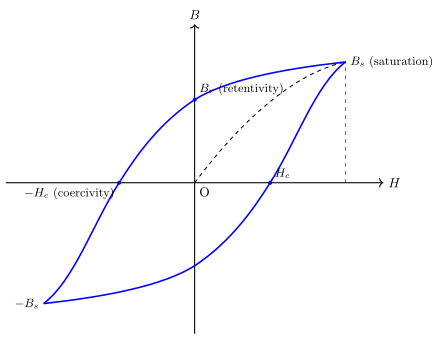
Hysteresis bh loop ferromagnetic material retentivity coercivity saturation Description of the curve to draw (axes: horizontal = magnetising field H, vertical = flux density B):
- Starting from the origin O, as H increases, B increases along OA and reaches saturation at point A.
- As H is reduced back to zero, B does not retrace OA but follows AB, so at H = 0 there is a residual flux density OB = Br called retentivity (remanence).
- To reduce B to zero, a reverse field must be applied; the value OC of reverse H at which B = 0 is the coercivity (Hc).
- Increasing the reverse field takes B to saturation in the opposite direction (point D), and reversing H again completes the closed loop D→E→F→A.
The loop area represents the energy lost per unit volume per cycle (hysteresis loss). For a ferromagnetic (soft or hard) material the loop is broad and symmetric about the origin.
✓Final answerDraw a closed loop symmetric about the origin on B (y-axis) vs H (x-axis): saturation at both ends, positive B-intercept = retentivity (Br), and negative H-intercept = coercivity (Hc).
🎓Unlock everything free for 14 days
- ✓Full step-by-step solutions
- ✓Concept-first explanations
- ✓Methods, shortcuts & mistakes
- ✓PYQ mapping + timed mock tests
Full access for 14 days. No credit card required.