Physics · Ch 2 — Mechanical Properties of Fluids
Coefficient of Viscosity
Coefficient of Viscosity
According to Newton's law of viscosity, for a streamline flow, the viscous force f acting on any given layer of a fluid is directly proportional both to the area A of that layer and to the local velocity gradient dv/dx there:
where η is a constant, called the coefficient of viscosity of the fluid. From Eq. (2.34), the coefficient of viscosity itself can be written as:
The SI unit of the coefficient of viscosity is Ns/m² (equivalently, Pa·s); its CGS unit is the poise. It is important to note that 'A' in this expression is NOT a cross-sectional area — it is the area of the fluid layer measured parallel to the direction of flow, the area over which the layer's own viscous drag actually acts.
A microscopic view of viscosity. Consider laminar flow between two parallel plates, X and Y, with plate X held stationary and plate Y moving at some velocity ; layers of fluid a, b and c between them move at velocities , v, and respectively. The velocity attributed to any given layer of fluid is really the mean velocity of all the molecules currently within that layer — so the molecules in layer b have mean velocity v, while those in layer c have a slightly greater mean velocity . As will be seen in the next chapter, each individual molecule also carries its own random thermal velocity, usually much larger in magnitude than this small mean-velocity difference between layers, and as a result molecules are continually being exchanged, in large numbers, between neighbouring layers. On average, a molecule crossing from the faster layer c into the slower layer b arrives moving too fast for its new surroundings by roughly dv, and is slowed down by collisions with the molecules already in layer b — so momentum is steadily transferred from the faster-moving layer c to its slower neighbour b, and ultimately, layer by layer, all the way to the stationary plate X. Since the original source of this momentum is the moving plate Y, the overall effect is a continuous transfer of momentum from plate Y to plate X; left entirely to itself (with no external force reapplied), this transfer would eventually bring plate Y's velocity, relative to plate X, down to zero. Because the direction each exchanged molecule takes after its collisions is essentially random, this process converts some of the fluid's ordered, macroscopic kinetic energy of flow into disordered thermal energy — i.e. the process is dissipative, or frictional, exactly the character expected of a drag force. In liquids there is, on top of this same momentum-exchange mechanism, an additional and stronger direct interaction between molecules in adjacent layers, due to the intermolecular (cohesive) forces that set liquids apart from gases — and this additional interaction is what makes a liquid's viscous drag generally stronger and more sensitive to temperature than a gas's. …
Fluid | Temperature | Coefficient of Viscosity Ns/m²
Air | 0°C | 0.017×10⁻³
Air | 40°C | 0.019×10⁻³
Water | 20°C | 1×10⁻³
Water | 100°C | 0.3×10⁻³ …
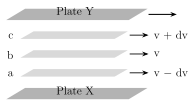
Drawn by us to help you understand the concept clearly, and verified to make sure it's accurate. For exams, practice from your textbook's own diagram.
What this diagram shows. Plate X is stationary and plate Y moves with velocity v₀; the fluid between them flows in layers a, b, c with velocities v−dv, v and v+dv. Molecules jumping between adjacent layers transfer momentum from the faster layers toward plate …