Physics · Ch 2 — Mechanical Properties of Fluids
Viscosity
Viscosity
When water is poured out of a glass, it flows freely and quickly; but when syrup or honey is poured, it flows sluggishly and clings to the sides of the container. This difference in behaviour is due to fluid friction — friction that acts both within the fluid itself (between its own internal layers) and between the fluid and the surfaces it touches. This property of a fluid is called viscosity. Water, correspondingly, has low viscosity, while syrup or honey has high viscosity. (The only fluid that is almost entirely non-viscous is liquid helium at around 2 K.)
A river gives a natural illustration of viscosity in action: the water near both banks of a river is observed to flow slowly, while the water gradually flows faster and faster as one moves toward the centre of the river, where the flow is fastest of all. This observation makes clear that there is some opposing force acting between adjacent layers of the flowing fluid, resisting their relative motion — this is exactly the property called viscosity: the property of a fluid by virtue of which relative motion between its different layers experiences a dragging (opposing) force, called the viscous drag.
The rate of change of a fluid's velocity (dv) with distance (dx), measured away from a stationary reference layer, is called the velocity gradient, dv/dx. …
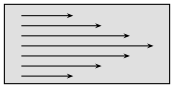
Drawn by us to help you understand the concept clearly, and verified to make sure it's accurate. For exams, practice from your textbook's own diagram.
What this figure shows. A fluid flowing through a channel or pipe is shown divided into several parallel horizontal layers, each drawn with a velocity arrow of different length: the central-most layer has the longest arrow (the fastest flow), and the outermost layers, closest to the stationary channel walls, have the shortest arrows (the slowest flow, dragged back by friction against the boundary). This is the characteristic velocity profile of a real, viscous fluid in flow, and is the direct picture behind the definition of viscosit …
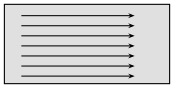
Drawn by us to help you understand the concept clearly, and verified to make sure it's accurate. For exams, practice from your textbook's own diagram.
What this figure shows. The same channel/pipe geometry as Fig. 2.28, but now with every layer's velocity arrow drawn the same length, showing all layers of the fluid moving at exactly the same speed with no relative sliding and hence no dragging force between them at all — the idealised case of a fluid with zero viscosity, drawn directly beside Fig. 2.28 for contrast against a real, viscous fluid's …
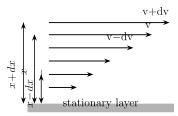
Drawn by us to help you understand the concept clearly, and verified to make sure it's accurate. For exams, practice from your textbook's own diagram.
What this figure shows. A schematic showing several fluid layers stacked at increasing distance x away from one fixed, stationary reference layer, with each successive layer at a greater x labelled with a progressively higher flow velocity v. The figure is the direct picture behind the velocity gradient dv/dx — the rate at which the flow speed increases with distance from the stationary boundary — which appears directly in Newton's law of viscosity in the next secti …