Q.The given figure shows a streamline flow of a non-viscous liquid having density 1000 kg/m³. The cross sectional area at point A is 2 cm² and at point B is 1 cm². The speed of liquid at the point A is 5 cm/s. Both points A and B are at the same horizontal level. Calculate the difference in pressure at A and B.
Concept understanding — Bernoulli's Principle
Bernoulli's Principle: From Intuition to Precision
Imagine you're standing on a railway platform as an express train roars past. You feel a strange pull — a gentle but definite tug — drawing you toward the train. That's not your imagination. It's Bernoulli's Principle at work in the real world.
The Core Intuition
Here's the simplest way to think about it: fast-moving fluid (air or water) exerts less pressure than slow-moving fluid.
When the train rushes by, it drags the air next to it along. That air moves fast. The air on the other side of you, far from the train, is nearly still. The still air pushes harder than the fast air, so you feel a net push toward the train.
This isn't magic — it's a direct consequence of how energy is conserved in a flowing fluid.
The Precise Statement
P+21ρv2+ρgh=constant
Where:
- P = pressure of the fluid
- ρ = density of the fluid
- v = speed of the fluid
- g = acceleration due to gravity
- h = height above a reference level
Bernoulli's Principle states: For an ideal fluid (incompressible, non-viscous, flowing steadily along a streamline), an increase in the fluid's speed occurs simultaneously with a decrease in pressure or a decrease in the fluid's potential energy.
Breaking It Down Piece by Piece
The equation has three terms, each representing a form of "energy per unit volume":
- P — Pressure energy. Think of it as the "push" the fluid has stored.
- 21ρv2 — Kinetic energy per unit volume. Faster flow means more of this.
- ρgh — Gravitational potential energy per unit volume. Higher elevation means more of this.
The sum stays constant along a streamline. So if one term goes up, at least one other must go down.
A common mistake is to think Bernoulli's Principle says "fast flow always means low pressure." That's only true when height doesn't change. If a fluid flows uphill, it can slow down and still have lower pressure — the height term eats up the energy.
A Concrete Example: The Garden Hose
Put your thumb over the end of a garden hose. The water shoots out faster — but the pressure at the nozzle drops. You can feel it: the hose feels "softer" near your thumb. The water's speed increased, so its pressure decreased. That's Bernoulli in your hands.
When Does Bernoulli's Principle Apply?
It works perfectly for:
- Ideal fluids — water, air at moderate speeds (below about 0.3 times the speed of sound)
- Steady flow — no turbulence or sudden changes
- Along a single streamline — you can't compare two different streamlines unless they start from the same reservoir
| Condition | Applies? | Why |
|-----------|----------|-----|
| Water flowing in a pipe | Yes | Incompressible, low viscosity |
| Air over an airplane wing | Yes (approximately) | Low speed, steady flow |
| Blood in arteries | Partially | Pulsatile flow, not steady |
| Hurricane winds | No | Turbulent, compressible effects |
The Deeper Reason: Energy Conservation
Bernoulli's Principle is really just the law of conservation of energy applied to a fluid. Imagine a small parcel of fluid moving along a streamline. As it moves, its total mechanical energy (pressure energy + kinetic energy + gravitational potential energy) stays constant — assuming no friction or heat exchange.
That's it. No new physics — just old physics in a new disguise.
A Final Check
If you remember nothing else, remember this: Where speed is high, pressure is low — provided height doesn't change. That one idea explains why airplanes fly, why curveballs curve, and why you feel that tug from a passing train.
This topic frequently turns up in searches like "Bernoulli's Principle: definition, formula and real-world examples" — Bernoulli's Principle is a syllabus-aligned topic under Mechanical Properties of Fluids in NCERT Class 11 Physics, making it a natural fit for both board exams and JEE/NEET practice sets. Cross-checking this explanation against the relevant NCERT Physics chapter and solving a few past-year questions will round out your preparation.
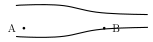
Continuity doubles the speed at B; level flow reduces Bernoulli to the kinetic term.
P1−P2=21ρ(v22−v12)=21×1000×[(0.10)2−(0.05)2]=3.75 Pa (the book's printed 3.75×10⁴ Pa comes from a cm→m slip — see the note in the full solution).
A₁v₁=A₂v₂ then (P1−P2)=21ρ(v22−v12).
From continuity v2=A1v1/A2=2×5/1=10 cm/s. With h2=h1, Bernoulli gives (P1−P2)=21ρ(v22−v12)=21×1000×[(0.10)2−(0.05)2]=21×1000×(100−25)×10−4=3.75 Pa
The printed Solution carries the squared speeds as plain (100−25) without the 10−4 from (cm/s)² → (m/s)² and so prints P1−P2=37500 Pa =3.75×10⁴ Pa. With the speeds correctly converted (5 cm/s = 0.05 m/s, 10 cm/s = 0.10 m/s), the difference is 3.75 Pa. The printed value corresponds to speeds of 5 m/s and 10 m/s.
P1−P2=21ρ(v22−v12)=21×1000×[(0.10)2−(0.05)2]=3.75 Pa (the book's printed 3.75×10⁴ Pa comes from a cm→m slip — see the note in the full solution).
Catch the unit slip by magnitude: centimetre-per-second flows produce only pascals of pressure difference, not tens of kilopascals.
Squaring cm/s values and treating them as (m/s)² — exactly the slip the book's own printed Solution makes (see the note).
- CBSE 2026Set ANNUAL1 markQ.Write Bernoulli's theorem.
›Reveal solutionSolution
Bernoulli's theorem: P + ½ρv² + ρgh = constant along a streamline, for steady, incompressible, non-viscous flow.
Bernoulli's theorem follows from applying the work-energy theorem to a fluid element flowing along a streamline. It states that, for an ideal fluid (incompressible, non-viscous) in steady (streamline) flow, the total mechanical energy per unit volume — the sum of pressure energy (P), kinetic energy per unit volume (½ρv²), and gravitational potential energy per unit volume (ρgh) — remains constant at every point along the streamline: P + ½ρv² + ρgh = constant. A key consequence is that where the fluid speed v is higher (e.g. a narrower part of a pipe), the pressure P must be lower, and vice versa — this explains phenomena like the lift on an aircraft wing and the Magnus effect on a spinning ball.
✓Final answerP + ½ρv² + ρgh = constant (along a streamline, for ideal, steady flow).
- CBSE 2025Set ANNUAL1 markMCQQ.In Bernoulli's theorem, which of the following is constant?(a) Linear momentum(b) Angular momentum(c) Mass(d) Energy
›Reveal solutionSolution
Bernoulli's theorem is a statement of conservation of energy for an ideal, incompressible, non-viscous fluid in streamline flow.
For steady, streamline flow of an ideal (non-viscous, incompressible) fluid, Bernoulli's theorem states that the sum of pressure energy, kinetic energy and potential energy per unit volume remains constant along a streamline:
P+21ρv2+ρgh=constant
Here P is the pressure energy per unit volume, 21ρv2 the kinetic energy per unit volume, and ρgh the potential energy per unit volume. This is a direct consequence of the work–energy theorem applied to fluid flow, so it is the total energy (per unit volume) that stays constant, not momentum, angular momentum or mass individually (mass is conserved separately via the continuity equation).
✓Final answer(d) Energy.
- CBSE 2025Set ANNUAL1 markMCQQ.The pressure energy per unit volume of a liquid of density ρ at pressure P is (A) P/ρ (B) sqrt(P/ρ) (C) P.ρ (D) P
›Reveal solutionSolution
The pressure energy per unit volume of a liquid is simply equal to the pressure P.
Bernoulli's equation expresses conservation of energy per unit volume along a streamline:
P+21ρv2+ρgh=constant
Here, 21ρv2 is the kinetic energy per unit volume and ρgh is the potential energy per unit volume. By the same logic (and dimensionally, since [P]=[energy]/[volume]=N/m2=J/m3), the pressure energy per unit volume is just P itself.
(Note: P/ρ would instead be the pressure energy per unit mass.)
✓Final answer(D) P.
- CBSE 2025Set ANNUAL1 markQ.State True or False: Bernoulli's theorem is based on the law of conservation of momentum.
›Reveal solutionSolution
The statement is False: Bernoulli's theorem follows from conservation of energy, not conservation of momentum.
Bernoulli's theorem states that for an ideal (incompressible, non-viscous) fluid in streamline flow, the sum P + (1/2)rhov^2 + rhogh remains constant along a streamline. It is derived by applying the work-energy theorem to a fluid element — the net work done on the fluid element by pressure forces equals its change in kinetic energy plus change in gravitational potential energy. This is fundamentally an application of the law of conservation of mechanical energy to fluid flow, not conservation of momentum.
✓Final answerFalse — Bernoulli's theorem is based on the law of conservation of energy.
- CBSE 2024Set ANNUAL1 markMCQQ.The principle of Bernoulli's theorem is based on (A) Conservation of momentum (B) Conservation of mass (C) Conservation of energy (D) None of these
›Reveal solutionSolution
Bernoulli's theorem is a statement of energy conservation for flowing fluids.
Bernoulli's equation, P+21ρv2+ρgh=constant, states that the sum of pressure energy, kinetic energy, and potential energy per unit volume remains constant along a streamline for an ideal (non-viscous, incompressible) fluid in steady flow. This is derived directly from the work-energy theorem applied to a fluid element — i.e. from the principle of conservation of energy.
✓Final answer(C) Conservation of energy.
- CBSE 2024Set SET-AP55001 markMCQQ.Bernoulli's theorem is based on:(a) The principle of conservation of mass(b) The principle of conservation of momentum(c) The principle of conservation of energy(d) All of the above
›Reveal solutionSolution
Bernoulli's theorem (P + ½ρv^2 + ρgh = constant along a streamline) is derived from the work-energy theorem for an ideal (incompressible, non-viscous) fluid in streamline flow — it is fundamentally an energy-conservation statement.
Bernoulli's equation is obtained by equating the net work done on a fluid element (by pressure differences) to its change in kinetic and potential energy as it flows along a streamline — exactly the work-energy theorem, which itself is a form of the conservation of mechanical energy. It assumes the fluid is incompressible and non-viscous (no energy lost to friction), so total mechanical energy per unit volume is conserved along the flow.
It is not a statement of conservation of mass (that's the continuity equation, A1v1 = A2v2) nor directly conservation of momentum — it's about energy.
✓Final answerThe correct option is (c) The principle of conservation of energy.
- CBSE 2024Set SET-NDP60001 markQ.Bernoulli's theorem is based on the law of conservation of ................. (energy / momentum).
›Reveal solutionSolution
Bernoulli's theorem is a statement of the conservation of energy for a flowing ideal fluid.
Bernoulli's equation states that for steady, incompressible, non-viscous flow along a streamline,
P+21ρv2+ρgh=constant
Each term here represents an energy density (energy per unit volume): P is associated with the fluid's pressure (flow) energy, 21ρv2 is kinetic energy per unit volume, and ρgh is gravitational potential energy per unit volume. The theorem is derived by applying the work–energy theorem to a fluid element moving through a pipe of varying cross-section and height, and it asserts that the total mechanical energy per unit volume of the fluid remains constant along a streamline (in the absence of viscous losses). This is exactly the principle of conservation of energy applied to fluid flow.
✓Final answerBernoulli's theorem is based on the law of conservation of Energy.
- CBSE 2023Set ANNUAL1 markMCQQ.A device thate works on Bernoulli's theorem is the(a) Voltmeter(b) Screw gauge(c) Venturi-meter(d) Spherometer
›Reveal solutionSolution
A Venturi-meter measures flow rate using Bernoulli's theorem (option c).
Bernoulli's theorem states that along a streamline of an ideal (incompressible, non-viscous) fluid in steady flow, the sum P + (1/2)pv^2 + p g h is constant, where P is pressure, p is density, v is flow speed, and h is height.
A Venturi-meter is a tube with a constriction (narrower section) fitted into a pipe. By continuity, the fluid speeds up as it passes through the narrower section. By Bernoulli's theorem, since the speed increases at the constriction, the pressure there must decrease. Measuring this pressure difference (via manometer tubes) lets the flow speed/rate be calculated — this is a direct, textbook application of Bernoulli's theorem.
The other options are unrelated: a voltmeter measures potential difference (electrical, not fluid flow); a screw gauge and spherometer are mechanical length-measuring instruments based on the principle of a micrometer screw, with no connection to fluid dynamics.
✓Final answerThe correct option is (c) Venturi-meter.
🎓Unlock everything free for 14 days
- ✓Full step-by-step solutions
- ✓Concept-first explanations
- ✓Methods, shortcuts & mistakes
- ✓PYQ mapping + timed mock tests
Full access for 14 days. No credit card required.