Physics · Ch 16 — Semiconductor Devices
Exclusive OR / X-OR Gate
Exclusive OR / X-OR Gate
The Exclusive-OR (X-OR) gate is a two-input, one-output gate whose defining behaviour is that its output goes HIGH (1) only when its two inputs are at genuinely DIFFERENT logic levels from each other -- one 0 and the other 1, in either order -- and stays LOW (0) whenever the two inputs AGREE (both 0, or both 1). Put another way, an X-OR gate's output is high whenever an ODD number of its inputs are high (here, exactly one out of two). Its Boolean expression is , and can equivalently be written out in full sum-of-products form as (Fig. 16.32) -- capturing exactly the two input rows (A=1,B=0 and A=0,B=1) where the output is high. Because it effectively COMPARES its two inputs and signals whether they differ, the X-OR gate is an extremely useful building block in computational and arith …
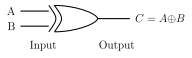
Drawn by us to help you understand the concept clearly, and verified to make sure it's accurate. For exams, practice from your textbook's own diagram.
What this figure shows. A shape very similar to the OR gate's curved-back, pointed-front outline (Fig. 16.28), but with an EXTRA separate curved line drawn just outside/behind the main concave back edge -- a second, thinner curve running parallel to and slightly apart from the gate body's own curved back -- which is the distinguishing feature that marks an X-OR gate's symbol apart from a plain OR gate's. Two input lines (A and B) enter through this double-curved back, and a single output line (labelled $C=A\oplu …
Input A | Input B | Output C
0 | 0 | 0
0 | 1 | 1 …