Question 99 of 99
Q.(a) With a suitable diagram explain the structure of an ovule. OR
(b) Which is called as the "King of Spices" ? Write its origin and uses.
Puducherry TnboardTamil Nadu HSC (DGE) Board 2026Subjective· 5mImportance★★★★★
100% · 99/99 Questions
You're viewing a preview — the full solution, concept, methods & PYQ mapping are locked.
Start your 14-day free trial to unlock the full solution →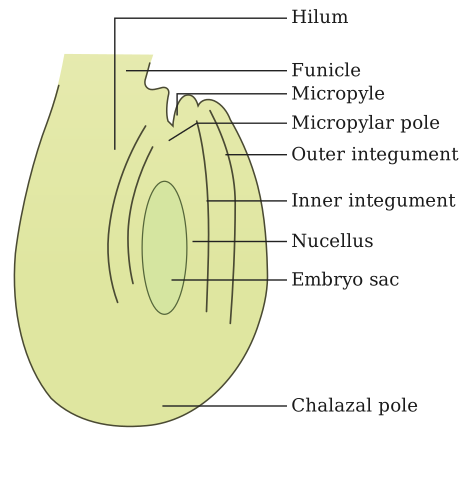
(a) An ovule's parts are the funicle, hilum, integuments, micropyle, nucellus and embryo sac, with the chalaza at the base; (b) Black Pepper, native to the Western Ghats, is the "King of Spices".
(a) Structure of an ovule
Since a diagram cannot be physically drawn here, the structure of a typical anatropous angiosperm ovule (the most common type) is described part by part, as it would be labelled in the diagram:
- Funicle: the stalk that attaches the ovule to the placenta (the ovary wall tissue bearing the ovules).
- Hilum: the point/region where the funicle joins the body of the ovule.
- Integument(s): one or two protective layers of tissue that envelop the nucellus, growing up around it but leaving a small opening at the tip.
- Micropyle: the small pore left at the tip of the integuments, through which the pollen tube enters the ovule during fertilisation.
- Nucellus: the megasporangium tissue enclosed within the integuments, inside which the megaspore mother cell undergoes meiosis to eventually produce the embryo sac.
- Embryo sac: the mature female gametophyte lying within the nucellus, typically 8-nucleate/7-celled, consisting of an egg apparatus (1 egg cell + 2 synergids) at the micropylar end, 3 antipodal cells at the chalazal end, and a central cell containing 2 polar nuclei.
- Chalaza: the basal region of the ovule, opposite the micropyle, where the integuments, nucellus, and funicle all meet/fuse.
- Raphe: in an anatropous ovule (where the body of the ovule is inverted so that the micropyle lies close to the funicle), the fused funicle forms a ridge, the raphe, running along one side of the ovule.
(b) The "King of Spices"
…
Unlock everything free for 14 days
- Full step-by-step solutions
- Concept-first explanations
- Methods, shortcuts & mistakes
- PYQ mapping + timed mock tests
Full access for 14 days. No credit card required.