Question 93 of 99
Q.(a) Draw and label the structure of T.S. of mature anther. OR
(b) Generally human activities are against the ecosystem. As a student how will you help to protect ecosystem ?
Puducherry TnboardTamil Nadu HSC (DGE) Board 2025Subjective· 5mImportance★★★★★
94% · 93/99 Questions
You're viewing a preview — the full solution, concept, methods & PYQ mapping are locked.
Start your 14-day free trial to unlock the full solution →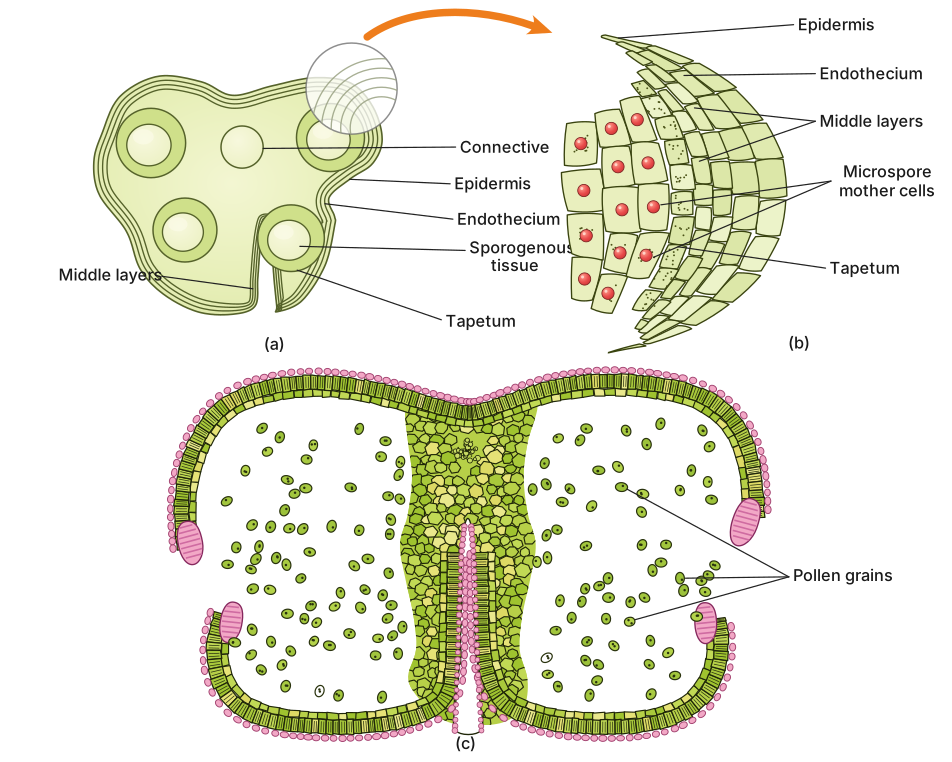
(a) A mature anther in T.S. is four-lobed with four pollen sacs, each walled by epidermis-endothecium-middle layers-tapetum, joined by a central connective; (b) students can protect the ecosystem through everyday responsible actions like planting trees, avoiding plastic, and conserving resources.
(a) T.S. of a mature anther
Since a diagram cannot be drawn here, the structure of a transverse section of a typical mature (bilobed, tetrasporangiate) anther is described part by part:
- Overall shape: in T.S., the anther appears as a broadly four-lobed (dumbbell-like) structure, made up of two thecae (lobes), one on each side, joined together in the middle by a connective.
- Connective: the central sterile tissue that joins the two anther lobes together, running through the middle of the anther and containing a vascular strand (bundle), which supplies nutrients to the developing pollen.
- Pollen sacs (microsporangia): each of the two lobes (thecae) contains TWO pollen sacs, giving four pollen sacs in total in a typical mature anther. Each pollen sac, in transverse section, is bounded from outside to inside by four distinct wall layers:
- Epidermis: the outermost, single-layered protective covering of the anther.
- Endothecium: the layer just beneath the epidermis, whose cells develop characteristic fibrous (radial) thickenings as the anther matures, which help create tension that causes the anther to split open (dehisce) at maturity.
- Middle layers: two to three thin-walled layers lying beneath the endothecium, which are generally crushed and become non-functional as the anther matures.
- Tapetum: the innermost wall layer, directly surrounding the pollen mother cells/developing pollen grains, providing them with nourishment and materials (including for the pollen wall) during development; it is nutritive and gets used up as the pollen matures.
- Pollen grains: at maturity, each pollen sac is packed with numerous pollen grains (formed from microspore tetrads by meiosis of the pollen mother cells).
- Dehiscence: the two adjacent pollen sacs of each lobe often merge into one at maturity, and the anther eventually splits open (commonly along a longitudinal line of weakness called the stomium), releasing the mature pollen grains for pollination. …
Unlock everything free for 14 days
- Full step-by-step solutions
- Concept-first explanations
- Methods, shortcuts & mistakes
- PYQ mapping + timed mock tests
Full access for 14 days. No credit card required.