Q.What are the processes involved in a Carnot engine?
🔒You're viewing a preview — the full solution, concept, methods & PYQ mapping are locked.
🔒 Start your 14-day free trial to unlock the full solution →Concept understanding — Carnot Engine
The Carnot Engine: Why Nature Puts a Ceiling on Efficiency
Imagine you have a steam engine. You burn coal, heat water, make steam, push a piston. You get work out. But you also always waste heat — the exhaust steam is still hot. Could you ever build an engine that converts all the heat into work? The Carnot engine is the thought experiment that answers that question with a firm no.
The intuition is simple: heat flows spontaneously only from hot to cold. To make it do work, you must let some of it "fall" to a lower temperature, just as a water wheel can only extract work from water falling downhill — you never get all the potential energy back, because the water ends up at the bottom. The Carnot engine is the perfect water wheel: it wastes the absolute minimum heat required by the second law of thermodynamics.
The Precise Definition
A Carnot engine is an idealised, reversible heat engine that operates in a cycle between two thermal reservoirs at temperatures TH (hot) and TC (cold), where TH>TC. The cycle consists of exactly four reversible processes:
- Isothermal expansion at TH — the working substance (usually an ideal gas) absorbs heat QH from the hot reservoir while expanding slowly, doing work on the surroundings.
- Adiabatic expansion — the gas is thermally insulated and continues expanding, doing work. Its temperature drops from TH to TC with no heat exchange.
- Isothermal compression at TC — the gas is in contact with the cold reservoir. It is compressed slowly, rejecting heat QC to the cold reservoir.
- Adiabatic compression — the gas is insulated again and compressed further, raising its temperature back to TH with no heat exchange, returning to the starting state.
Every step is reversible — the gas is always in thermodynamic equilibrium, and the direction can be reversed by an infinitesimal change. This is the ideal limit that real engines can approach but never reach.
The Efficiency — The One Result You Must Know
The efficiency η of any heat engine is defined as:
η=Heat inputWork output=QHW
From energy conservation over one cycle, W=QH−QC, so:
η=1−QHQC
For a Carnot engine, the ratio of heat exchanged is exactly equal to the ratio of absolute temperatures:
QHQC=THTC
ηCarnot=1−THTC
This is the maximum possible efficiency for any engine operating between TH and TC. No real engine can beat it — not because of engineering limitations, but because of the second law of thermodynamics.
Temperatures must be in Kelvin. Using Celsius gives a completely wrong (and often >1) result. For example, between 100°C and 0°C, TH=373K, TC=273K, so η=1−273/373≈0.27 (27%). If you used Celsius, you'd get 1−0/100=1 (100%), which is impossible.
Why This Is the Maximum …
The Carnot cycle has four steps: isothermal expansion, adiabatic expansion, isothermal compression, adiabatic compression. …
Step 1. A→B, isothermal expansion at the hot reservoir's temperature TH: heat QH flows in from the source as the gas expands.
Step 2. B→C, adiabatic expansion: the gas continues to expand, thermally isolated, with its temperature falling from TH to TL.
Step 3. C→D, isothermal compression at the cold reservoir's temperature TL: heat QL is rejected to the sink as the gas is compressed. …
List the four legs in order, naming which reservoir (or insulati …
- Getting the order wrong, e.g. placing both adiabatic legs consecutively -- the cycle strictly …
- CBSE 2025Set ANN3 marksQ.Sadi Carnot, the scientist arrived at a cycle of processes to be adopted to achieve the maximum efficiency of a heat engine.(a) Name the processes in Carnot cycle.(b) Draw P-V diagram of Carnot cycle for a heat engine with an ideal gas as the working substance.
›Reveal solutionSolution
A Carnot cycle has four reversible steps - isothermal expansion, adiabatic expansion, isothermal compression, adiabatic compression - forming a closed loop of two isotherms and two adiabats on the P-V diagram.
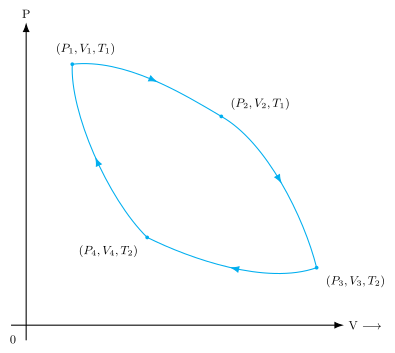
Carnot cycle heat engine ideal gas working (a) The four reversible processes of a Carnot cycle, in order, are:
- Isothermal expansion at the higher temperature T1 (heat Q1 absorbed from the source).
- Adiabatic expansion (temperature falls from T1 to T2, no heat exchange).
- Isothermal compression at the lower temperature T2 (heat Q2 rejected to the sink).
- Adiabatic compression (temperature rises from T2 back to T1, no heat exchange). …
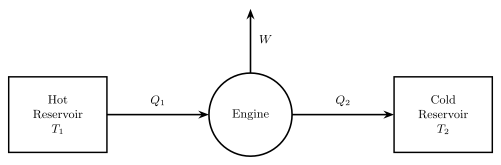
- CBSE 2020Set ANN3 marksQ.Observe the given figure.(a) Is this a heat engine or refrigerator ?(b) Write the 4 steps of operation in the Carnot cycle.
›Reveal solutionSolution
The diagram (heat Q1 in from the hot reservoir, work W out, heat Q2 out to the cold reservoir) represents a heat engine; a Carnot engine operates this cycle through four reversible steps: isothermal expansion, adiabatic expansion, isothermal compression, adiabatic compression.
- Heat engine or refrigerator? In the figure, heat Q1 flows IN from the hot reservoir (T1) into the engine, part of it is converted to useful work W (delivered out), and the remaining heat Q2 is rejected OUT to the cold reservoir (T2). This is the defining energy flow of a heat engine (Q1 = W + Q2), which absorbs heat from a hot source and converts part of it into work while rejecting the rest to a cold sink. (A refrigerator would instead have work W done ON the system to pump heat from the cold reservoir to the hot one — the opposite direction.)
- The four steps of the Carnot cycle (for a Carnot heat engine using an ideal gas as the working substance):
- Isothermal expansion at temperature T1: the gas is placed in contact with the hot reservoir and allowed to expand slowly, absorbing heat Q1 from the reservoir at constant temperature T1, doing work on the surroundings.
- Adiabatic expansion: the gas is thermally isolated and allowed to expand further with no heat exchange; it does work at the expense of its internal energy, so its temperature falls from T1 to T2. …
🎓Unlock everything free for 14 days
- ✓Full step-by-step solutions
- ✓Concept-first explanations
- ✓Methods, shortcuts & mistakes
- ✓PYQ mapping + timed mock tests
Full access for 14 days. No credit card required.