Question 61 of 64
Q.Draw the I-V characteristic curves of a light emitting diode (LED) for yellow and green light. On what factors do the wavelength and intensity of the light emitted by an LED depend?
West Bengal WbchseWest Bengal HS (WBCHSE) Board 2026Subjective· 3mImportance★★★★★
95% · 61/64 Questions
You're viewing a preview — the full solution, concept, methods & PYQ mapping are locked.
Start your 14-day free trial to unlock the full solution →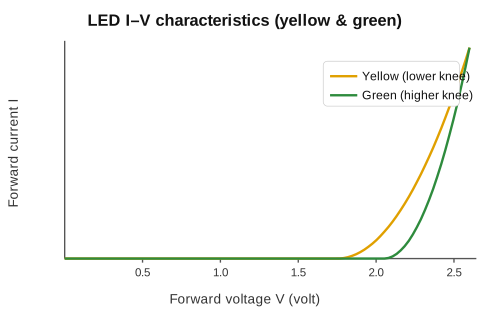
Both LED I-V characteristics stay flat until a knee voltage and then rise sharply in forward bias, with the green LED's knee at a higher voltage than the yellow LED's; the emitted wavelength is set by the band gap (lambda = hc/Eg) and the intensity by the forward current.
Description of the I-V characteristic curves (current on y-axis, forward voltage on x-axis):
- In forward bias the current is negligible until the applied voltage reaches a threshold (knee/turn-on) voltage, after which the current rises steeply and almost linearly.
- The knee voltage of an LED is roughly equal to Eg/e. Green light has a shorter wavelength (higher photon energy) than yellow, so a green LED needs a larger band gap and therefore turns on at a HIGHER forward voltage. Plotted together, the two curves have the same general shape but the green curve is shifted to the right of the yellow curve (larger knee voltage).
- (In reverse bias an LED passes only a tiny current and has a low reverse breakdown voltage, so it is normally operated in forward bias.)
Factors: …
Unlock everything free for 14 days
- Full step-by-step solutions
- Concept-first explanations
- Methods, shortcuts & mistakes
- PYQ mapping + timed mock tests
Full access for 14 days. No credit card required.