Q.(a) For an extrinsic semiconductor, indicate on the energy band diagram, the donor and acceptor levels. [1]
You're viewing a preview — the full solution, concept, methods & PYQ mapping are locked.
Start your 14-day free trial to unlock the full solution →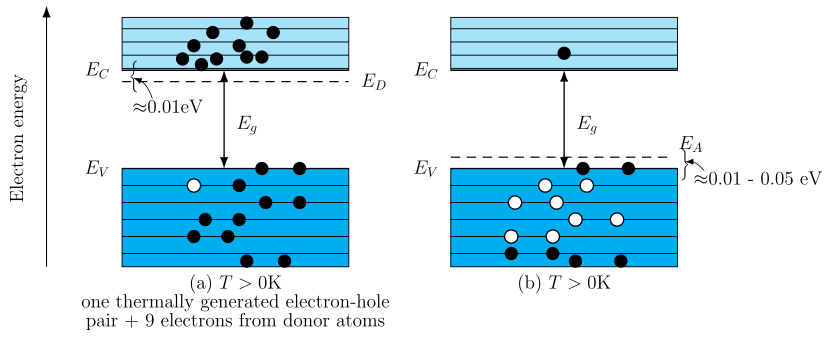
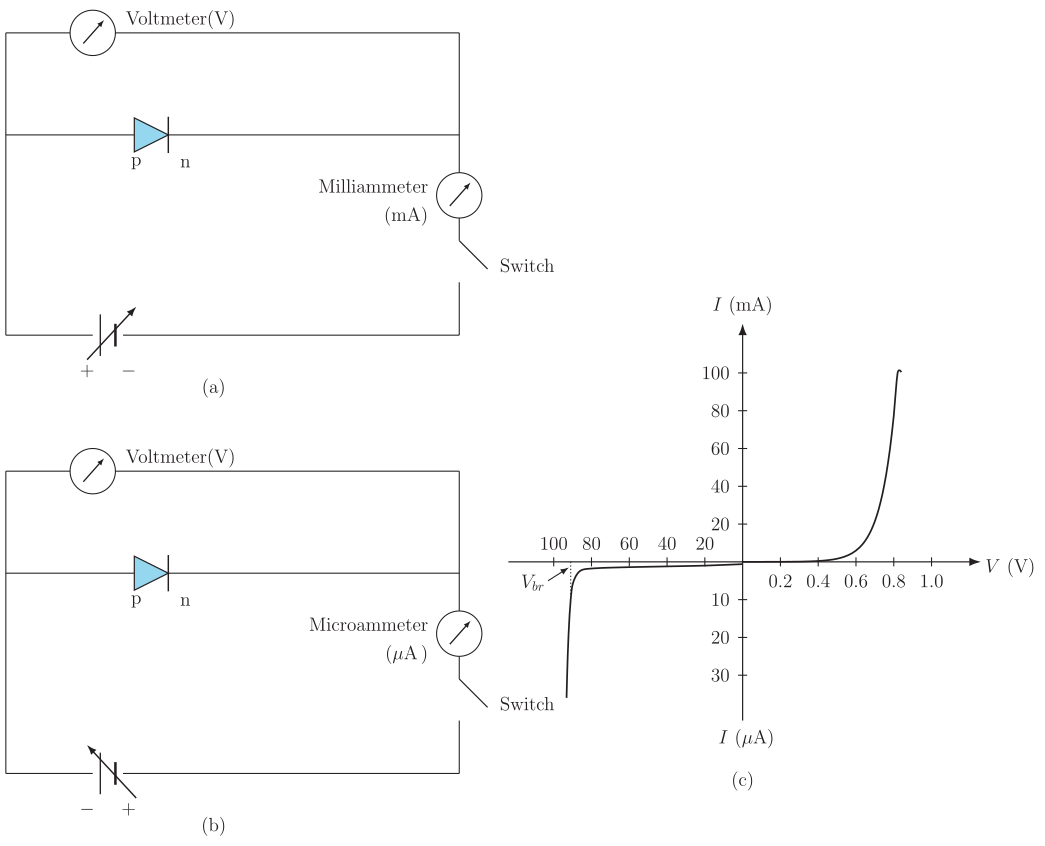
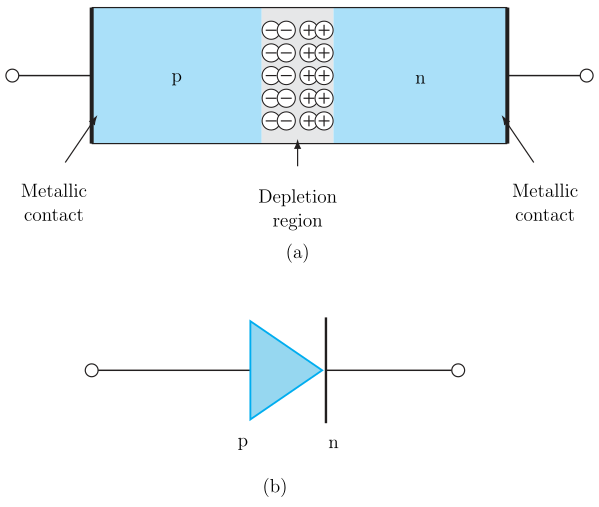
Dopant energy levels sit close to the nearest band they donate to/accept from; at a p-n junction, carriers diffusing across under their concentration gradient leave behind fixed ions that set up a field, which drives a canceling drift current — equilibrium between the two currents is the potential barrier.
(a) Energy band diagram for an extrinsic semiconductor:
Draw the conduction band (CB, top) and valence band (VB, bottom) with the forbidden energy gap between them.
-
Donor level: for an n-type semiconductor (doped with pentavalent impurity, e.g. phosphorus in silicon), the extra, loosely-bound fifth electron occupies an energy level located JUST BELOW the conduction band — a small energy gap away, so these electrons are easily excited into the conduction band even at room temperature.
-
Acceptor level: for a p-type semiconductor (doped with trivalent impurity, e.g. boron), the impurity atom creates an energy level located JUST ABOVE the valence band, ready to accept an electron from the valence band (leaving behind a hole), also with only a small energy gap to overcome.
(b) Diffusion and drift currents forming the potential barrier:
When a p-n junction is formed, there is a large concentration gradient of free carriers across the junction: electrons are abundant on the n-side and scarce on the p-side (and vice versa for holes). Due to this concentration gradient, majority carriers DIFFUSE across the junction — electrons diffuse from n to p, holes diffuse from p to n — constituting a diffusion current.
As these carriers cross and recombine near the junction, they leave behind uncompensated, FIXED ionised dopant atoms: positive ions on the n-side, negative ions on the p-side, near the junction. This creates a narrow region depleted of free carriers, called the DEPLETION REGION, with an internal electric field pointing from the n-side to the p-side (from + ions to − ions).
…
Unlock everything free for 14 days
- Full step-by-step solutions
- Concept-first explanations
- Methods, shortcuts & mistakes
- PYQ mapping + timed mock tests
Full access for 14 days. No credit card required.