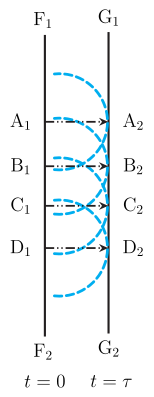
Q.(a) Define a wavefront. Using Huygens' geometrical construction, explain with the help of a diagram how the plane wavefront travels from the instant to in air.
You're viewing a preview — the full solution, concept, methods & PYQ mapping are locked.
Start your 14-day free trial to unlock the full solution →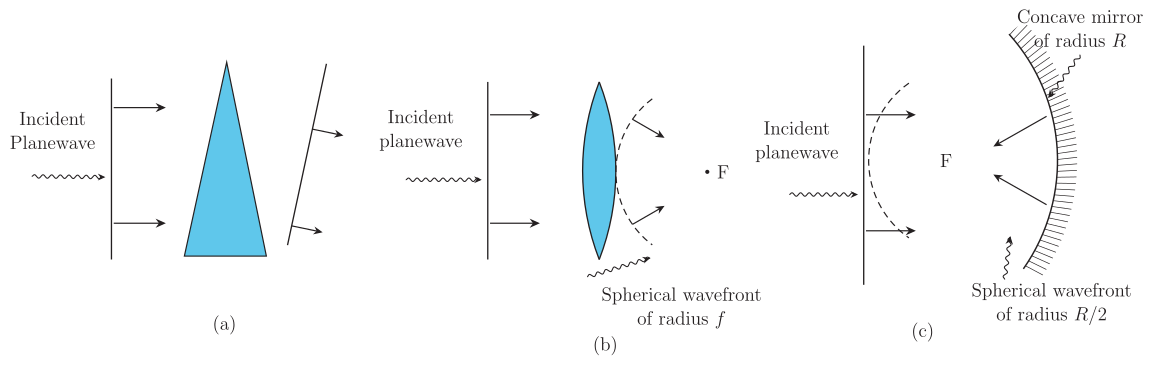
A wavefront is a surface of constant phase; Huygens' principle treats every point on it as a secondary source, and the envelope of these wavelets at a later time gives the new wavefront. For a plane wave, the envelope is another parallel plane. A convex lens delays the central part more than the edges, converting the plane wavefront into a converging spherical wavefront.
(a) Wavefront definition and Huygens' construction for a plane wave
1. What is a wavefront?
A wavefront is the continuous locus of all points in a medium that are vibrating in the same phase. In a plane wave, these points lie on parallel planes perpendicular to the direction of propagation. The distance between successive wavefronts equals the wavelength .
2. Huygens' principle — the core idea
Christiaan Huygens proposed that every point on a given wavefront acts as a source of secondary spherical wavelets (disturbances). These wavelets travel outward with the wave speed in the medium. After a time , the new wavefront is the tangent envelope (common tangent surface) to all these secondary wavelets.
Think of a row of stones dropped into a pond at the same instant — each creates an expanding circular ripple. The line that just touches all these circles at a given moment is the new wavefront.
3. Step-by-step construction for a plane wavefront
-
Initial wavefront at : Consider a plane wavefront (a straight line in 2D) moving perpendicular to its plane in air. All points on have the same phase.
-
Secondary sources: Choose several points on . Each point emits a spherical wavelet of radius .
-
Draw the wavelets: With each chosen point as centre, draw arcs of radius on the side toward which the wave is travelling.
-
Find the envelope: Draw a line that is tangent to all these arcs. Since the wavelets have equal radii and the original wavefront is straight, the tangent line is also straight and parallel to .
-
Result: The new wavefront at is the plane , shifted forward by distance .
A common mistake is to think the wavelets themselves are the new wavefront. They are not — the new wavefront is the common tangent to all wavelets, not the sum of their amplitudes.
Diagram description (for your sketch):
Draw a horizontal line (wavefront at ). Below it, mark points along . From each, draw a semicircle of equal radius downward. Draw a line that just touches all semicircles at their lowest points. Label the distance between and as . Arrows perpendicular to show the direction of propagation.
(b) Plane wavefront incident on a convex lens
1. What happens at the lens?
A convex lens is thicker at the centre than at the edges. Light travels slower in glass than in air (refractive index ). The central part of the wavefront passes through more glass, so it is delayed more than the edges. This differential delay bends the wavefront.
2. Applying Huygens' principle through the lens …
Unlock everything free for 14 days
- Full step-by-step solutions
- Concept-first explanations
- Methods, shortcuts & mistakes
- PYQ mapping + timed mock tests
Full access for 14 days. No credit card required.