Q.The shape of the wavefront originating from a line source is __________ .
You're viewing a preview — the full solution, concept, methods & PYQ mapping are locked.
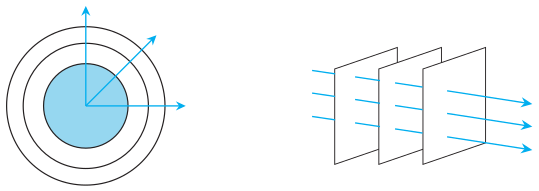
Start your 14-day free trial to unlock the full solution →A line source emits waves that spread out cylindrically, so the wavefront is a cylinder — specifically, a cylindrical surface coaxial with the source.
The key idea here is the shape of a wavefront — the surface over which the wave’s phase is constant. For a point source, the wavefront is a sphere (spherical wave). For a line source, think of it as an infinite row of point sources along a straight line. Each point emits spherical waves, and their superposition creates a wave that propagates outward perpendicular to the line. The resulting surface of constant phase is a cylinder whose axis is the line source itself.
Why a cylinder? Because the disturbance is the same at all points at a given perpendicular distance from the line — the wavefront is symmetric about the line. If you slice perpendicular to the line, you see concentric circles; in 3D, those circles extend into cylindrical surfaces.
A common mistake is to say “circular” wavefront. That’s correct only in a 2D cross-section. In 3D, the wavefront is a cylinder, not a circle.
Let’s walk through it step by step.
-
Define the source. A line source is an infinitely long, straight source of waves — for example, a long fluorescent tube emitting light, or a long vibrating string in a ripple tank.
-
Recall the definition of a wavefront. A wavefront is the locus of all points that are in the same phase (e.g., all crests at the same instant). For a wave spreading from a source, the wavefront is perpendicular to the direction of propagation.
-
Consider a point on the line source. Each infinitesimal segment of the line acts like a point source, emitting spherical waves. But because the source is continuous and infinite, the waves from all these points interfere constructively only in directions perpendicular to the line. …
Unlock everything free for 14 days
- Full step-by-step solutions
- Concept-first explanations
- Methods, shortcuts & mistakes
- PYQ mapping + timed mock tests
Full access for 14 days. No credit card required.