Q.Two statements are given – one labelled Assertion (A) and the other labelled Reason (R). Select the correct answer from the codes (a), (b),
You're viewing a preview — the full solution, concept, methods & PYQ mapping are locked.
Start your 14-day free trial to unlock the full solution →A wavefront is defined as the locus of points oscillating in phase; the reason correctly explains why — all points lie at equal optical path from the source. Both statements are true, and (R) explains (A).
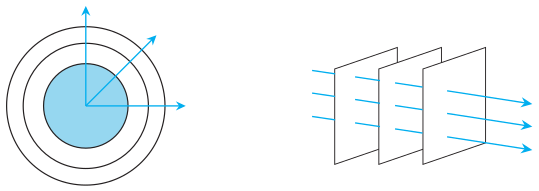
The heart of this question lies in understanding what a wavefront actually is. When a wave propagates through space, we can identify surfaces where all points share the same phase of oscillation. These surfaces are wavefronts. The definition itself guarantees that any two points on the same wavefront oscillate in phase, which means the phase difference between them is zero.
Now let's examine each statement carefully.
Evaluating the Assertion
The assertion claims that the phase difference between any two points on a wavefront is zero. This is not just true — it is the defining characteristic of a wavefront.
When we draw a wavefront (spherical for a point source, planar for a distant source, etc.), we are tracing the set of all points that the wave disturbance reaches at the same instant, having traveled the same optical path length from the source. Since phase depends on the path traveled, equal path means equal phase.
Assertion (A) is true.
Evaluating the Reason
The reason states that all points on a wavefront are at the same distance from the source and thus oscillate in the same phase. This is the physical explanation for why the assertion holds.
For a point source emitting waves isotropically, a wavefront at time is a sphere of radius , where is the wave speed. Every point on this sphere is equidistant from the source. Since the phase of a wave at distance is given by
where is the wave number, all points at the same have the same phase at any given time .
Even for more complex sources, the principle holds: a wavefront is constructed by connecting points that are reached by the wave after traveling equal optical path lengths (accounting for different media via refractive index). Equal optical path → equal phase.
Reason (R) is true. …
Unlock everything free for 14 days
- Full step-by-step solutions
- Concept-first explanations
- Methods, shortcuts & mistakes
- PYQ mapping + timed mock tests
Full access for 14 days. No credit card required.