Q.Draw a labelled diagram of cyclotron. Explain its working principle. Show that cyclotron frequency is independent of the speed and radius of the orbit.
You're viewing a preview — the full solution, concept, methods & PYQ mapping are locked.
Start your 14-day free trial to unlock the full solution →Part (a): A cyclotron accelerates ions using an AC field in the dee gap and a perpendicular magnetic field that bends them in semicircles; the cyclotron frequency is independent of speed and radius. Part (b): Ampère's law gives the solenoid field ; a toroid is an endless solenoid whose field () is confined inside the ring.
Part (a) — Cyclotron
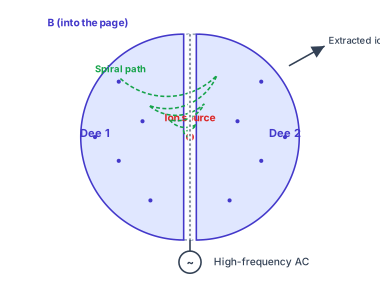
Construction: two hollow semicircular metal electrodes (dees) separated by a small gap, placed in a strong uniform magnetic field perpendicular to their plane. A high-frequency alternating voltage is applied across the gap; an ion source sits at the centre; a deflector extracts the beam at the rim.
Working:
- An ion (charge , mass ) released at the centre is accelerated across the gap by the electric field, gaining energy .
- Inside a dee there is no electric field; the magnetic force provides the centripetal force, bending the ion into a semicircle of radius .
- The AC frequency is tuned so the field reverses exactly when the ion re-enters the gap, accelerating it again.
- Each crossing raises the speed, so increases and the ion spirals outward, finally leaving at the maximum radius with high energy.
Cyclotron frequency is independent of and . The time for one semicircle,
is the same for every orbit. The full period is
depending only on the charge-to-mass ratio and — not on the ion's speed or radius. This is exactly why one fixed-frequency AC keeps the ion in step throughout. …
Unlock everything free for 14 days
- Full step-by-step solutions
- Concept-first explanations
- Methods, shortcuts & mistakes
- PYQ mapping + timed mock tests
Full access for 14 days. No credit card required.