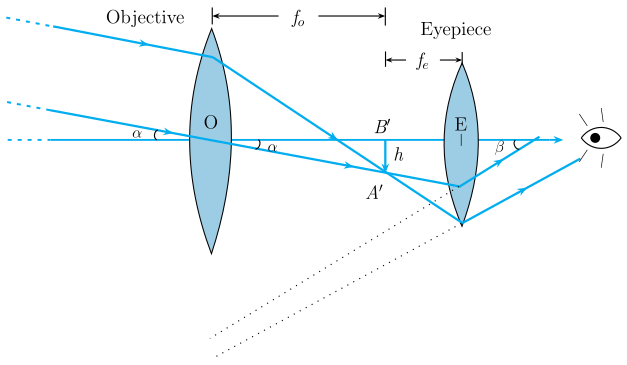
Q.Draw the ray diagram of an astronomical telescope showing image formation in the normal adjustment position. Write the expression for its magnifying power.
🔒You're viewing a preview — the full solution, concept, methods & PYQ mapping are locked.
🔒 Start your 14-day free trial to unlock the full solution →Part (a)Concept understanding — Angular Magnification
What is Angular Magnification?
When you look at a tiny object — say a grain of salt — you hold it close to your eye to see it bigger. But there is a limit: bring it too close and it blurs. The closest distance at which your eye can focus comfortably is called the near point, conventionally taken as 25 cm for a normal eye. At that distance, the object subtends a certain angle at your eye. That angle determines how large it appears — not its physical size, but the fraction of your field of view it occupies.
Now imagine using a magnifying glass. The same grain of salt now looks much larger. Why? Because the lens lets you bring the object even closer than 25 cm while still seeing a clear, magnified image. That image is formed at a comfortable viewing distance, but the angle it subtends at your eye is far bigger than the angle the object would subtend at 25 cm without the lens.
Angular magnification is simply the ratio of these two angles:
Angular magnification M=θobjectθimage
where θimage is the angle subtended by the image when viewed through the instrument, and θobject is the angle subtended by the object when viewed with the naked eye at the near point (25 cm).
Why "Angular" and Not "Linear"?
A common confusion: a microscope or telescope does not give you a physically larger object — it gives you a larger apparent size. The image on your retina is bigger because the rays entering your eye are steeper. That steepness is measured by the angle. So magnification here is about angles, not actual lengths.
Angular magnification is dimensionless. It tells you how many times wider the image appears compared to the object seen directly at the near point.
A Concrete Example
Take a simple magnifier (a convex lens) of focal length f=5 cm. You place the object just inside the focal point so that a virtual, erect image forms at infinity (or at the near point). For the "image at infinity" case, the angle subtended by the image is θimage≈h/f, where h is the object height. The angle subtended by the object at the near point (25 cm) is θobject≈h/25.
Thus:
M=h/25h/f=f25
For f=5 cm, M=5. The image appears 5 times larger than the object seen at 25 cm.
For a magnifier, the formula M=1+f25 applies when the image is formed at the near point (25 cm) — giving slightly higher magnification than the infinity-focus case.
The Big Picture
Angular magnification is the language of all optical instruments:
- Simple magnifier: M≈25/f (image at infinity) …
Part (b)Concept understanding — Resolving Power of Microscope
The Core Problem: When Two Points Become One Blur
Imagine you are looking at two tiny dots drawn very close together on a piece of paper. From far away, they look like a single dot. As you bring the paper closer, at some point your eye suddenly sees two separate dots. That moment — the threshold where your eye (or a microscope) can just barely tell that there are two objects instead of one — is the heart of resolving power.
A microscope's job is to show you fine detail. But no matter how good the lenses are, there is a fundamental limit: light itself behaves like a wave. When light passes through the circular opening of a lens, it does not travel in perfect straight lines. It spreads out and forms a pattern called an Airy disk — a bright central spot surrounded by faint rings. Every point in your specimen becomes a tiny blurry disk in the image, not a perfect point.
If two points in the specimen are very close, their Airy disks overlap. When they overlap too much, your eye cannot tell them apart — they merge into one blob. The resolving power of a microscope is its ability to show two closely spaced points as distinct.
Resolving power is not about magnification. You can magnify a blurry image as much as you like — it only becomes a bigger blur. Resolution is about separating detail, not enlarging it.
The Precise Criterion: Lord Rayleigh's Condition
Lord Rayleigh proposed a practical rule: two points are just resolved when the centre of one Airy disk falls exactly on the first dark ring of the other. At that point, the combined intensity has a small dip between the two peaks — your eye can just detect that there are two sources.
For a microscope, the smallest distance d between two points that can just be resolved is given by:
d=2nsinβ1.22λ
where:
- λ is the wavelength of light used
- n is the refractive index of the medium between the specimen and the objective lens
- β is the half-angle of the cone of light entering the objective
The quantity nsinβ is called the numerical aperture (NA) of the objective lens. So the formula is often written as:
d=2⋅NA1.22λ
Resolving power=d1=1.22λ2⋅NA
A larger resolving power means you can see finer detail (smaller d).
What This Tells Us: Two Levers for Better Resolution
1. Shorter wavelength λ — Blue light resolves better than red light. Ultraviolet light resolves even better, which is why electron microscopes (using much shorter "wavelengths" of electrons) can see atoms.
2. Larger numerical aperture nsinβ — You can increase n by using oil between the slide and the objective (oil immersion). Air has n≈1, but special oils have n≈1.5. You can increase sinβ by using a lens that collects light from a wider cone — a lens with a shorter focal length and larger diameter. …
Part (a)
Astronomical telescope (normal adjustment). Ray diagram: parallel rays from a distant object enter the objective (focal length fo) at a small angle α and form a real, inverted, diminished image A′B′ at its focus. This image sits at the focus of the eyepiece (focal length fe), so the eyepiece sends out parallel rays and the final image is at infinity (relaxed eye). Tube length L=fo+fe.
Magnifying power (small angles, α=A′B′/fo, β=A′B′/fe): …
Part (a): In normal adjustment the objective forms a real image at the common focus of objective and eyepiece; the final image is at infinity and M=fo/fe. Part (b): A compound microscope's objective forms a real magnified image which the eyepiece magnifies further; its resolving power is 2μsinβ/λ.
Part (a) — Astronomical telescope
Ray diagram (normal adjustment). A distant object subtends a small angle α at the objective. Parallel rays converge to a real, inverted, diminished image A′B′ in the objective's focal plane (distance fo). The eyepiece is positioned so that A′B′ lies at its focus, hence rays leave the eyepiece parallel and the final image is at infinity — the eye is fully relaxed. The distance between the lenses is L=fo+fe.
Magnifying power is the ratio of the angle β subtended by the final image at the eye to the angle α subtended by the object at the unaided eye:
M=αβ.
Using small-angle approximations with the common image height A′B′,
α≈foA′B′,β≈feA′B′,
so
M=A′B′/foA′B′/fe=fefo(with a − sign for the inverted image). …
- CBSE 2026Set 55/3/11 markMCQQ.A telescope has an objective lens of focal length 144 cm and an eyepiece of focal length 6.0 cm. The magnifying power and the length of the telescope tube will be respectively : (A) 24, 150 cm (B) 42, 138 cm (C) 24, 138 cm (D) 42, 150 cm
›Reveal solutionSolution
For a telescope in normal adjustment, the magnifying power is the ratio of objective to eyepiece focal lengths (M=fo/fe), and the tube length is their sum (L=fo+fe). Here, M=144/6=24 and L=144+6=150 cm, so the correct option is (A).
The question gives you a telescope with an objective of focal length fo=144 cm and an eyepiece of focal length fe=6.0 cm. You need the magnifying power and the length of the telescope tube.
The key idea is that a telescope is used to view distant objects. Light from a faraway object arrives as nearly parallel rays. The objective lens forms a real, inverted image at its focal plane. The eyepiece then acts as a magnifier to view that image.
For relaxed viewing (normal adjustment), the eyepiece is adjusted so that the final image is at infinity. This means the image formed by the objective must lie exactly at the focal point of the eyepiece. So the distance between the two lenses — the tube length — is simply the sum of their focal lengths.
The magnifying power (or angular magnification) is defined as the ratio of the angle subtended at the eye by the final image to the angle subtended by the object when viewed directly. For a telescope in normal adjustment, this ratio simplifies beautifully to the ratio of the focal lengths.
For a telescope in normal adjustment:
M=fefoandL=fo+fe
Let's apply this directly.
- Magnifying power:
M=fefo=6.0144=24
- Tube length:
L=fo+fe=144+6.0=150 cm
So the magnifying power is 24 and the tube length is 150 cm. …
- CBSE 2025Set A1 markQ.Fill in the blank with appropriate word: Simple microscope is a converging lens of ______ focal length.
›Reveal solutionSolution
A simple microscope must have a short focal length to give useful magnification.
A simple microscope is just a single convex (converging) lens used to view a small object placed within its focal length, forming a magnified, virtual, erect image. Its angular magnification (when the image is formed at the near point D = 25 cm) is given by m = 1 + D/f. This shows that the magnification increases as the focal length f decre …
- CBSE 2025Set ANNUAL1 markMCQQ.The magnifying power of a telescope is 9. When it is adjusted for parallel rays, the distance between the objective and eyepiece is 20 cm. The focal lengths of the lenses are(i) 10 cm, 20 cm(ii) 15 cm, 5 cm(iii) 18 cm, 2 cm(iv) 11 cm, 9 cm
›Reveal solutionSolution
fo = 18 cm and fe = 2 cm.
…
- CBSE 2024Set ANNUAL1 markMCQQ.What should be increased to increase the angular magnification of a simple microscope?(a) The power of the lens(b) The focal length of the lens(c) Lens aperture(d) Object size
›Reveal solutionSolution
Angular magnification m=D/f (or 1+D/f), so increasing the power (1/f) directly increases m.
For a simple microscope (magnifying glass), the angular magnification is m=fD (normal adjustment, image at infinity) or m=1+fD (image at the near point), where D is the least distance of distinct vision and f is the focal length. Since m∝f1, and the power of a lens is P=f1, increasing the power of the lens (equivalently, decreasing f) directly increases the angular magnification. Increasing lens aperture …
- CBSE 2020Set 55/2/11 markQ.For a higher resolving power of a compound microscope, the wavelength of light used should be ___________ .
›Reveal solutionSolution
The resolving power of a microscope is inversely proportional to the wavelength of light used. To get higher resolving power, we need a shorter wavelength, so the blank should be filled with small or short.
The Concept: What Resolving Power Really Means
When you look through a microscope, you want to see fine details — two tiny dots close together should appear as two separate dots, not one blurry blob. The resolving power is the microscope's ability to distinguish between two closely spaced objects as distinct. It is not the same as magnification; you can magnify a blurry image all you want, but you won't see more detail.
The key formula that governs this is the Abbe diffraction limit for a microscope:
Resolving power∝minimum resolvable distance d1∝λ1
More precisely, the minimum distance d that can be resolved is given by:
d=nsinθ0.61λ
where λ is the wavelength of light used, n is the refractive index of the medium between the specimen and the objective lens, and θ is the half-angle of the cone of light entering the objective.
Notice that d is the smallest separation you can see. A smaller d means higher resolving power (you can see finer details). Since d is directly proportional to λ, a smaller λ gives a smaller d, and thus a higher resolving power.
Step-by-Step Reasoning
-
Identify the goal: We want higher resolving power. That means we want to see finer details, so the minimum distance d between two distinguishable points must become smaller.
-
Look at the formula: From d=nsinθ0.61λ, for a fixed microscope (where n and θ are constant), d is directly proportional to λ.
-
Apply the relationship: If λ decreases, d decreases. A smaller d means better resolution — we can distinguish objects that are closer together. …
-
- CBSE 2020Set ANNUAL1 markQ.Mention a method to increase the resolving power of a microscope.
›Reveal solutionSolution
Resolving power =λ2μsinβ; increase it by using a shorter wavelength λ or a larger numerical aperture μsinβ (e.g. oil immersion).
Concept. The resolving power of a microscope is
R.P.=λ2μsinβ,
where λ is the wavelength of light used, μ the refractive index of the medium between the object and objective, and β the half-angle of the cone of light entering the objective. (μsinβ is the numerical aperture.)
…
- CBSE 2019Set ANNUAL1 markMCQQ.The magnifying power of an astronomical telescope for normal adjustment is -(a) - f_o / f_e(b) - f_o × f_e(c) - f_e / f_o(d) - f_o + f_e
›Reveal solutionSolution
Magnifying power in normal adjustment: M = −f_o/f_e.
In normal adjustment the final image is formed at infinity, so the length of the telescope is f_o + f_e and the angular magnification is
M=−fefo,
…
- CBSE 2018Set ANNUAL1 markMCQQ.A magnifying glass is to be used at the fixed object distance of 1 inch. If it is to produce an erect image 5 items magnified, its focal length should be-(a) 0.2"(b) 0.8"(c) 1.25"(d) 5"
›Reveal solutionSolution
Use m = v/u with m = +5, u = −1" → v = −5"; then the lens equation gives f = 1.25".
A magnifying glass gives an erect, virtual, magnified image, so magnification m = +5.
With m=uv and u=−1′′: v=mu=5×(−1)=−5′′ (virtual, same side).
…
- CBSE 2018Set ANNUAL1 markQ.Fill in the blank: In a Galilean telescope the eye lens is a ______ lens.
›Reveal solutionSolution
The eyepiece of a Galilean telescope is a concave (diverging) lens.
A Galilean telescope consists of a convex (converging) objective lens and a concave (diverging) eye lens. The concave eyepiece is placed before the objective's focal point so that it intercepts the converging rays and produces a virtual, erect and magnified image.
…
🎓Unlock everything free for 14 days
- ✓Full step-by-step solutions
- ✓Concept-first explanations
- ✓Methods, shortcuts & mistakes
- ✓PYQ mapping + timed mock tests
Full access for 14 days. No credit card required.