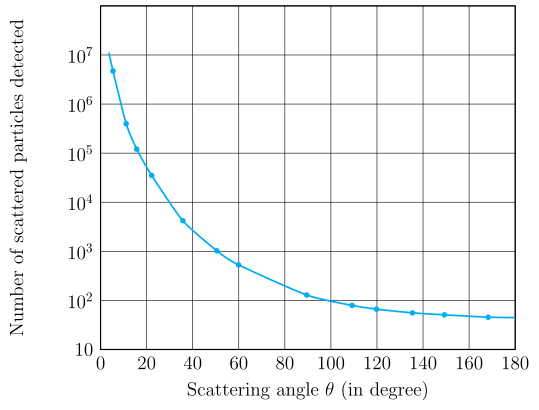
Q.Draw a plot of -particle scattering by a thin foil of gold to show the variation of the number of the scattered particles with scattering angle. Describe briefly how the large angle scattering explains the existence of the nucleus inside the atom. Explain with the help of impact parameter picture, how Rutherford scattering serves a powerful way to determine an upper limit on the size of the nucleus.
You're viewing a preview — the full solution, concept, methods & PYQ mapping are locked.
Start your 14-day free trial to unlock the full solution →Rutherford’s gold-foil experiment showed that most -particles pass through undeflected, but a tiny fraction scatter through large angles — this could only happen if the atom’s positive charge is concentrated in a tiny, massive nucleus. By relating the scattering angle to the impact parameter, the experiment sets an upper limit on nuclear size (about m).
The core idea
Before Rutherford, the atom was imagined as a “plum pudding” — positive charge spread uniformly throughout a sphere, with electrons embedded like raisins. If that were true, -particles (fast, heavy, positively charged) would barely be deflected as they passed through. But Geiger and Marsden observed that about 1 in 8000 -particles bounced back — some through angles greater than . That was impossible with a diffuse charge. The only explanation: the positive charge and most of the mass must be crammed into a region far smaller than the atom itself — the nucleus.
1. The scattering plot
The graph of number of scattered -particles versus scattering angle looks like this:
- At small (say –), is huge — most particles are barely deflected.
- As increases, drops sharply. At , is already very small.
- Beyond (backscattering), is tiny but non-zero — these are the particles that hit the nucleus nearly head-on.
Mathematically, Rutherford derived:
So the curve falls off steeply, not linearly. A log‑scale plot would show a straight line for this relation — a powerful experimental check.
A common mistake is to think the graph is symmetric about . It is not — the fall from to is far steeper than from to , because changes fastest near .
2. How large‑angle scattering proves the nucleus exists
Imagine firing a bullet at a sheet of tissue paper. If the bullet bounces straight back, there must be something hard behind the paper. Similarly:
- A small deflection ( small) means the -particle passed far from any concentrated charge — it felt only a weak Coulomb repulsion from the whole atom.
- A large deflection ( near ) means the -particle came very close to a massive, positively charged core — so close that the repulsive force was enormous, reversing its direction.
If the positive charge were spread out, the force at any point inside the atom would be too weak to reverse a fast -particle. Only a point‑like (or very tiny) nucleus can produce the huge electric field needed for backscattering.
The existence of any -particle scattered through is direct evidence that the atom contains a dense, positively charged nucleus — because a diffuse charge cannot produce such a large repulsive force.
3. The impact parameter picture and nuclear size
The impact parameter is the perpendicular distance between the initial velocity vector of the -particle and the centre of the nucleus. It determines the scattering angle:
- Large → particle passes far from nucleus → small .
- Small → particle passes close to nucleus → large .
- → head‑on collision → (direct backscatter).
Rutherford derived the exact relation:
where is the atomic number of the target, the elementary charge, and the kinetic energy of the -particle. …
Unlock everything free for 14 days
- Full step-by-step solutions
- Concept-first explanations
- Methods, shortcuts & mistakes
- PYQ mapping + timed mock tests
Full access for 14 days. No credit card required.