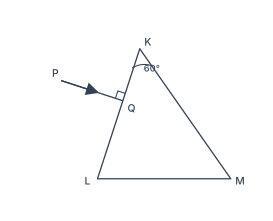
Q.A triangular prism of refracting angle is made of a transparent material of refractive index . A ray of light is incident normally on the face KL as shown in the figure. Trace the path of the ray as it passes through the prism and calculate the angle of emergence and angle of deviation.
You're viewing a preview — the full solution, concept, methods & PYQ mapping are locked.
Start your 14-day free trial to unlock the full solution →The ray enters normally, hits the second face at exactly the critical angle (), and emerges grazing along the face. The angle of emergence is and the angle of deviation is .
Why Critical Angle Comparison is the Key
When a ray enters a prism normally, it passes straight through the first face without bending. The real action happens at the second face, where the ray meets the glass-air boundary. The question becomes: does it emerge, or does it reflect internally?
The answer lies in comparing the angle of incidence at the second face with the critical angle for the material. If the incidence angle exceeds the critical angle, total internal reflection occurs. If it's less, the ray emerges with refraction. If it equals the critical angle, the emergent ray grazes along the surface — a special borderline case.
Here, the refractive index is unusual enough that the critical angle works out to a clean — exactly the prism angle. That's the entire story in a nutshell.
Step-by-Step Solution
1. The ray enters normally on face KL
Normal incidence means the ray strikes perpendicular to the surface. By Snell's law, . With , , so regardless of the refractive indices. The ray passes straight through the first face without any deviation.
Normal incidence is the simplest case — no bending at the first surface. The ray continues inside the prism along the same line as the incident ray.
2. Find the angle of incidence at the second face
Inside the prism, the ray travels toward face KM. The prism has a refracting angle at vertex K. Since the ray entered normally on face KL, it makes an angle of with the normal to KL. Inside the prism, the ray is parallel to the base LM (or nearly so, depending on geometry).
The geometry of a triangular prism tells us: when a ray enters normally on one face, the angle it makes with the normal to the second face equals the prism angle . This is because the normals to the two faces are inclined at the prism angle.
Therefore, at the second face KM, the angle of incidence is:
3. Calculate the critical angle for the material
The critical angle is given by:
Substituting :
Therefore:
4. Compare with
We have and . They are exactly equal.
This is the critical case: the ray strikes the second face at precisely the critical angle. It does not undergo total internal reflection (which requires ), nor does it emerge normally. Instead, it emerges at the maximum possible angle — grazing along the surface.
A common mistake is to think means total internal reflection. It does not — TIR requires . At equality, the ray just barely emerges, with the emergent angle being .
5. Apply Snell's law at the second face to find the angle of emergence …
Unlock everything free for 14 days
- Full step-by-step solutions
- Concept-first explanations
- Methods, shortcuts & mistakes
- PYQ mapping + timed mock tests
Full access for 14 days. No credit card required.