Q.Why is it difficult to detect the presence of an anti-neutrino during β-decay ? Define the term decay constant of a radioactive nucleus and derive the expression for its mean life in terms of the decay constant.
🔒You're viewing a preview — the full solution, concept, methods & PYQ mapping are locked.
🔒 Start your 14-day free trial to unlock the full solution →Part (a)Concept understanding — Decay Constant
Decay Constant — The First Meeting
Imagine you have a room full of 1000 identical, unstable nuclei. Each one is like a tiny time bomb, but with no clock — it could pop in the next second, or a million seconds from now. You cannot predict which one will go next, but you can measure how likely any single nucleus is to decay in a given interval of time.
That likelihood is the decay constant, denoted by the Greek letter λ (lambda).
The Intuition
If λ=0.1 s−1, it means: each nucleus has a 10% chance of decaying in the next second. Not that 10% of the nuclei will decay in exactly one second — but that the probability per unit time is 0.1.
This is a rate, not a count. It stays constant for a given isotope, no matter how many nuclei are left. Whether you have a billion nuclei or just ten, each one still "rolls the dice" with the same probability per second.
The decay constant does not depend on how many nuclei are present. It is an intrinsic property of the isotope — like its fingerprint.
The Precise Statement
For a sample containing N radioactive nuclei at time t, the rate at which they decay (the activity) is:
−dtdN=λN
The minus sign means N is decreasing. The equation says: the number of decays per second is proportional to the number of nuclei present, and λ is the constant of proportionality.
From this, we get the exponential decay law:
N(t)=N0e−λt
where N0 is the initial number of nuclei.
Connecting to Half-Life and Mean Life
The decay constant is the most fundamental of the three related quantities. The others are derived from it.
Half-life T1/2 is the time after which half the nuclei remain. Set N=N0/2:
2N0=N0e−λT1/2⇒21=e−λT1/2
Take natural logs:
ln(21)=−λT1/2⇒−ln2=−λT1/2
So:
λ=T1/2ln2=T1/20.693
Mean life τ is the average lifetime of a nucleus. It turns out to be:
τ=λ1
Three forms of the same idea:
λ=T1/20.693=τ1
If you know any one of λ, T1/2, or τ, you know all three.
A Concrete Example
Carbon-14 has a half-life of about 5730 years. Its decay constant is:
λ=5730 years0.693≈1.21×10⁻⁴ year−1
That is a very small number — each C-14 nucleus has only a 0.012% chance of decaying in a year. That is why carbon dating works: the decay is slow enough to measure over thousands of years, but fast enough to be detectable.
Common Misconception …
Part (b)Concept understanding — Nuclear Force Range
What is the Range of a Force?
Before we talk about the nuclear force, think about forces you already know. Gravity and electromagnetism have infinite range — a magnet on Earth still feels the pull of a magnet on the Moon, though it's unimaginably weak. The force just gets weaker with distance, but it never truly becomes zero.
Now imagine a force that simply does not exist beyond a certain distance. That's the nuclear force. It's like a rope that only works if you're within arm's length — step back, and the rope goes slack. This is what we mean by finite range.
The Nuclear Force: A Short-Range Glue
The strong nuclear force holds protons and neutrons together inside the nucleus. But here's the puzzle: protons are positively charged and repel each other violently. If the nuclear force had infinite range like electromagnetism, it would either pull everything together or push everything apart — but it doesn't. It only acts when particles are extremely close, about the size of a proton or neutron.
The nuclear force range is roughly 1–2 femtometers (1 fm = 10−15 m). For comparison, a hydrogen atom is about 100,000 fm across. The nuclear force is a microscopic, neighbourhood-only force.
The Precise Statement
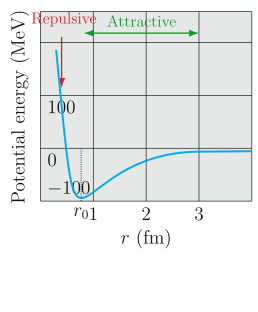
The strong nuclear force between two nucleons (protons or neutrons) is negligible when their separation exceeds about 2.5 fm. It becomes strongly attractive at distances around 1–2 fm, and then turns repulsive if they get closer than about 0.5 fm (this prevents the nucleus from collapsing).
Vnuclear(r)≈0for r>2.5 fm
This is why a nucleus is so dense — nucleons must be packed within this tiny range to feel the binding force. It's also why only certain combinations of protons and neutrons are stable: if the nucleus gets too large, protons on opposite sides are too far apart to feel the nuclear attraction, but they still feel the electric repulsion. That's why heavy elements need extra neutrons (which add attraction without repulsion) to stay stable.
Why Does It Have a Range?
The short answer: the nuclear force is mediated by particles called pions (pi mesons), which have mass. Unlike photons (massless, infinite range) or gravitons (massless, infinite range), massive exchange particles produce a force that dies out exponentially beyond a characteristic distance — the Compton wavelength of the pion. …
Part (a)
Anti-neutrino detection. The anti-neutrino emitted in β-decay is very hard to detect because it is electrically neutral (leaves no ionisation track, undeflected by fields), has negligible rest mass, and interacts only through the extremely weak weak nuclear force (tiny cross-section) — so it can traverse enormous thicknesses of matter without interacting.
Decay constant λ: the probability per unit time that a given nucleus decays; dtdN=−λN, giving N=N0e−λt.
Mean life. The number decaying between t and t+dt is λN0e−λtdt, so …
(a) Anti-neutrinos evade detection because they are neutral, almost massless and interact only via the weak force; the decay constant λ is the decay probability per unit time and the mean life is τ=1/λ.
(b) Nuclear force is short-range and charge-independent; the nucleon-pair potential has a repulsive core at small r and an attractive well around 1 fm.
Part (a)
Why the anti-neutrino is elusive
In β−-decay a neutron becomes a proton, an electron and an anti-neutrino νˉe. The anti-neutrino is nearly undetectable because:
- it is electrically neutral — it cannot ionise atoms or be bent by electric/magnetic fields, so none of the usual charged-particle tracking works;
- it has negligible rest mass and travels at nearly the speed of light, carrying away energy and momentum almost invisibly;
- it interacts only through the weak nuclear force, whose interaction cross-section is extraordinarily small, so it can pass through immense thicknesses of matter without a single interaction.
Its existence was inferred from the missing energy–momentum in β-decay long before it was directly observed.
Decay constant and mean life
The decay constant λ is the probability per unit time that any one nucleus decays. For N nuclei,
dtdN=−λN ⇒ N(t)=N0e−λt.
The number decaying in [t,t+dt] is ∣dN∣=λN0e−λtdt. Each such nucleus lived a time t, so the mean life is
τ=N01∫0∞t∣dN∣=N01∫0∞tλN0e−λtdt=λ∫0∞te−λtdt.
Using ∫0∞te−λtdt=λ21,
τ=λ⋅λ21=λ1. …
- CBSE 2025Set 55/6/11 markMCQQ.Assertion (A): The binding energy per nucleon is practically constant for mass number in the range (30<A<170). Reason (R): Nuclear forces between the nucleons for mass numbers in the range (30<A<170) are not short-range. (A) Both Assertion (A) and Reason (R) are true and Reason (R) is the correct explanation of the Assertion (A). (B) Both Assertion (A) and Reason (R) are true, but Reason (R) is not the correct explanation of the Assertion (A). (C) Assertion (A) is true, but Reason (R) is false. (D) Both Assertion (A) and Reason (R) are false.
›Reveal solutionSolution
The binding energy per nucleon is indeed nearly constant in the range 30<A<170 because nuclear forces are short-range and saturate, meaning each nucleon interacts only with its immediate neighbors. The Reason incorrectly states that nuclear forces are "not short-range," making it false. The correct option is (C).
The binding energy curve is one of the most important graphs in nuclear physics, and understanding why it has the shape it does reveals the fundamental nature of the strong nuclear force.
Why binding energy per nucleon plateaus
The binding energy per nucleon, AB, measures how tightly bound each nucleon is on average. For medium-mass nuclei (roughly A=30 to 170), this quantity hovers around 8 to 8.8 MeV per nucleon, staying remarkably constant. This plateau exists because of two competing effects:
The saturation property of nuclear forces. The strong nuclear force is extremely short-range—it acts only over distances of about 1 to 2 fm (roughly the size of a nucleon itself). Each nucleon in the interior of a nucleus interacts with only its nearest neighbors, typically 8 to 12 nucleons in a close-packed arrangement. Adding more nucleons to the nucleus doesn't increase the number of interactions per nucleon in the bulk; it just adds more nucleons experiencing the same local environment.
Think of it like a crowd of people holding hands: each person can only hold hands with their immediate neighbors. Doubling the crowd size doesn't double the number of hands each person holds—it stays constant.
Volume vs. surface effects. The total binding energy grows roughly as A (volume term in the semi-empirical mass formula), while the number of nucleons is also A, so AB remains approximately constant. Surface nucleons are slightly less bound (they have fewer neighbors), but for large A, the fraction of surface nucleons becomes negligible.
AB≈aV−aSA−1/3−aCA4/3Z2−aAA2(A−2Z)2±Aδ(A)
For medium-mass nuclei, the volume term aV dominates, and the correction terms are small, yielding a nearly flat curve.
Evaluating the Assertion and Reason
-
Assertion (A): The binding energy per nucleon is practically constant for 30<A<170.
This is true. Experimental data shows that AB varies only slightly in this range, peaking near iron-56 at about 8.8 MeV/nucleon and remaining within ±5% across the entire interval. This is the stable plateau region of the binding energy curve.
-
Reason (R): Nuclear forces are not short-range for 30<A<170.
This is false. Nuclear forces are always short-range, regardless of mass number. The range of the strong force is approximately 1–2 fm and does not change with A. In fact, it is precisely because nuclear forces are short-range that the binding energy per nucleon saturates and remains constant. …
-
- CBSE 2024Set 55/5/11 markMCQQ.The potential energy between two nucleons inside a nucleus is minimum at a distance of about ______. (A) 0.8 fm (B) 1.6 fm (C) 2.0 fm (D) 2.8 fm
›Reveal solutionSolution
The nuclear force is attractive at intermediate distances and strongly repulsive at very short distances. The potential energy minimum occurs at the equilibrium separation where the net force is zero, which is approximately 0.8 fm — option (A).
Why this distance matters
The nuclear force between two nucleons (protons or neutrons) is not like gravity or electromagnetism. It has a very short range — it only acts over distances comparable to the size of a nucleus itself. The key feature is that the force is strongly repulsive when nucleons are too close (to stop them from collapsing into each other) and attractive at slightly larger separations, binding the nucleus together.
The potential energy curve for the nucleon-nucleon interaction therefore has a deep minimum at some equilibrium separation. That minimum is the distance where the attractive and repulsive contributions balance — the "sweet spot" where a pair of nucleons would sit if undisturbed.
Step-by-step reasoning
-
Recall the shape of the nuclear potential.
The nuclear force is modelled by potentials like the Yukawa potential or the Reid soft-core potential. All such models show a repulsive core below about 0.5 fm and an attractive well that peaks (minimum potential) near 0.8 fm to 1.0 fm.
-
Eliminate the larger distances.
At 1.6 fm, the nuclear force is still attractive but much weaker — the potential is already climbing back toward zero. At 2.0 fm and 2.8 fm, the interaction is negligible (the force range is about 2 fm). The minimum cannot be there because the potential is nearly zero, not a deep well.
-
Identify the correct value. …
-
- CBSE 2024Set A1 markMCQQ.S.I. unit of decay constant is (A) metre (B) hertz (C) per metre (D) metre^2
›Reveal solutionSolution
The SI unit of the decay constant is per second (s⁻¹) = hertz → option (B).
The decay law dN/dt = −λN shows that λ has dimensions of (rate)/(number) = per unit time. Its SI unit is therefore per second (s⁻¹), which is the same as the hertz. Among the given choices, hertz is th …
- CBSE 2023Set 55/4/11 markMCQQ.Which of the following statements is not true for nuclear forces ? (A) They are stronger than Coulomb forces. (B) They have about the same magnitude for different pairs of nucleons. (C) They are always attractive. (D) They saturate as the separation between two nucleons increases.
›Reveal solutionSolution
Nuclear forces are short-range, charge-independent, and saturate — but they are not always attractive; they become repulsive at very short distances (hard-core repulsion), making statement (C) false.
The key to this question lies in understanding the range and nature of the strong nuclear force. Unlike the Coulomb force, which is long-range and can be either attractive or repulsive, the nuclear force has a very specific behaviour: it is strongly attractive at typical nucleon separations (around 1–2 fm), but becomes strongly repulsive when nucleons are pushed too close together (below about 0.5 fm). This repulsive core is what prevents nuclei from collapsing.
Let’s examine each statement carefully.
-
Statement (A): "They are stronger than Coulomb forces."
This is true. At distances of about 1 fm, the nuclear force between two protons is roughly 100 times stronger than the electrostatic repulsion. That’s why nuclei with many protons can stay bound despite the Coulomb repulsion.
-
Statement (B): "They have about the same magnitude for different pairs of nucleons."
This is also true. The strong nuclear force is charge-independent — it acts almost identically between two protons, two neutrons, or a proton and a neutron (ignoring the small electromagnetic correction). This is why the deuteron (p–n) and the diproton (p–p) would have similar binding if not for Coulomb repulsion.
-
Statement (C): "They are always attractive."
This is false. While nuclear forces are attractive at typical internucleon distances, they become repulsive at very short separations (the “hard core”). This repulsion is essential to explain nuclear stability and the fact that nucleons do not coalesce into a point. So the force is not always attractive — it has a repulsive core.
-
Statement (D): "They saturate as the separation between two nucleons increases." …
-
- CBSE 2021Set A1 markMCQQ.Which of the following is correct for radioactive element? (A) T_a = λ/0.6931 (B) T_a = 1/λ (C) T_a = (0.6931)λ (D) T_a = 1/λ²
›Reveal solutionSolution
Mean (average) life T_a = 1/λ.
Radioactive decay follows N=N0e−λt, where λ is the decay constant. The average (mean) life is the average time an atom survives before decaying, obtained by weighting each lifetime by the number of atoms decaying then:
Ta=N0∫0∞tλN0e−λtdt=λ1.
…
- CBSE 2019Set ANNUAL1 markQ.Write the relation between average life and decay constant of a radioactive atom.
›Reveal solutionSolution
Average life is the reciprocal of the decay constant: τ=1/λ.
For a sample undergoing radioactive decay, the number of undecayed nuclei falls as
N(t)=N0e−λt
where λ is the decay constant (probability of decay per unit time per nucleus).
The average (mean) life τ is the average time for which a nucleus exists before decaying, obtained by averaging t over the decay distribution:
τ=∫0∞N0λe−λtdt∫0∞tN0λe−λtdt=λ1
…
🎓Unlock everything free for 14 days
- ✓Full step-by-step solutions
- ✓Concept-first explanations
- ✓Methods, shortcuts & mistakes
- ✓PYQ mapping + timed mock tests
Full access for 14 days. No credit card required.