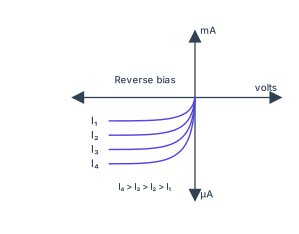
Q.Identify the semiconductor diode whose V-I characteristics are as shown.
You're viewing a preview — the full solution, concept, methods & PYQ mapping are locked.
Start your 14-day free trial to unlock the full solution →The V-I curve shows current increasing with reverse bias (third quadrant operation), characteristic of a photodiode operating in photoconductive mode where light generates carriers that flow under reverse bias.
A standard p-n junction diode conducts heavily in forward bias (first quadrant) and blocks current in reverse bias except for a tiny leakage. The curve shown behaves differently: it operates primarily in the third quadrant (negative voltage, negative current), meaning current flows and increases as reverse bias increases. This is the signature of a light-detecting diode.
When light falls on a reverse-biased p-n junction, photons with energy greater than the band gap create electron-hole pairs in the depletion region. The built-in electric field sweeps these carriers across the junction, producing a photocurrent proportional to light intensity. The more reverse bias you apply, the wider the depletion region and the more efficiently carriers are collected—hence current magnitude grows with reverse voltage.
Why this identifies a photodiode
-
Third-quadrant operation: The curve sits in the region where both voltage and current are negative (reverse bias with current flow). A normal diode would show negligible current here; a photodiode is designed to operate here.
-
Current increases with reverse bias: As increases, increases. This happens because:
- Wider depletion width → more photogenerated carriers collected
- Stronger electric field → faster carrier sweep-out
- The photocurrent (light intensity) × (collection efficiency)
-
No significant forward conduction shown: The first quadrant (forward bias) is either absent or minimal in the sketch, confirming the device is used in reverse mode—the standard operating regime for photodetection. …
Unlock everything free for 14 days
- Full step-by-step solutions
- Concept-first explanations
- Methods, shortcuts & mistakes
- PYQ mapping + timed mock tests
Full access for 14 days. No credit card required.