Q.(a)
🔒You're viewing a preview — the full solution, concept, methods & PYQ mapping are locked.
🔒 Start your 14-day free trial to unlock the full solution →Part (a)Concept understanding — Charged Particle in Magnetic Field
Charged Particle in a Magnetic Field
When a charged particle moves through a magnetic field, the field grabs it sideways. Unlike an electric field, which can speed a charge up or slow it down, a magnetic field only bends the path — it never changes the particle's speed. Understanding why leads directly to circular and helical motion, the basis of cyclotrons, mass spectrometers and the aurora.
The force: always sideways
A particle of charge q moving with velocity v in a magnetic field B feels the magnetic (Lorentz) force:
F=q(v×B)
Because of the cross product, F is perpendicular to both v and B. Its magnitude is
F=∣q∣vBsinθ
where θ is the angle between v and B.
Since F⊥v, the force does no work: F⋅v=0. Therefore the kinetic energy and the speed stay constant — the field only changes the direction of motion, never the magnitude.
Case 1: velocity perpendicular to the field → a circle
If v⊥B (θ=90∘), the force F=qvB stays constant in size and always points toward one central point. That is exactly the condition for uniform circular motion, with the magnetic force acting as the centripetal force:
qvB=rmv2
Solving for the radius:
r=qBmv
The time period of one revolution is
T=v2πr=qB2πm
The period T (and the frequency f=qB/2πm, the cyclotron frequency) does not depend on the speed or the radius. A faster particle traces a bigger circle but takes exactly the same time per loop. This speed-independence is what makes the cyclotron work.
Case 2: velocity at an angle → a helix
If v makes an angle θ with B, split it into two parts:
- Perpendicular component v⊥=vsinθ — feels the magnetic force and drives circular motion of radius r=qBmv⊥.
- Parallel component v∥=vcosθ — feels no force (since v∥×B=0) and carries the particle steadily along the field line.
Combining a circle with a steady drift gives a helix. The distance advanced along the field in one full turn is the pitch:
p=v∥T=vcosθ⋅qB2πm
A quick example
An electron (m=9.1×10⁻³¹ kg, q=1.6×10⁻¹⁹ C) enters a 0.02 T field at 106 m/s, perpendicular to B:
r=qBmv=(1.6×10⁻¹⁹)(0.02)(9.1×10⁻³¹)(106)≈2.8×10⁻⁴ m …
Why this formula?
Charged Particle in a Magnetic Field — Why the Key Formulas Hold
Let's build this from first principles. The core idea is that a magnetic field exerts a force only on a moving charge, and that force is always perpendicular to both the velocity and the field.
1. The Fundamental Force Law: Lorentz Force
The starting point is the Lorentz force for a charge q moving with velocity v in a magnetic field B:
Fm=q(v×B)
Why this form?
- Cross product v×B means the force is perpendicular to both v and B.
- Magnitude: Fm=∣q∣vBsinθ, where θ is the angle between v and B.
- Direction: given by the right-hand rule (for positive q).
Key insight: Because Fm⊥v, the magnetic force does no work — it changes only the direction of velocity, not its speed.
2. Circular Motion in a Uniform Magnetic Field
Consider a charge q moving with speed v perpendicular to a uniform B (so θ=90∘, sinθ=1).
Step 1: Force provides centripetal acceleration
The magnetic force is the only radial force:
Fm=qvB
This must equal the centripetal force required for circular motion:
Fc=rmv2
Step 2: Equate and solve for r
qvB=rmv2
Cancel one v (assuming v=0):
qB=rmv
Thus:
r=qBmv
This is the radius of the circular path (cyclotron radius).
Why this makes sense:
- Larger mass m → harder to turn → larger r
- Larger charge q or stronger B → stronger force → tighter turn → smaller r
- Faster speed v → more momentum → larger r
3. Angular Frequency (Cyclotron Frequency)
From the circular motion relation:
ω=rv
Substitute r=qBmv:
ω=qBmvv=mqB
Thus:
ωc=mqB
Why this is remarkable:
- ωc is independent of speed v — all particles with same q/m have the same angular frequency, regardless of how fast they move.
- This is the principle behind cyclotrons (particle accelerators).
4. General Motion: Helical Path …
Part (b)Concept understanding — Moving Coil Galvanometer
Moving Coil Galvanometer: From Intuition to Formula
Imagine you have a tiny, lightweight coil of wire, suspended so it can rotate freely. If you pass a current through it, that coil becomes an electromagnet. Now place it between the poles of a strong permanent magnet. The coil will try to twist — it experiences a torque. The bigger the current, the harder it twists. That is the entire physical idea behind a moving coil galvanometer: use a current to produce a rotation, and measure the rotation to know the current.
But a freely spinning coil would just keep turning. To get a useful measurement, you need something that opposes that rotation — a restoring force that grows as the coil turns further. That is the job of a spring (usually a fine phosphor-bronze strip called a torsion fibre). The spring twists as the coil rotates, producing a restoring torque that exactly balances the magnetic torque at some angle. That equilibrium angle is your reading.
The Radial Magnetic Field — The Key Trick
Here is the clever part. If the magnetic field were uniform and the coil rotated out of alignment, the torque would change with angle — making the scale non-linear. To avoid that, the poles of the magnet are shaped into concave cylindrical surfaces, and a soft iron cylinder is placed inside the coil. This creates a radial magnetic field: the field lines always point radially outward (or inward), so the plane of the coil is always parallel to the field as it rotates.
In a radial field, the magnetic torque on the coil is independent of the coil's angular position. The torque depends only on the current.
That is what makes the deflection directly proportional to current — a linear scale.
The Physics in Equations
Let the coil have N turns, each of area A. A current I flows through it. The magnetic field strength is B (radial). The torque due to the magnetic field on a single turn is:
τm=NIAB
This is because the force on each vertical side of the coil is ILB (where L is the length of the side), and the lever arm is the width of the coil, so the product gives I×(area)×B per turn.
The spring provides a restoring torque proportional to the twist angle θ:
τs=kθ
where k is the torsion constant of the spring (unit: N·m/rad).
At equilibrium, the two torques balance:
NIAB=kθ
So the deflection is:
θ=kNABI
The quantity kNAB is called the current sensitivity of the galvanometer. It tells you how many radians of deflection you get per ampere of current.
θ=(kNAB)I
What This Means for a Student
- Larger N, A, or B makes the galvanometer more sensitive — more deflection for the same current. …
Part (a)
- Helical path and frequency. Resolve v into v∥=vcosθ (along B) and v⊥=vsinθ (⊥B). The Lorentz force q(v×B) acts only on v⊥, giving uniform circular motion of radius r=qBmv⊥; v∥ is unaffected, giving uniform drift along B. Circle + drift = helix. Time period T=qB2πm (independent of v), so
f=T1=2πmqB.
- Magnetic moment of the orbiting electron. Equivalent current I=ef=(1.6×10⁻¹⁹)(8×10¹⁴)=1.28×10⁻⁴ A. Area A=πr2=π(2×10⁻¹⁰)2=1.257×10⁻¹⁹ m2. …
- A charge at angle θ to B moves in a helix; f=2πmqB; the hydrogen electron's orbital moment is ≈1.6×10⁻²³ A m2.
- SI=KNBA (raise N,B,A or lower K); SV=SI/R need not rise with N; series resistance for the voltmeter is 4985 Ω.
Part (a)
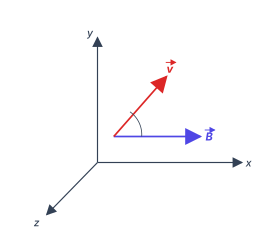
(i) Helical path. As shown in the figure, the velocity v makes an angle θ with the magnetic field B — neither parallel nor perpendicular.
The Lorentz force F=q(v×B) is always perpendicular to v, so it changes direction, not speed.
- v∥=vcosθ (along B) feels no force (v∥×B=0) ⇒ uniform straight drift.
- v⊥=vsinθ feels F=qv⊥B, a centripetal force ⇒ circular motion, qv⊥B=rmv⊥2⇒r=qBmv⊥.
The superposition of a circle (in the plane ⊥B) and a steady drift (along B) is a helix of pitch p=v∥T. The period
T=v⊥2πr=qB2πm
is independent of speed, so the frequency of revolution is
f=2πmqB.
(ii) Magnetic moment of the orbiting electron. An electron orbiting f times per second is a current loop of current I=ef:
I=(1.6×10⁻¹⁹)(8×10¹⁴)=1.28×10⁻⁴ A.
Orbit area A=πr2=π(2×10⁻¹⁰)2=1.257×10⁻¹⁹ m2. Hence …
Showing the 12 most recent of 38 on this concept.
- CBSE 2026Set 55/3/11 markMCQQ.Assertion (A) : The cylindrical soft iron core in a moving coil galvanometer only makes the magnetic field radial and does not affect the strength of the magnetic field. Reason (R) : In a moving coil galvanometer, the plane of the coil is always perpendicular to the magnetic field. (A) Both Assertion (A) and Reason (R) are true and Reason (R) is the correct explanation of the Assertion (A). (B) Both Assertion (A) and Reason (R) are true, but Reason (R) is not the correct explanation of the Assertion (A). (C) Assertion (A) is true, but Reason (R) is false. (D) Both Assertion (A) and Reason (R) are false.
›Reveal solutionSolution
The soft iron core makes the field radial AND, being ferromagnetic, concentrates the magnetic flux — it increases the field strength, so the Assertion is false. In a radial field the plane of the coil is always parallel to the field lines (the coil's normal is perpendicular to B), so the Reason is also false. The correct option is (D).
The question tests two separate facts about the moving coil galvanometer: what the cylindrical soft iron core actually does, and how the coil sits relative to the magnetic field.
1. Role of the soft iron core — is the Assertion true?
The core, together with the concave pole pieces, shapes the field in the air gap so that it is radial: at every angular position of the coil, the field lines point along the radius. This makes the deflecting torque independent of the coil's position, which is what gives the galvanometer its linear scale θ∝I.
But that is not all the core does. Soft iron is ferromagnetic, with a very high relative permeability (μr≫1). It provides a low-reluctance path for the magnetic flux, so the flux crowds through the core and the field strength B in the narrow air gap becomes much larger than it would be without the core. The claim that the core "only makes the field radial and does not affect the strength" is therefore false — the Assertion is false.
2. Orientation of the coil — is the Reason true?
In the radial field the field lines run along the radius, and the plane of the rectangular coil (tangential to the cylindrical core) always contains those field lines. So the plane of the coil is always parallel to the magnetic field — equivalently, the coil's normal is perpendicular to B in every position. That is exactly what keeps the torque at its maximum value throughout the rotation: …
- CBSE 2026Set V11 markMCQQ.The path traced by a charged particle moving perpendicular to a uniform magnetic field is :(a) circle(b) straight line(c) helix(d) ellipse
›Reveal solutionSolution
- CBSE 2026Set ANNUAL1 markMCQQ.The distance travelled by a charged particle in one rotation along the magnetic field is called(a) pitch(b) angular frequency(c) radius of helix(d) angular displacement
›Reveal solutionSolution
A charged particle entering a magnetic field with velocity components both along and perpendicular to B moves in a helix; the axial distance covered in one full turn is called the pitch.
The component of velocity perpendicular to B (v_perp) causes circular motion (radius r = m v_perp / qB), while the component along B (v_parallel) is unaffected and produces uniform linear motion along the field direction. The combination is a helix. I …
- CBSE 2026Set ANNUAL1 markMCQQ.A positively charged particle enters in a perpendicular uniform magnetic field, its path will be:(a) Elliptical(b) Parabolic(c) Linear(d) Circular
›Reveal solutionSolution
A charged particle moving perpendicular to a uniform magnetic field traces a circle because the magnetic force is always perpendicular to velocity.
When a positive charge q moves with speed v perpendicular to a uniform field B, it experiences a force F=qvB directed perpendicular to v (by F=qv×B). This force acts as a centripetal force, constantly changing the direction of veloci …
- CBSE 2026Set ANNUAL1 markMCQQ.If a charged particle enters perpendicularly into a uniform magnetic field, then which of the following statements is true?(a) Both energy and momentum remain constant.(b) Energy remains constant, but momentum changes.(c) Both energy and momentum change.(d) Energy changes but momentum remains constant.
›Reveal solutionSolution
The magnetic force is always perpendicular to the velocity, so it can never do work on the charge — kinetic energy (and hence speed) stays exactly constant. But the force continuously deflects the particle into a circular path, constantly changing the direction of its momentum vector even while its magnitude is unchanged.
The magnetic force and work done
The force on a charge q moving with velocity v in a magnetic field B is the Lorentz (magnetic) force:
F=qv×B
By the definition of the cross product, F is always perpendicular to v. The (infinitesimal) work done by this force over a displacement ds=vdt is
dW=F⋅ds=(qv×B)⋅(vdt)=0
because v×B is perpendicular to v, so its dot product with v is zero. Since dW=0 at every instant, the total work done by the magnetic force is always zero.
By the work–energy theorem, since no work is done, the kinetic energy — and hence the speed ∣v∣ and hence the magnitude of momentum ∣p∣=m∣v∣ — of the particle remains constant.
Why momentum itself still changes
…
- CBSE 2025Set D1 markMCQQ.If the number of turns is increased in any moving coil galvanometer, then its sensitivity (A) increases (B) decreases (C) remains unchanged (D) may increase or may decrease
›Reveal solutionSolution
A galvanometer's current sensitivity is (NAB/k), directly proportional to the number of turns N, so more turns → higher sensitivity.
The deflection of a moving-coil galvanometer is
θ=kNABI
so its current sensitivity is
Iθ=kNAB
…
- CBSE 2025Set ANNUAL1 markMCQQ.A charged particle enter in a magnetic field perpendicular to the magnetic lines of forces. The path of the charged particle is :(a) circular(b) ellipse(c) straight line(d) helical
›Reveal solutionSolution
A charge moving perpendicular to a uniform magnetic field traces a circle, because the magnetic force always acts as a centripetal force.
The magnetic force on a moving charge is F=qv×B. When v⊥B, this force has constant magnitude qvB and is always directed perpendicular to v — i.e., it always points toward a fixed centre. A force of constant magnitude always perpendicular to velocity is exactly the condition for unifo …
- CBSE 2024Set ANNUAL1 markMCQQ.In any electric circuit, galvanometer in its original form is used to -(a) detect the current(b) measure the current(c) measure the voltage(d) measure the resistance
›Reveal solutionSolution
A galvanometer in its basic form is a sensitive current-detecting device, not a calibrated measuring instrument.
A galvanometer is a sensitive instrument used to detect the presence (and direction) of a small current in a circuit through the deflection of a coil/needle. In its original form it is not calibrated to read numerical values of current, voltage o …
- CBSE 2024Set A1 markMCQQ.The value of current obtained in a moving coil galvanometer is proportional to (A) deflection (θ) (B) resistance (R) (C) magnetic field (B) (D) none of these
›Reveal solutionSolution
A moving-coil galvanometer is linear: I ∝ θ (the deflection).
In a moving-coil galvanometer, the current-carrying coil in the radial magnetic field experiences a deflecting torque NBIA, balanced by the restoring torque kθ of the suspension:
NBIA=kθ⇒I=NBAkθ.
…
- CBSE 2024Set ANNUAL1 markMCQQ.When a charged particle moves in a uniform magnetic field in a direction perpendicular to the field, then the path of the particle will be -(a) Parabolic(b) Circular(c) Straight line(d) Helical
›Reveal solutionSolution
A uniform magnetic force acting always perpendicular to the velocity provides centripetal force, so the particle moves in a circle.
When a charged particle of charge q moves with velocity v perpendicular to a uniform magnetic field B, it experiences a magnetic force:
F=qv×B
…
- CBSE 2024Set ANNUAL1 markMCQQ.A charged particle enters at 30° to the magnetic field. Its path becomes :(a) circular(b) helical(c) elliptical(d) straight line
›Reveal solutionSolution
Entering at an oblique angle (neither 0° nor 90°) to B gives a helix — the velocity component along B is unaffected, while the perpendicular component causes circular motion.
When a charged particle enters a uniform magnetic field at an angle θ (here 30°) to B, resolve its velocity into two components:
- v∥=vcosθ, along B: experiences no magnetic force (F=qv×B=0 for this component), so the particle drifts uniformly along the field direction.
- v⊥=vsinθ, perpendicular to B: experiences a force qv⊥B that is always perpendicular to this velocity component, producing uniform circular motion in the plane perpendicular to B. …
- CBSE 2024Set ANNUAL1 markQ.Why is it necessary to introduce a cylindrical soft iron core inside the coil of a galvanometer ?
›Reveal solutionSolution
The soft-iron core makes the field radial, ensuring the deflecting torque (and hence the scale) is uniform.
In a moving-coil galvanometer, concave pole pieces together with a cylindrical soft-iron core placed inside the coil make the magnetic field radial — i.e. B is always along the plane of the coil, no matter what angle the coil has turned through. Because of this, the angle between the field and the normal to the coil stays 90° throughout the motion, so the deflecting torque τ=NBIA has no sinθ dependence and stays proportional to the current I alone. This gives a uniform torque for a given current at every deflection, so the pointer's deflection is directly proportional to the cu …
🎓Unlock everything free for 14 days
- ✓Full step-by-step solutions
- ✓Concept-first explanations
- ✓Methods, shortcuts & mistakes
- ✓PYQ mapping + timed mock tests
Full access for 14 days. No credit card required.