Q.(a) On what factors does the speed of an electromagnetic wave in a medium depend ?
You're viewing a preview — the full solution, concept, methods & PYQ mapping are locked.
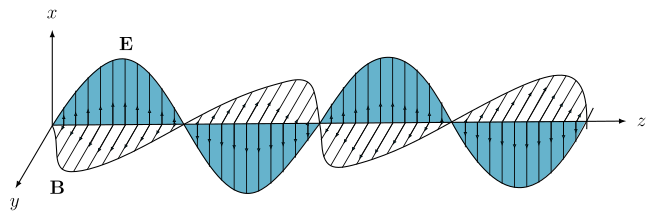
Start your 14-day free trial to unlock the full solution →The speed of an EM wave in a medium depends on the medium’s electric permittivity and magnetic permeability. An EM wave is produced by an accelerating charge. For propagation along the z-axis, the electric field oscillates along x and the magnetic field along y, both in phase.
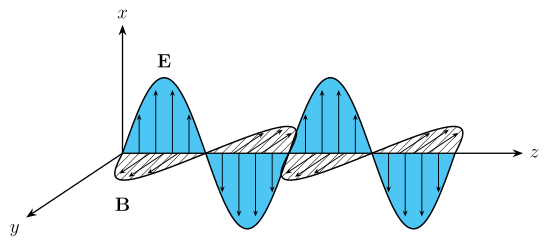
The Concept and Intuition
Electromagnetic waves are the self-sustaining dance of electric and magnetic fields. When a charged particle accelerates, it disturbs the electric field around it. This changing electric field, by Maxwell’s laws, creates a magnetic field. A changing magnetic field, in turn, creates an electric field. These two fields regenerate each other, allowing the disturbance to travel outward as a wave — even through empty space.
The speed of this wave is not arbitrary. It is determined by how easily the medium allows electric and magnetic fields to form. The electric permittivity () tells us how much the medium resists the formation of an electric field; the magnetic permeability () tells us the same for magnetic fields. The wave’s speed is the inverse square root of their product.
Step-by-Step Solution
1. Factors affecting the speed of an EM wave in a medium
The speed of an electromagnetic wave in a linear, isotropic, non-magnetic medium is given by:
where is the magnetic permeability of the medium and is its electric permittivity.
For a vacuum, these take their minimum values: and , giving the universal constant m/s.
In any material medium, both and are larger than their vacuum values. This means the wave always slows down compared to vacuum. The ratio is called the refractive index of the medium, where and are the relative permeability and permittivity.
A common mistake is to think the speed depends on frequency or amplitude. It does not — for a given medium, and are (ideally) constants. However, in dispersive media, can vary with frequency, causing different colours (frequencies) to travel at slightly different speeds — that is how a prism splits white light.
2. How an electromagnetic wave is produced
An electromagnetic wave is produced whenever an electric charge accelerates. This includes:
- A charge oscillating back and forth (like in a radio antenna)
- A charge moving in a circle (like an electron in a synchrotron)
- Any change in the velocity of a charged particle
The reason is rooted in Maxwell’s equations. A changing current (which is moving charge) produces a changing magnetic field. That changing magnetic field induces a changing electric field, and so on. The disturbance propagates outward at speed , carrying energy away from the source. …
Unlock everything free for 14 days
- Full step-by-step solutions
- Concept-first explanations
- Methods, shortcuts & mistakes
- PYQ mapping + timed mock tests
Full access for 14 days. No credit card required.