Q.(a) Write the vector form of the Biot-Savart law.
You're viewing a preview — the full solution, concept, methods & PYQ mapping are locked.
Start your 14-day free trial to unlock the full solution →The Biot-Savart law gives the magnetic field due to a current element. For two perpendicular long straight wires, the net field at a point is the vector sum of the fields from each wire, found using . At P(4,5), the fields are (out of page) and (into page), giving a resultant of into the page.
The Concept
The Biot-Savart law is the fundamental relation that tells us how a current-carrying conductor produces a magnetic field. For a long straight wire, symmetry simplifies this to a neat result: the field at a perpendicular distance from the wire has magnitude and circles the wire according to the right-hand rule.
When two wires are present, the principle of superposition applies — the net magnetic field is simply the vector sum of the individual fields. The key is to treat each wire's contribution independently, then add them as vectors.
Step-by-Step Solution
Part (a): Vector form of Biot-Savart law
The Biot-Savart law in vector form states that the magnetic field produced by a current element at a point located by the position vector (from the element to the point) is:
where is the unit vector from the current element to the point, and is the permeability of free space.
Part (b): Magnetic field at point P
1. Identify the geometry.
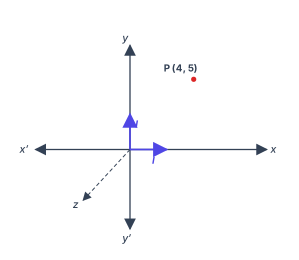
Wire 1 lies along the -axis (the x-axis). Wire 2 lies along the -axis (the y-axis). Point P has coordinates .
The perpendicular distance from P to the x-axis wire is simply the y-coordinate: .
The perpendicular distance from P to the y-axis wire is the x-coordinate: .
2. Determine the direction of each field using the right-hand rule.
For a long straight wire, point your thumb in the direction of the current, and your fingers curl in the direction of the magnetic field lines.
- Wire along x-axis: The current is along the direction. At point P (which has positive y), the field circles the wire. Using the right-hand rule, the field at P points out of the page (along ).
- Wire along y-axis: The current is along the direction. At point P (which has positive x), the field circles this wire. Using the right-hand rule, the field at P points into the page (along ).
A common mistake is to get the direction wrong for the y-axis wire. Draw it: thumb pointing up (along ), and at a point to the right (positive x), your fingers curl into the page. Always sketch the geometry. …
Unlock everything free for 14 days
- Full step-by-step solutions
- Concept-first explanations
- Methods, shortcuts & mistakes
- PYQ mapping + timed mock tests
Full access for 14 days. No credit card required.