Q.Predict the direction of the induced current in coil 1 in the following situations, justifying your answers:
You're viewing a preview — the full solution, concept, methods & PYQ mapping are locked.
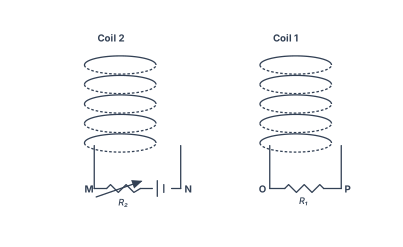
Start your 14-day free trial to unlock the full solution →The induced current in coil 1 always opposes the change in magnetic flux linking it. (a) Clockwise — coil 2's approaching face acts as a south pole.
(b) Anticlockwise — coil 2's receding face acts as a south pole.
(c) Anticlockwise (momentary) — increasing resistance in coil 2 reduces its current, decreasing flux through coil 1.
The core idea: Lenz's law and the "opposition" principle
Every induced current arises to oppose the change that produces it. You don't ask "what does the induced current do?" — you ask "what change is happening to the magnetic flux through coil 1?" The induced current then sets up its own magnetic field that tries to cancel that change. The direction of the induced current follows from the right-hand rule once you know which polarity the induced field must have.
The figure shows two coaxial coils. Coil 2 carries a current from a battery, with a variable resistance in series. The current direction in coil 2 is marked — it flows such that the face of coil 2 nearest coil 1 becomes a south pole (using the right-hand grip rule: if current is clockwise when viewed from coil 1's side, that face is a south pole). This is the given polarity; we'll use it consistently.
A common mistake is to think about the absolute polarity of coil 2's field. Lenz's law cares only about the change in flux. A south pole approaching is not the same as a south pole receding — the induced response flips.
Let's take each case.
(a) Coil 2 is moved towards coil 1
-
What changes? As coil 2 approaches, the magnetic field from coil 2 at the location of coil 1 gets stronger. The flux through coil 1 increases. The direction of this flux is from coil 2 toward coil 1 — since the near face of coil 2 is a south pole, field lines enter coil 1 from that side.
-
What must the induced field do? By Lenz's law, the induced current in coil 1 must create a magnetic field that opposes this increase in flux. That means the induced field should point away from coil 2 — i.e., the near face of coil 1 must also become a south pole, repelling the approaching south pole.
-
What current direction gives a south pole on the near face? For a coil, if the near face is a south pole, the current as seen from that side is clockwise (right-hand rule: fingers curl in the direction of current, thumb points north; so for a south pole on the near side, the current is clockwise when viewed from coil 2's side).
Think of it as magnetic repulsion: like poles repel. The approaching south pole is "met" by an induced south pole — that's the opposition.
Result for (a): Induced current in coil 1 is clockwise (as seen from coil 2's side).
(b) Coil 2 is moved away from coil 1
-
What changes? Coil 2 recedes, so the field from coil 2 at coil 1 weakens. The flux through coil 1 decreases. The direction of the existing flux is still from coil 2 toward coil 1 (south pole facing).
-
What must the induced field do? To oppose a decrease in flux, the induced current must create a field that adds to the original flux — i.e., it must try to keep the flux from dropping. So the induced field should point in the same direction as the original field: toward coil 1. That means the near face of coil 1 becomes a north pole (attracting the receding south pole of coil 2). …
Unlock everything free for 14 days
- Full step-by-step solutions
- Concept-first explanations
- Methods, shortcuts & mistakes
- PYQ mapping + timed mock tests
Full access for 14 days. No credit card required.