Q.(a)(i) Derive an expression for the resistivity of a conductor in terms of the number density of free electrons and the relaxation time.
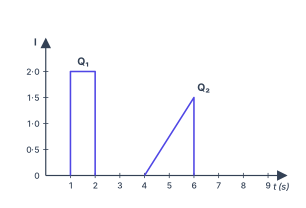
(ii) The figure shows the plot of current through a cross-section of a wire over two different time intervals. Compare the charges (Q1 and Q2) that pass through the cross-section during these time intervals.
(OR)
(b)(i) A battery of emf E and internal resistance r is connected to a variable external resistance R. (I) Obtain the expression for the current I in the circuit and the value of the maximum current the battery can supply. (II) Obtain the terminal voltage V across the battery and its maximum possible value.
(ii) The above battery sends a current I1 when R=R1 and a current I2 when R=R2. Obtain the internal resistance of the battery in terms of I1, I2, R1 and R2.
CBSECBSE Class XII Board 2025Subjective· 3mImportance★★★★★
Electrons in a metal are always moving — but randomly. At room temperature they zip around at roughly 106 m/s, colliding with the lattice ions every few trillionths of a second. Without an electric field this motion cancels out: for every electron heading left another heads right, so the net velocity is zero.
Apply a battery and the field gives every electron a tiny, steady push in one direction. Between collisions the electron accelerates only briefly before smashing into an ion and losing its directed motion. What survives is a very small average velocity along the field — the drift velocity.
Note
The random thermal speed is about 105 m/s, but the drift velocity is only about 10−4 m/s — about a billion times slower. An electron drifts slower than a snail, yet a lamp lights instantly, because the electric field (not the electrons) propagates at nearly the speed of light and starts every electron drifting almost at once.
The precise definition
Drift velocity (vd) is the average velocity acquired by the charge carriers in a conductor under an applied electric field:
vd=meEτ
where:
e = electron charge (1.6×10⁻¹⁹ C)
E = electric field inside the conductor (V/m)
τ = average relaxation time — the mean time between collisions (s)
m = electron mass (9.1×10⁻³¹ kg)
vd=meEτ
Linking to current
Drift velocity connects the microscopic motion of electrons to the current an ammeter reads:
I=neAvd
where n is the free-electron number density and A the cross-sectional area. A larger vd means more current, but vd stays tiny because τ is tiny (about 10−14 s in copper).
Tip
For a copper wire carrying 1 A with area 1 mm² and n≈8.5×1028 m−3:
Let's build this from first principles — understanding why electrons drift the way they do, not just memorizing the formula.
1. The Core Idea: What is Drift Velocity?
In a conductor, free electrons are constantly moving randomly (thermal motion, speeds ~105 m/s). Without an electric field, their net displacement is zero — they're like a swarm of bees buzzing in all directions.
When we apply an electric field E, it gently nudges each electron in the opposite direction (since electrons are negatively charged). This small, steady net velocity superimposed on the random motion is drift velocity (vd).
Key insight: Drift velocity is not the speed of individual electrons — it's the average velocity of the entire electron cloud.
2. The Derivation: Step by Step
Step 1: Force on a single electron
An electron of charge −e in an electric field E experiences:
F=−eE
The magnitude of acceleration (opposite to E) is:
a=mF=meE
where m is the electron's mass.
Step 2: What happens between collisions?
Electrons don't accelerate forever — they keep colliding with atoms/ions in the metal lattice. Let the average time between collisions be τ (relaxation time). Just after a collision an electron's velocity is essentially random (zero average in the field direction); it then accelerates for time τ before the next collision.
Step 3: Drift velocity
Averaging the field-driven velocity over the relaxation time τ gives the net drift:
vd=meEτ
Here τ is the average time since the last collision, so this expression already averages over electrons at every stage between collisions — it is the standard result used in the NCERT treatment.
3. Connecting to Current: The Big Picture
Drift velocity directly gives us current densityJ:
J=nevd
where n = number of free electrons per unit volume. …
Part (b)Concept understanding — Internal Resistance
Internal Resistance – The Battery That Fights Itself
Imagine you have a bucket of water with a tap at the bottom. When you open the tap fully, water flows out freely. But if the pipe is narrow or clogged, the flow is weaker even though the bucket is full. A battery behaves the same way: it has a "full bucket" of electrical energy (its emf, or electromotive force), but inside the battery, there is always some "clogged pipe" that resists the flow of charge. That clog is called internal resistance.
The Intuition
Every real battery is not a perfect source of voltage. If you connect a small bulb to a fresh battery, it glows brightly. But if you connect a powerful motor that draws a large current, the same battery might struggle — the voltage at its terminals drops, and the motor runs slower. Why? Because inside the battery, the chemical reactions and the materials themselves have a natural opposition to the flow of charge. This opposition is internal resistance, denoted by r (or sometimes Rint).
Think of it this way: the battery has two "battles" to fight. First, it must push charge through the external circuit (the bulb, the motor, the wires). Second, it must push charge through its own internal structure. The harder it has to push (i.e., the larger the current), the more voltage it "loses" inside itself.
The Precise Statement
Internal resistance is the opposition to the flow of electric current offered by the materials and chemical processes inside a source of emf (like a battery, cell, or generator). It is measured in ohms (Ω).
For a cell or battery, the relationship between the emf (E), the terminal voltage (V), the current (I), and the internal resistance (r) is given by:
V=E−Ir
This is the single most important equation to remember.
V=E−Ir
Here:
E is the electromotive force — the maximum voltage the battery can provide when no current flows (open circuit). Think of it as the "ideal" voltage.
V is the terminal voltage — the actual voltage you measure across the battery's terminals when it is delivering current.
I is the current flowing through the circuit (and therefore through the battery itself).
r is the internal resistance.
The term Ir is the voltage drop inside the battery. It is the "price" the battery pays for delivering current.
What Happens in Different Situations?
Condition
Current I
Terminal Voltage V
Why?
Open circuit (no load)
I=0
V=E
No current means no internal drop.
Small load (e.g., a dim bulb)
Small I
V≈E
The Ir term is tiny.
Large load (e.g., a powerful motor)
Large I
V<E significantly
The Ir drop becomes noticeable.
Short circuit (wires directly across terminals)
Very large I
V≈0
Almost all voltage is lost inside the battery; the battery heats up and may be damaged.
Watch out
A common mistake is to think that internal resistance is a "bad" thing that can be eliminated. It cannot — every real source has some internal resistance. Even a brand new AA battery has a small r (typically 0.1 to 0.5Ω). Old or weak batteries have much larger r, which is why they fail to power high-current devices.
Why Does Internal Resistance Matter?
Power loss inside the battery: The power dissipated as heat inside the battery is Ploss=I2r. This is why batteries get warm when delivering large currents.
Maximum power transfer: There is a famous theorem (Maximum Power Transfer Theorem) that says a source delivers maximum power to an external load when the load resistance equals the internal resistance (Rload=r). But this is inefficient — half the power is wasted inside the source. …
Why this formula?
Internal Resistance: Why the Key Formulas Hold
Internal resistance is a fundamental concept in real-world circuits. No battery is perfect — every practical source has some internal resistance (r) that opposes the flow of current inside the source itself.
1. The Core Idea: A Real Battery = An Ideal Source + A Resistor
Think of a real battery as:
An ideal EMF source (E) — provides constant voltage with zero internal resistance.
A small resistor (r) — connected in series inside the battery.
Why series? Because the current that leaves the battery must first pass through its internal material (electrolyte, electrodes), which offers resistance.
2. The Terminal Voltage Formula
When the battery delivers current I to an external circuit:
The ideal source produces E.
The internal resistor r drops some voltage: Vdrop=Ir (Ohm's law).
The voltage available at the terminals (V) is what's left:
V=E−Ir
Why this makes sense:
If I=0 (open circuit), V=E — you measure the full EMF.
If I increases, V decreases — the internal drop grows.
If I is huge (short circuit), V→0 and all voltage is lost inside.
3. The Short-Circuit Current Formula
If you connect the terminals directly (external resistance R=0):
The only resistance in the circuit is r.
By Ohm's law: Ishort=rE
Why this holds:
The entire EMF is now dropped across r alone.
This is the maximum current the battery can deliver — limited by its internal resistance.
In practice, this can damage the battery (heating, chemical damage).
4. Power Delivered to External Load
When the battery is connected to an external load R:
Total circuit resistance: R+r
Current: I=R+rE
Power delivered to the external load (Pout):
Pout=I2R=(R+rE)2R
Why this matters:
Power is not simply E2/R — because r limits current. …
(i) Resistivity from drift velocity. In field E, electrons acquire drift velocity vd=meEτ. Current density J=nevd=mne2τE. Comparing with J=σE=ρ1E:
ρ=ne2τm from the drift-velocity model; the charge in each interval is the area under the I–t graph, so Q1:Q2 is the ratio of those areas.
For a real battery I=R+rE (max E/r), V=E−Ir (max E), and r=I1−I2I2R2−I1R1.
Part (a)
Resistivity. Between collisions an electron accelerates as a=meE; over the mean free time τ (relaxation time) it gains an average drift velocity
vd=aτ=meEτ.
With n free electrons per unit volume, the current density is
J=nevd=ne⋅meEτ=mne2τE.
Microscopic Ohm's law is J=σE, so the conductivity is σ=mne2τ and the resistivity is its reciprocal:
ρ=σ1=ne2τm.
Resistivity grows with electron mass and falls with higher electron density and longer relaxation time.
Charges from the graph.Figure — 55/4/1 Q22
Since I=dtdQ, the charge passing a cross-section in any interval is
Q=∫Idt=area under the I–t curve for that interval. …
Same / Similar Concept — real previous-year questions on the same or a closely similar concept, not this exact question.
Showing the 12 most recent of 54 on this concept.
CBSE 2026Set A1 markMCQ
Q.A cell of internal resistance r is connected to an external resistance R. The current will be maximum in R, if
(A) R = r/2
(B) R = r
(C) R > r
(D) R < r
›Reveal solutionSolution
I = ε/(R+r); smaller R ⇒ larger current, so current is maximum for R < r (ideally R → 0).
The circuit current is I=R+rε.
For a fixed emf ε and fixed internal resistance r, the current increases as the external resistance R decreases. Hence the current through R is maximum when R is as small as possible. Among the given choices, this corresponds t …
Q.The electromotive force of an accumulator battery is 10 V and internal resistance 0.5Ω. The maximum electric current obtained from the battery will be
(a) 5 A
(b) 10 A
(c) 20 A
(d) 0.05 A
›Reveal solutionSolution
The maximum current a cell can deliver is its short-circuit current, I = EMF / internal resistance.
A real battery has EMF (epsilon) and internal resistance r. When connected to an external circuit of resistance R, the current is I = epsilon/(R+r), which is largest when R = 0 (sho …
Q.Drift velocity Vd varies with the intensity of electric field E as per the relation
(a) Vd is proportional to E^2
(b) Vd is proportional to 1/E
(c) Vd is proportional to sqrt(E)
(d) Vd is proportional to E
›Reveal solutionSolution
Drift velocity is the (small) average velocity electrons gain between collisions due to the electric field, and it comes out directly proportional to E.
When an electric field E is applied to a conductor, each free electron experiences a force F = eE, giving it an acceleration a = eE/m between collisions with the lattice ions. If tau is the average time between collisions (relaxation time), the average extra velocity gained (the drift velocity) is
Q.Fill in the blank: The quantity measured across a cell without drawing any current from it, is ..... .
›Reveal solutionSolution
The potential difference measured across a cell's terminals when no current is drawn from it equals the cell's EMF.
When current I flows, the terminal voltage is V=ε−Ir (less than the EMF ε due to the voltage drop across internal resistance r). When no current is drawn (I=0, open circuit, e.g. measured with a …
A cell's internal resistance behaves like the resistance of the electrolyte column between its electrodes, so it depends on every geometric and chemical factor that affects that column.
Inside a cell, current flows through the electrolyte between the two electrodes. Treating the electrolyte as a conducting medium, its resistance follows the same rule as any conductor: r=ρAl, where ρ is the electrolyte's resistivity, l the distance between the plates, and A the area of the plates. So (i) a larger plate area A gives a lower resistance (more parallel paths for current), (ii) a larger separation l between plates gives a higher resistance (lon …
Q.If the current flowing in a copper wire be allowed to flow in another copper wire of same length but of doubled the radius then what will be the effect on the drift velocity of the electron?
›Reveal solutionSolution
For the same current, vd∝1/A, and doubling the radius quadruples the cross-sectional area.
Current is related to drift velocity by I=nAevd, so for the same current I (and the same material, hence the same n), vd=nAeI∝A1. If the radius is doubled, the cross-sectional area A=πr2 becomes 4 times larger. So the drift velocity becomes
Q.State Ohm's law in terms of current density, specific conductance and electric field intensity.
›Reveal solutionSolution
Microscopic Ohm's law: current density J = σE (σ = conductivity, E = field).
The usual Ohm's law is V = IR. In microscopic (vector) form, it relates the current density J (current per unit cross-sectional area) to the electric field E inside the conductor through the material's specific conductance (conductivity) σ:
Q.Which of the following statement(s) is/are true ? A potential difference of V is applied at the two ends of a conductor of length l and area of cross-section A. Statement I : When potential difference is doubled, current density also gets doubled. Statement II : When potential difference is doubled, drift velocity gets halved. Statement III : When area of cross-section is doubled, current density decreases.
(a) I and II are true
(b) Only I is true
(c) Only III is true
(d) II and III are true
›Reveal solutionSolution
Doubling V doubles E, so J = σE and v_d = μE both double — Statement I true, Statement II (drift velocity halved) false. J = V/(ρl) is independent of area, so Statement III (J decreases when A doubles) is also false. Only I is true → option (b).
Statement I: J = σE and E = V/l, so doubling V doubles E and hence doubles the current density J. TRUE.
Statement II: drift velocity v_d = (eE/m)τ ∝ E ∝ V. Doubling V doubles v_d, it does not halve it. FALSE.
Q.The relation between drift velocity v of free electrons in conductor in electric conduction and potential difference V between ends of conductor is
(A) proportional to V
(B) inversely proportional to V
(C) proportional to V^2
(D) inversely proportional to V^2
›Reveal solutionSolution
Drift velocity is directly proportional to the potential difference V.
In a conductor of length L across which a potential difference V is applied, the electric field is E = V/L. Free electrons acquire a drift velocity
Q.If the length of a conductor is doubled while keeping the potential difference across it constant, then the drift velocity of electron will
(A) remain the same
(B) be double
(C) be halved
(D) increase fourfold
›Reveal solutionSolution
Doubling the length at constant V halves the drift velocity.
Q.A thick wire is stretched so that its length becomes two times. What is the ratio of change in resistance of the wire to the initial resistance of the wire?
(i) 2 : 1
(ii) 4 : 1
(iii) 3 : 1
(iv) 1 : 4
›Reveal solutionSolution
New resistance is 4 times the old, so the change is 3 times the original: ratio 3 : 1.
Resistance R=ρL/A. Stretching keeps the volume AL constant, so if length doubles (L→2L) the area halves (A→A/2). Then R′=ρ(2L)/(A/2)=4ρL/A=4R. The change in …