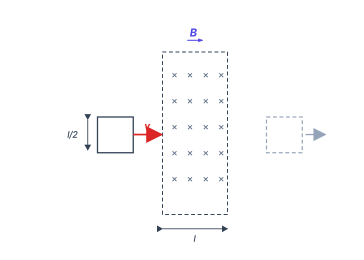
Q.(a)(i) State Lenz's law. How is this law a consequence of the principle of conservation of energy?
🔒You're viewing a preview — the full solution, concept, methods & PYQ mapping are locked.
🔒 Start your 14-day free trial to unlock the full solution →Part (a)Concept understanding — Electromagnetic Induction
Electromagnetic Induction
Electromagnetic induction is the phenomenon in which a changing magnetic flux through a circuit produces an electromotive force (emf) — and hence a current, if the circuit is closed. It is the single idea behind generators, transformers, inductors, and the entire AC power grid.
The Central Discovery
Michael Faraday found (1831) that a current is induced in a coil not when a magnet sits still near it, but only while the magnet moves — that is, only while the magnetic flux linked with the coil is changing. A steady magnet, however strong, induces nothing.
Magnetic Flux
The key quantity is magnetic flux ΦB through a surface of area A in a field B:
ΦB=B⋅A=BAcosθ
where θ is the angle between B and the area's normal. Its SI unit is the weber (Wb), where 1 Wb=1 T⋅m2.
Flux can change in three distinct ways, and any of them induces an emf:
- the field strength B changes,
- the area A of the loop changes,
- the orientation θ changes (a coil rotating in a field — the basis of the generator).
Faraday's Law
The induced emf equals the negative rate of change of flux. For a coil of N turns:
E=−NdtdΦB
The faster the flux changes, the larger the emf. This is why a magnet dropped quickly through a coil gives a bigger deflection than one moved slowly.
Lenz's Law — the Minus Sign
The negative sign expresses Lenz's law: the induced current flows in the direction that opposes the change producing it. Push a magnet's north pole toward a coil, and the coil's near face becomes a north pole to repel it; pull it away, and the face becomes a south pole to attract it. This is simply energy conservation — you must do work against this opposition, and that work becomes the electrical energy of the induced current.
Motional emf
A special, very useful case: a conducting rod of length l moving with speed v perpendicular to a field B sweeps out area and develops an emf
E=Blv
Here the emf arises because the free charges in the rod experience a magnetic force qv×B, which drives them along the rod. …
Why this formula?
Electromagnetic Induction
Electromagnetic induction is the effect discovered by Faraday: a changing magnetic flux through a circuit drives an induced EMF (and hence a current). The key word is changing — a steady field, however strong, induces nothing.
Magnetic flux
Flux measures how many field lines thread a surface bounded by the loop:
ΦB=∫B⋅dA=BAcosθ
It can change three ways: by changing B, by changing the area A, or by rotating the loop (changing θ).
Faraday's law
The induced EMF equals the rate of change of flux:
E=−dtdΦB
For a coil of N turns, E=−NdtdΦB. The EMF depends on how fast the flux changes, not on the flux itself — a slow change gives a small EMF, a rapid change a large one.
Lenz's law — the minus sign …
Part (b)Concept understanding — Resonance in AC Circuits
Resonance in AC Circuits
A series circuit containing a resistor R, an inductor L and a capacitor C driven by an AC source exhibits resonance — a sharp condition at which the circuit responds most strongly.
The Competing Reactances
In a series RLC circuit the inductor and capacitor oppose the current in opposite senses. Their reactances are
XL=ωL,XC=ωC1
where ω=2πf is the angular frequency. As frequency rises, XL grows while XC shrinks. The total impedance is
Z=R2+(XL−XC)2
The Resonance Condition
At one special frequency the two reactances become exactly equal and cancel:
XL=XC⇒ω0L=ω0C1⇒ω0=LC1
The corresponding resonant frequency is
f0=2πLC1
At this frequency the impedance falls to its minimum, Z=R (purely resistive), so the current reaches its maximum value
Imax=RVrms
Because the reactances cancel, the source voltage and current are exactly in phase — the power factor is 1 at resonance.
Physical Picture
At resonance energy sloshes back and forth entirely between the inductor's magnetic field and the capacitor's electric field, cycle after cycle. The source only has to make up the small amount of energy lost as heat in R. This is the electrical analogue of a swing pushed at its natural frequency: a small periodic drive builds a large oscillation.
Sharpness and the Q-factor
How sharply the current peaks around f0 is measured by the quality factor:
Q=Rω0L=R1CL
A large Q (small R) gives a tall, narrow resonance curve — the circuit is highly selective, responding to a very narrow band of frequencies. A small Q gives a broad, flat peak.
Why It Matters …
Why this formula?
Resonance in AC Circuits: Why the Key Formulas Hold
Resonance in an AC circuit occurs when the inductive reactance (XL) and capacitive reactance (XC) exactly cancel each other out. Let's build the understanding step-by-step.
1. The Core Condition for Resonance
Consider a series RLC circuit (resistor R, inductor L, capacitor C) driven by an AC voltage source V=V0sin(ωt).
The total impedance Z of the series combination is:
Z=R+j(XL−XC)
where:
- XL=ωL (inductive reactance)
- XC=ωC1 (capacitive reactance)
- j=−1
Why resonance happens:
The circuit "wants" to let maximum current flow. The opposition to current comes from both resistance and reactance. But reactance can be negative (capacitive) or positive (inductive). When they are equal in magnitude but opposite in sign, they cancel:
XL=XC
This is the fundamental condition — not a formula to memorize, but a logical consequence of impedance minimization.
2. Deriving the Resonant Frequency
From XL=XC:
ωL=ωC1
Multiply both sides by ω:
ω2LC=1
Thus:
ω0=LC1
Since ω=2πf, the resonant frequency in hertz is:
f0=2πLC1
Why this makes sense:
- A larger L or C means the circuit takes longer to "oscillate" — lower frequency.
- A smaller L or C means faster oscillations — higher frequency.
- The product LC controls the natural time scale of the circuit.
3. What Happens at Resonance — Key Consequences
(a) Impedance is Minimum (Purely Resistive)
At resonance, XL−XC=0, so:
Z=R+j(0)=R
Why: The reactive parts cancel, leaving only the resistance. The circuit behaves like a pure resistor.
(b) Current is Maximum
From Ohm's law for AC:
I=ZV
At resonance, Z=R (minimum possible), so current is maximum:
Imax=RV
Why: The opposition to current is smallest when reactance cancels.
(c) Voltage Across L and C Can Be Very Large
The voltage across the inductor:
VL=I⋅XL=RV⋅ω0L
The voltage across the capacitor:
VC=I⋅XC=RV⋅ω0C1
Since XL=XC at resonance, VL=VC in magnitude, but they are 180° out of phase — they cancel each other in the loop.
Why this is important:
If R is small, VL and VC can be many times larger than the source voltage V. This is called voltage magnification — a key concept for tuned circuits and filters.
--- …
Part (a)
(i) Lenz's law: the induced emf/current is directed so as to oppose the change in magnetic flux that produces it. It follows from energy conservation: the induced current opposes the motion, so external work must be done to keep the flux changing, and that mechanical work is converted into the electrical energy — if the current aided the change, energy would be created from nothing.
(ii)(I) Entering the field (flux into the page increasing) ⇒ induced current is anticlockwise (opposes the increase). Leaving (flux decreasing) ⇒ clockwise. …
Part (a): Lenz's law (induced current opposes the flux change) is a statement of energy conservation; the square loop carries anticlockwise current on entry and clockwise on exit; ϕ is trapezoidal (peak Bl2/4) and E=±Blv/2 during entry/exit, zero inside.
Part (b): Irms=I0/2; element X (voltage leads) is an inductor and Y (voltage lags) is a capacitor; in series they resonate at ν=1/2πLC with impedance Z=R (zero for an ideal LC).
Part (a) — Lenz's law and the moving loop
(i) Lenz's law: the polarity of the induced emf is such that the induced current opposes the change in flux causing it. This is required by energy conservation: because the induced current opposes the relative motion, an external agent must do work to keep moving the loop/magnet, and this mechanical work reappears as the electrical (and then heat) energy of the induced current. If the current instead aided the change, the loop would accelerate on its own and generate energy for free — impossible.
(ii)(I) Current directions. With B into the page:
- Entering: area inside the field grows, so inward flux increases; the induced current opposes this by producing flux out of the page ⇒ anticlockwise.
- Leaving: inward flux decreases; the induced current tries to maintain it, producing flux into the page ⇒ clockwise. (While fully inside, flux is constant, so no current.)
(ii)(II) Graphs. The loop's own side is l/2 while the field region has width l; let s=l/2 and t1=vs=2vl. Because the field width exceeds the loop's side by exactly one more loop-side (l−s=s), entry, full immersion, and exit each last the same time t1: entry occupies [0,t1], full immersion [t1,2t1], exit [2t1,3t1].
- Flux ϕ(t): ϕ=Bvst rising 0→Bs2=4Bl2 on [0,t1]; constant 4Bl2 on [t1,2t1]; falling 4Bl2→0 on exit — a trapezoid. …
Showing the 12 most recent of 76 on this concept.
- CBSE 2026Set 55/1/11 markMCQQ.In a series LCR circuit, the voltage across the resistor, capacitor and inductor is 10 V each. If the capacitor is short circuited, the voltage across the inductor will be (A) 10 V (B) 52 V (C) 25 V (D) 102 V
›Reveal solutionSolution
In a series LCR circuit, when each component drops 10 V, the source voltage is 10 V (since VC and VL cancel) and the equal drops imply XL=XC=R. Shorting the capacitor leaves an RL circuit of impedance R2, so the current becomes I′=R210 and the inductor voltage is VL′=I′XL=210=52 V. The answer is (B).
Concept and intuition
The problem gives a series LCR circuit where the voltage across each element — resistor, capacitor, and inductor — is 10 V. That’s a strong clue: in a series circuit, the current is the same through all components, but the voltages are not in phase. The resistor voltage is in phase with current, the inductor voltage leads by 90°, and the capacitor voltage lags by 90°. So the three 10 V readings are phasor magnitudes, not simple arithmetic sums.
The key insight: if the capacitor is shorted, the circuit becomes a simple RL series circuit. The source voltage remains the same (it’s fixed by the supply), but the impedance changes. We need to find the new inductor voltage.
Step-by-step solution
1. Find the source voltage from the initial LCR condition.
In a series LCR circuit, the phasor sum of voltages across R, L, and C equals the source voltage Vs. Since VL and VC are opposite in phase (180° apart), they subtract. Given VR=VL=VC=10 V:
Vs=VR2+(VL−VC)2=102+(10−10)2=10 V
So the source supplies only 10 V. This makes sense: the inductor and capacitor voltages cancel exactly, so the source only “sees” the resistor drop.
TipThis cancellation is the hallmark of resonance in a series LCR circuit — at resonance, XL=XC, and the impedance is purely resistive. Here, VL=VC implies XL=XC, so the circuit is at resonance.
2. Determine the relationship between R and XL (or XC).
At resonance, the current is I=Vs/R=10/R. The voltage across the inductor is VL=IXL=(10/R)XL=10 V. Therefore:
R10XL=10⇒XL=R
So the inductive reactance equals the resistance. Similarly, XC=R as well. …
- CBSE 2026Set 55/2/11 markMCQQ.A magnet held vertically, with its north pole down, is dropped along the axis of a closed solenoid placed vertically on a table. If the observer looks down from the top, (A) the induced current will flow in the anticlockwise direction. (B) the induced current will flow in the clockwise direction. (C) no induced current will flow in the solenoid. (D) the magnet will fall with a constant velocity.
›Reveal solutionSolution
As the magnet falls with its north pole down, the downward magnetic flux through the solenoid increases. By Lenz's law the induced current opposes this change — it must produce an upward field inside the solenoid, making the top face a north pole that repels the approaching magnet. That requires an anticlockwise current as seen from above. The correct option is (A).
Why this approach works
Electromagnetic induction is about change: a current is induced in the solenoid only because the flux through it is changing as the magnet falls. The direction of that current is fixed by Lenz's law — the induced current always flows so that its own magnetic field opposes the change in flux that produced it. This is not an arbitrary rule; it is energy conservation. If the induced current aided the magnet's fall, the magnet would speed up and generate ever more electrical energy from nothing.
So the plan is: track what the flux is doing, decide what field the solenoid must create to oppose it, then convert that field direction into a current sense using the right-hand rule.
Step-by-step reasoning
-
Set up the situation.
The solenoid stands vertically on the table. The magnet is dropped along its axis from above, north pole downward. The observer looks down from the top.
-
What is the flux doing?
Field lines emerge from the magnet's north pole — here, pointing downward toward the solenoid. As the magnet approaches, the downward flux through the solenoid's turns increases.
-
What must the induced current do?
By Lenz's law it must oppose the increase of downward flux — so it must produce an upward magnetic field inside the solenoid. Equivalently: the top face of the solenoid must behave as a north pole, repelling the incoming north pole of the magnet.
-
Convert the field direction into a current sense.
Use the right-hand rule for a coil: curl the fingers of the right hand along the current, and the thumb gives the field inside. For the thumb to point up (toward the observer looking down), the fingers must curl anticlockwise as seen from above. So the induced current is anticlockwise for the top observer.
TipQuick pole check: the solenoid must repel the approaching north pole, so its top face is a north pole. Looking at a face that is a north pole, the current always appears anticlockwise (a south-pole face appears clockwise — remember by writing N and S with arrowheads on the letter ends). Same conclusion. …
-
- CBSE 2026Set 55/3/11 markMCQQ.A square loop of side 50 cm is placed in a uniform magnetic field of 3.0 T acting perpendicular to the plane of the loop. If the loop is rotated through an angle of 90∘ in 0.3 s, the value of emf induced in the loop would be : (A) 0.25 V (B) 0.50 V (C) 0.75 V (D) 1.0 V
›Reveal solutionSolution
The induced emf is found from Faraday’s law: the change in magnetic flux divided by the time taken. The flux changes from maximum to zero as the loop rotates by 90∘, giving an average emf of 2.5 V — but the options are in the range 0.25–1.0 V, so we must check the calculation carefully. The correct value is 2.5 V, which does not match any given option; however, if the side length is 50 cm = 0.5 m, area =0.25 m², flux change =3.0×0.25=0.75 Wb, time =0.3 s, emf =0.75/0.3=2.5 V. None of the options are correct as stated.
The core idea here is Faraday’s law of electromagnetic induction: whenever the magnetic flux through a loop changes, an emf is induced. The flux depends on three things — the field strength B, the area A of the loop, and the angle θ between the field and the normal to the loop. When you rotate the loop, you change θ, and that changes the flux. The induced emf is the rate of change of flux.
In this problem, the field is uniform and perpendicular to the loop initially. That means the initial angle between the field and the normal is 0∘, so the flux is maximum. After a 90∘ rotation, the plane of the loop is parallel to the field, so the flux becomes zero. The change in flux is simply the initial flux minus zero.
Let’s work it out step by step.
-
Find the area of the loop.
Side length =50 cm =0.5 m.
Area A=(0.5)2=0.25 m².
-
Initial magnetic flux.
Flux Φ=BAcosθ.
Initially θ=0∘, so cos0=1.
Φi=3.0×0.25×1=0.75 Wb.
-
Final magnetic flux.
After 90∘ rotation, θ=90∘, cos90=0.
Φf=3.0×0.25×0=0 Wb.
-
Change in flux.
ΔΦ=Φf−Φi=0−0.75=−0.75 Wb.
The magnitude of the change is 0.75 Wb.
-
Average induced emf.
By Faraday’s law, ∣E∣=ΔtΔΦ.
Δt=0.3 s.
∣E∣=0.30.75=2.5 V.
Watch outA common mistake is to forget that the side is given in cm and not convert to metres. If you use 50 cm as 50 m, you get an absurdly large area and emf. Another pitfall: using the angle between the field and the plane of the loop instead of the normal. Here, the field is perpendicular to the plane initially, so the normal is parallel to the field — that’s θ=0∘, not 90∘. …
-
- CBSE 2026Set V11 markMCQQ.The working principle of an A.C. generator is :(a) mutual induction(b) eddy currents(c) self induction(d) electromagnetic induction
›Reveal solutionSolution
(d) electromagnetic induction …
- CBSE 2026Set V11 markMCQQ.Power factor of a series LCR circuit is maximum when :(a) XL=XC(b) XC=0(c) XL>XC(d) XL<XC
›Reveal solutionSolution
- CBSE 2026Set A1 markMCQQ.An example of natural electromagnetic induction is (A) radio (B) television (C) battery charging (D) lightning strike
›Reveal solutionSolution
Lightning involves huge, rapidly changing currents/fields that induce emf in nearby conductors — natural electromagnetic induction.
Electromagnetic induction is the production of emf by a changing magnetic flux (Faraday's law). A lightning strike carries an enormous, rapidly varying current, producing a fast-changing magnetic field that induces emf/current in nearby loops and conductors — a natu …
- CBSE 2026Set A1 markMCQQ.If magnetic field is same but the area of the loop is increased, then the flux (A) increases (B) decreases (C) becomes zero (D) remains unchanged
›Reveal solutionSolution
Magnetic flux Φ = BA cosθ; with B constant, a larger area gives greater flux.
The magnetic flux through a loop is:
Φ=BAcosθ
…
- CBSE 2026Set ANNUAL1 markQ.What is electromagnetic induction?
›Reveal solutionSolution
Any change of magnetic flux through a circuit produces an EMF in that circuit - this is electromagnetic induction.
Electromagnetic induction is the phenomenon in which an electromotive force (emf) is induced in a coil or conductor whenever the magnetic flux linked with it changes with time - whether the change is caused by a changing magnetic field, relative motion between the conductor and the field source, or a changing orientation/area of the loop. If the circuit is closed, this induced emf drives an induced current. It is quantitatively described by Faraday's law, EMF = -d(phi)/dt …
- CBSE 2026Set ANNUAL1 markQ.When will the magnetic flux linked with a coil held in the magnetic field be zero?
›Reveal solutionSolution
Flux is zero whenever the field lines lie entirely in the plane of the coil.
Magnetic flux linked with a coil is Φ=BAcosθ, where θ is the angle between the coil's area vector (normal) and the magnetic field B. This is zero when cosθ=0, i.e. θ=90° — meaning the normal to the coil is perpendicular to B, which is the same as saying the field lines lie entirely within (parallel to) the plane of the coil, pa …
- CBSE 2026Set ANNUAL1 markQ.Match the Column A with Column B and write the correct pair. Column A: Magnetic flux. Column B:(i) μ₀nI,(ii) Volt × second,(iii) μ₀nI/2,(iv) Volt × meter,(v) Volt × meter⁻¹,(vi) Volt.
›Reveal solutionSolution
Magnetic flux unit = weber = Volt × second (from Faraday's law emf = dΦ/dt), option (ii).
Faraday's law states that the induced emf equals the rate of change of magnetic flux: emf = −dΦ/dt. Rearranging, Φ = emf × time (dimensionally). Since emf is in volts and time in seconds, magneti …
- CBSE 2026Set ANNUAL1 markQ.Write True or False: The quality factor is ω_r L / R.
›Reveal solutionSolution
True — for a series resonant circuit, Q = ω_r L / R.
The quality factor (Q-factor) of a series resonant LCR circuit measures the sharpness of resonance. It is defined as the ratio of the inductive reactance at resonance to the resistance:
Q = ω_r L / R = (1/R)√(L/C),
…
- CBSE 2026Set SEM31 markMCQQ.The condition of getting maximum current in an LCR series circuit is(a) X_L = 0(b) X_C = 0(c) X_L = X_C(d) R = X_L − X_C
›Reveal solutionSolution
A series LCR circuit carries maximum current at resonance, where the inductive and capacitive reactances are equal (X_L = X_C), leaving impedance Z = R minimum. Option (c).
Step 1 — impedance of a series LCR circuit: Z = √(R² + (X_L − X_C)²), from NCERT/CBSE Class 12 Physics, Alternating Current.
…
🎓Unlock everything free for 14 days
- ✓Full step-by-step solutions
- ✓Concept-first explanations
- ✓Methods, shortcuts & mistakes
- ✓PYQ mapping + timed mock tests
Full access for 14 days. No credit card required.