Q.Assertion (A): In a double slit experiment, if one slit is closed, the diffraction pattern due to the other slit will appear on the screen. Reason (R): For interference, at least two waves are required. (A) Both Assertion (A) and Reason (R) are true and Reason (R) is the correct explanation of the Assertion (A). (B) Both Assertion (A) and Reason (R) are true, but Reason (R) is not the correct explanation of the Assertion (A). (C) Assertion (A) is true, but Reason (R) is false. (D) Both Assertion (A) and Reason (R) are false.
You're viewing a preview — the full solution, concept, methods & PYQ mapping are locked.
Start your 14-day free trial to unlock the full solution →The assertion is true — closing one slit leaves a single-slit diffraction pattern — and the reason is also true, because interference requires two coherent waves. But the reason does not explain the assertion; it merely states a necessary condition for interference, not why a single slit produces diffraction. So both are true, but (R) is not the correct explanation of (A). The correct option is (B).
Let’s unpack this carefully. The question tests your understanding of two distinct phenomena: diffraction and interference, and how they relate in a double-slit experiment.
1. What happens when both slits are open?
In the classic Young’s double-slit experiment, light from a single source passes through two narrow slits. Each slit acts as a coherent secondary source (Huygens’ principle). The waves from the two slits overlap on the screen and interfere — producing alternating bright and dark fringes (interference pattern). But that’s not the whole story.
Each slit individually also diffracts the light — because the slit width is comparable to the wavelength. So the actual pattern on the screen is a combination: a broad single-slit diffraction envelope modulating the sharp double-slit interference fringes.
The intensity in a double-slit experiment is:
where (diffraction factor, = slit width) and (interference factor, = slit separation).
2. Assertion (A): If one slit is closed, the diffraction pattern due to the other slit will appear.
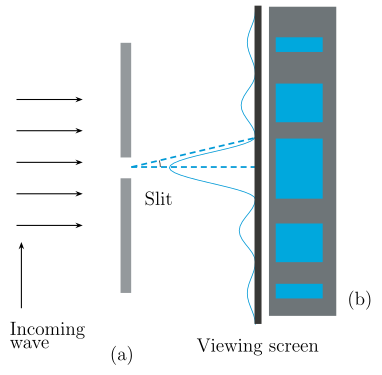
Yes — this is true. When you block one slit, you are left with a single slit of width . Light passing through that single slit spreads out due to diffraction. The pattern on the screen is a central bright maximum flanked by weaker, narrower secondary maxima — the classic single-slit diffraction pattern.
The single-slit diffraction pattern is given by , where . The first minimum occurs at .
So the assertion is correct.
3. Reason (R): For interference, at least two waves are required.
This is also true. Interference is the superposition of two or more coherent waves. With one slit, you have only one wavefront emerging — so no interference between two separate sources. You get diffraction, not interference. …
Unlock everything free for 14 days
- Full step-by-step solutions
- Concept-first explanations
- Methods, shortcuts & mistakes
- PYQ mapping + timed mock tests
Full access for 14 days. No credit card required.