Electronics · Ch 8 — Modulation and Demodulation
Antenna
Antenna
An antenna is a device that radiates electromagnetic waves into space (when transmitting) and captures them (when receiving). Antennas are essential to television, satellite broadcasting, radio broadcasting and cellular telephony, and they come in many shapes and sizes chosen to suit the job. Five common types are studied here.
Helical antenna
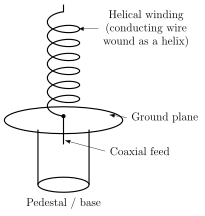
A helical antenna is a conducting wire wound in the shape of a helix (coil), usually mounted above a flat conducting ground plane. It is widely used at earth base-stations in satellite communication systems.
Yagi antenna
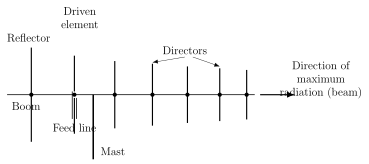
A Yagi antenna is an array of parallel, straight elements mounted along a boom: one (or more) is the driven element and the others are parasitic elements (a reflector and directors). The parasitic elements shape the antenna's directional pattern, giving it a strong beam — so it is often simply called a 'beam'. The name honours the Japanese researchers Yagi and Uda, who studied how parasitic elements affect directivity.
Loop antenna
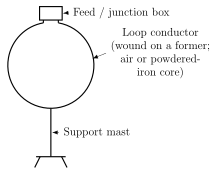
A loop antenna is a coil of wire wound on a former (a box shape or a spiral), with an air or powdered-iron core. Its gain is far lower than that of a long-wire antenna, but it also picks up far less noise, and a well-designed loop responds mainly to the magnetic component of the radio wave — which makes it useful for direction-finding and for compact receivers.
Horn antenna
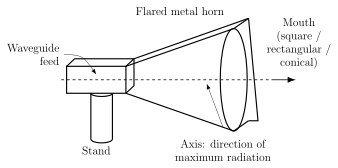
A horn antenna is a length of flaring metal waveguide shaped like a horn, used at UHF and microwave frequencies above about 300 MHz. The flare may be square, rectangular or conical, and the horn is fed by a waveguide; maximum radiation and reception occur along the axis of the horn. Horns are used as feeds for larger reflector (parabolic/dish) antennas, as standard antennas for calibrating the gain of other antennas, and as directive antennas in radar speed guns, automatic door openers and microwave instruments. …
Drawn by us to help you understand the concept clearly, and verified to make sure it's accurate. For exams, practice from your textbook's own diagram.
Textbook Figure 8.9.1 (Helical Antenna). The textbook prints a photograph; the drawn version should convey only the structural facts — a wire wound in a helix (coil) rising above a flat circular ground-plane disk on a pedestal base. Used at ear …
Drawn by us to help you understand the concept clearly, and verified to make sure it's accurate. For exams, practice from your textbook's own diagram.
Textbook Figures 8.9.2/8.9.3 (Yagi Antenna). The textbook prints photographs; the drawn version should convey only the facts — a horizontal boom carrying several parallel straight rod elements of differing lengths (one driven element, a longer reflector behind it, and …
Drawn by us to help you understand the concept clearly, and verified to make sure it's accurate. For exams, practice from your textbook's own diagram.
Textbook Figures 8.9.4/8.9.5 (Loop Antenna). The textbook prints photographs; the drawn version should convey only the facts — a closed loop (ring or rectangle) of conductor on a former with a small feed/junction point, with an air or powdered-iron core. Low gain but low noise picku …
Drawn by us to help you understand the concept clearly, and verified to make sure it's accurate. For exams, practice from your textbook's own diagram.
Textbook Figure 8.9.6 (Horn Antenna). The textbook prints a photograph; the drawn version should convey only the facts — a metal waveguide flaring out like a horn (square, rectangular or conical mouth) fed by a waveguide, radiating maximall …
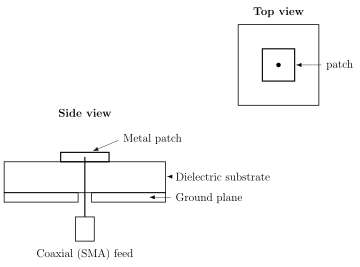
Drawn by us to help you understand the concept clearly, and verified to make sure it's accurate. For exams, practice from your textbook's own diagram.
Textbook Figures 8.9.7/8.9.8 (Microstrip Antenna). The textbook prints photographs; the drawn version should convey only the facts — a small square metal patch on a flat dielectric substrate (with a ground plane beneath) fed by an SMA-type connector. Light, cheap and printable; used …