Synapse And Synaptic Transmission
Imagine you are in a long corridor, and you need to pass a message to the person at the far end. You cannot shout across the whole hall — the sound would get garbled. Instead, you whisper to the person next to you, who whispers to the next, and so on. Each person is a neuron, and the tiny gap between them where the whisper crosses is the synapse.
A neuron carries an electrical signal along its length, but it cannot simply "touch" the next neuron and keep the electricity flowing. The gap between them — the synaptic cleft — is a physical barrier. The signal must be converted into a chemical message, cross the gap, and then be converted back into electricity. That entire process is synaptic transmission.
The Two Kinds of Synapses
There are two ways this handover happens, and they differ in speed and mechanism.
1. Electrical Synapse — This is like two people holding hands. The gap is extremely narrow (about 2–4 nm), and the neurons are connected by protein channels called gap junctions. Ions flow directly from one cell to the next, so the electrical signal passes almost instantly. This is rare in the human nervous system but common in places that need split-second coordination, like the heart muscle or the escape reflexes of some animals.
2. Chemical Synapse — This is the standard type in your brain and spinal cord. The gap is wider (about 20–40 nm), and there is no direct connection. The signal must be carried across by a chemical messenger — a neurotransmitter. This takes a tiny fraction of a second longer, but it gives the nervous system enormous flexibility: it can amplify, dampen, or even block signals at each synapse.
In the human nervous system, chemical synapses are the dominant type. Electrical synapses are the exception, not the rule.
How a Chemical Synapse Works (Step by Step)
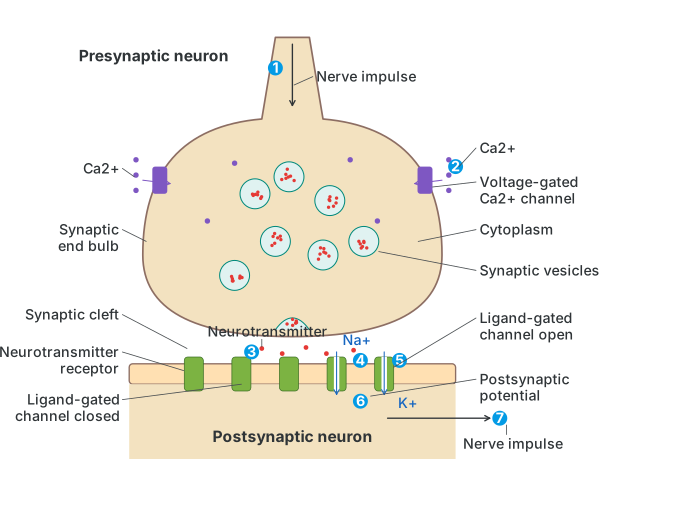
Let's trace the journey of a single impulse across a chemical synapse. The neuron that sends the signal is the presynaptic neuron; the one that receives it is the postsynaptic neuron.
Step 1: The electrical impulse arrives.
An action potential (the electrical signal) travels down the axon of the presynaptic neuron and reaches the synaptic knob — the swollen end of the axon.
Step 2: Calcium enters.
The arrival of the action potential opens voltage-gated calcium channels in the membrane of the synaptic knob. Calcium ions (Ca2+) rush into the knob from the extracellular fluid.
Step 3: Vesicles fuse and release neurotransmitter.
Inside the synaptic knob are tiny membrane sacs called synaptic vesicles, each packed with thousands of molecules of a neurotransmitter (for example, acetylcholine). The sudden rise in calcium causes these vesicles to move to the membrane, fuse with it, and release their contents into the synaptic cleft by exocytosis.
Step 4: Neurotransmitter binds to receptors.
The neurotransmitter molecules diffuse across the cleft and bind to specific receptor proteins on the membrane of the postsynaptic neuron. This is a lock-and-key fit — only the right neurotransmitter can activate a given receptor.
Step 5: Ion channels open, generating a new signal.
Binding of the neurotransmitter causes the receptor to open ion channels in the postsynaptic membrane. Depending on which ions flow in, the postsynaptic neuron may become:
- Depolarised (more likely to fire an action potential) — this is an excitatory synapse.
- Hyperpolarised (less likely to fire) — this is an inhibitory synapse.
Step 6: The neurotransmitter is removed.
If the neurotransmitter stayed in the cleft, the receptor would keep firing. So it must be cleared quickly. Acetylcholine, for example, is broken down by the enzyme acetylcholinesterase into acetate and choline, which are recycled back into the presynaptic knob.
The entire process — from arrival of the action potential to removal of the neurotransmitter — takes about 1–2 milliseconds. That is fast, but it is the main reason chemical synapses are slower than electrical ones.
Acetylcholine: The Classic Example
Acetylcholine (ACh) is the neurotransmitter used at the neuromuscular junction — where a motor neuron meets a muscle fibre. It is also widespread in the brain. When ACh binds to its receptor on a muscle cell, it opens sodium channels, causing depolarisation and muscle contraction. If acetylcholinesterase is blocked (by certain nerve gases or insecticides), the muscle cannot relax, leading to paralysis.
One-Way Traffic
A key feature of chemical synapses is that they transmit signals only in one direction — from presynaptic to postsynaptic. The neurotransmitter is released only from the presynaptic side, and receptors exist only on the postsynaptic side. This ensures that nerve impulses travel along a defined path and do not bounce backward.
To remember the direction: Pre releases, Post receives. The arrow always points forward.
Why This Matters
Synaptic transmission is not just a relay. It is where the nervous system does its real work. A single postsynaptic neuron may receive input from thousands of presynaptic neurons — some excitatory, some inhibitory. The neuron sums all these signals, and only if the net effect reaches a threshold does it fire its own action potential. This integration is the basis of every thought, movement, and memory you have.
Final answer: A synapse is the junction between two neurons where information is transmitted. In chemical synaptic transmission, an electrical impulse triggers the release of a neurotransmitter (e.g., acetylcholine) from the presynaptic neuron, which diffuses across the synaptic cleft and binds to receptors on the postsynaptic neuron, generating a new electrical signal. This process is slower than electrical transmission but allows for modulation, integration, and one-way signalling.
Synapse And Synaptic Transmission is a core NCERT/CBSE Class 11 Biology topic, and chemical synapses and neurotransmitter release is exactly the kind of detail that shows up in NEET Biology and state CET question papers. This page is aligned with common searches like "Synapse And Synaptic Transmission class 11 biology notes" and "Synapse And Synaptic Transmission important questions for NEET."