Biology · Ch 7 — Plant Growth and Mineral Nutrition
Auxins
Auxins
a. Auxins (Auxien = to grow) : F. W. Went first used the term auxin in 1931; auxin was chemically isolated that same year, from the urine of a person suffering from pellagra, by Kogl and Haagen-Smit. In the plant itself, auxin is synthesised in growing tips and other meristematic regions and is then transported to other parts of the plant, typically by basipetal (tip-to-base) polar transport in the stem. The most important and common natural auxin is indole-3-acetic acid (IAA), synthesised from the amino acid tryptophan. Several synthetic auxins are also used commercially, including IBA (indole butyric acid), NAA (naphthalene acetic acid) and 2,4-D (2,4-dichlorophenoxyacetic acid).
Physiological effects and applications of auxin : Auxin's primary physiological effect is cell enlargement. In most higher plants, the growing apical bud suppresses the growth of lateral buds -- a phenomenon called apical dominance -- and auxin is central to maintaining this dominance. Auxin also stimulates growth of the stem and root, induces cell multiplication (which is why it is used in tissue-culture media to raise callus), and stimulates the formation of lateral and adventitious roots. At higher concentrations, synthetic auxins such as 2,4-D act as selective herbicides, killing dicot weeds without harming monocot crops. Auxin application can induce seedless-fruit development (parthenocarpy) in crops such as orange, lemon, grape and banana. It also promotes cell division in the cambium and hastens the early differentiation of xylem and phloem. Auxin promotes root elongation at low concentration and shooting at higher concentration, and it hastens early rooting in propagation by 'cutting'.
A foliar spray of NAA and 2,4-D induces flowering in litchi and pineapple. Auxins also prevent premature fruit drop in apples, pears and oranges by preventing the formation of the abscission layer. They play a role in cell elongation, are known to increase the rate of respiration, and break dormancy in seeds to promote quick germination.
Know the Scientist …
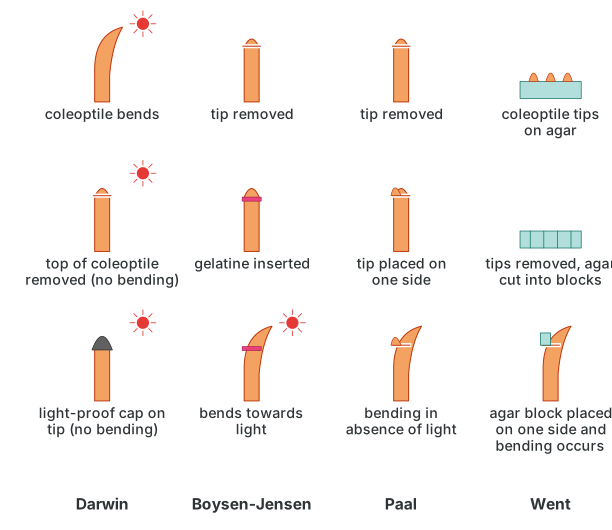
Drawn by us to help you understand the concept clearly, and verified to make sure it's accurate. For exams, practice from your textbook's own diagram.
What this figure shows. Four columns, one per scientist. Darwin: an intact coleoptile bends towards one-sided light, while one with its tip removed or covered by a light-proof cap does not bend. Boysen-Jensen: with a gelatine plate inserted between tip and stump the coleoptile still bends towards light, so the stimulus is a diffusible chemical. Paal: a tip replaced on one side of the cut stump makes the coleoptile bend away from that side even in darkness. Went: tips are placed on agar, the agar is cut into blocks, and a bl …