Photoperiodism: Why Plants Know When to Flower
Imagine a plant that flowers only in autumn, when days are short and nights are long. Another waits for the long, bright days of summer. A third simply flowers whenever it is mature enough, ignoring the season entirely. How does a plant, rooted in one spot, know what time of year it is? It cannot feel temperature the way we do — temperature is too erratic, a warm spell in February can fool no one. But day length changes with absolute, predictable regularity. That is the key.
Photoperiodism is the biological response of an organism to the relative lengths of light and dark periods in a 24-hour cycle. For plants, it is the mechanism that times flowering to the correct season.
The Intuition: A Calendar Made of Light
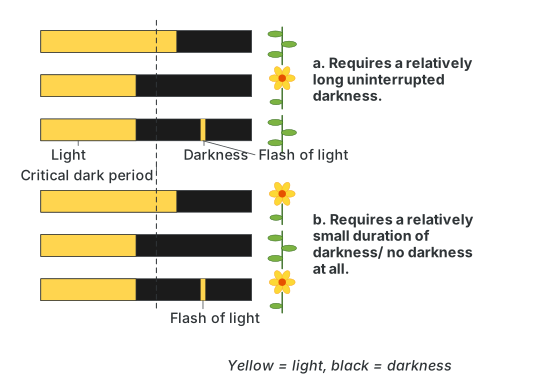
A plant does not have a clock in the usual sense, but it has an internal timer that measures the duration of uninterrupted darkness. The critical insight is this: it is the length of the night, not the length of the day, that matters most. A short-day plant does not flower because the day is short — it flowers because the night is long. A long-day plant flowers because the night is short.
Think of it as a switch. The plant needs a continuous, unbroken period of darkness that exceeds (or falls short of) a certain threshold. If you interrupt that dark period with even a brief flash of light, the plant's response changes completely. That is why a streetlamp can keep a short-day plant from flowering — it breaks the long night into two short nights, and the plant behaves as if the day is long.
The Precise Statement
Photoperiodism is the physiological reaction of organisms to the length of day or night. In plants, it is the response to the critical night length — a specific duration of uninterrupted darkness that must be exceeded (or not exceeded) for flowering to occur.
Plants are classified into three categories based on their photoperiodic response:
| Category | Flowers when | Critical condition | Example |
|---|
| Short-day plants (SDP) | Autumn / spring | Night length exceeds a critical value | Chrysanthemum, soybean, rice |
| Long-day plants (LDP) | Summer | Night length is less than a critical value (i.e., day is long) | Spinach, wheat, radish |
| Day-neutral plants (DNP) | Any season | No photoperiodic requirement | Tomato, sunflower, cucumber |
A common mistake is to think short-day plants need a short day. They need a long night. If you give a short-day plant a 16-hour day and an 8-hour night, it will not flower. But if you give it a 10-hour day and a 14-hour night, it will. The night is the signal.
The Mechanism (in brief)
The photoreceptor involved is phytochrome, a pigment that exists in two interconvertible forms: Pr (red-absorbing, inactive) and Pfr (far-red-absorbing, active). During the day, sunlight (rich in red light) converts Pr to Pfr. During the night, Pfr slowly reverts to Pr. The plant measures how much Pfr remains at a critical point in the night. If the night is long enough for Pfr to drop below a threshold, the flowering signal is triggered (in SDP) or suppressed (in LDP).
The critical night length is a fixed value for a given species, not a relative one. A short-day plant with a critical night length of 10 hours will flower only when nights are longer than 10 hours — regardless of whether the day is 13 or 14 hours long.
Why This Matters for Exams
You will be asked to classify plants, explain why a flash of light during the dark period changes the response, and distinguish between the three categories. Remember: the night is the signal, the day is just the background.
For students searching 'Photoperiodism class 11 biology notes' or 'Photoperiodism diagram and labelling', this topic falls squarely within the Plant Growth and Development unit of the NCERT/CBSE Class 11 Biology syllabus, and is a recurring theme in NEET Biology papers too. Distinguishing short-day, long-day, and day-neutral plants with real examples like chrysanthemum, wheat, and tomato is a standard exam expectation.