Biology · Ch 2 — Reproduction in Lower and Higher Animals
Spermatogenesis
Spermatogenesis
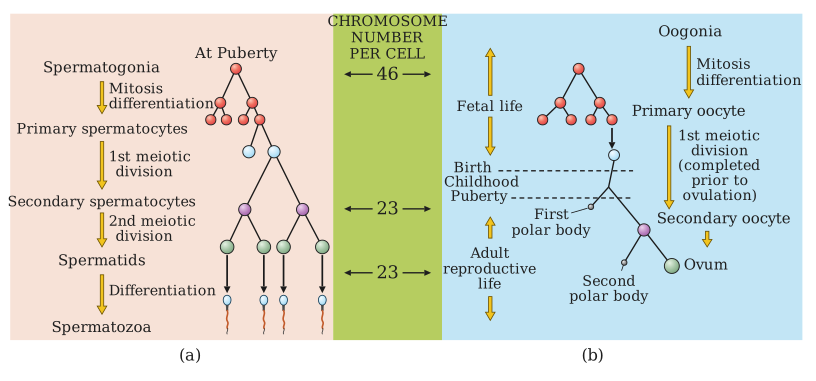
Spermatogenesis is the process by which the male gamete, the spermatozoon, is formed from the germinal epithelium of the testis; it begins at puberty, when the hypothalamus starts secreting gonadotropin-releasing hormone (GnRH), which brings about a significant rise in the secretion of follicle-stimulating hormone (FSH), which in turn induces spermatogenesis. Each seminiferous tubule is lined by a single layer of cuboidal epithelial cells, the germinal epithelium, whose cells undergo spermatogenesis to produce sperm; the process itself unfolds in three phases.
I. Multiplication phase : The diploid (2n) primordial germ cells of the seminiferous tubules divide repeatedly by mitosis to produce a large number of diploid spermatogonia, each with 46 chromosomes.
II. Growth phase : Some spermatogonia stop dividing and instead grow in size, accumulating food material, to develop into diploid (2n) primary spermatocytes.
III. Maturation phase : The primary spermatocyte undergoes meiotic (reduction) division: the first meiotic division (meiosis I) produces two haploid secondary spermatocytes (n), each with 23 chromosomes, and each secondary spermatocyte then undergoes a second meiotic division (meiosis II) to produce, in total, four haploid spermatids. …
Drawn by us to help you understand the concept clearly, and verified to make sure it's accurate. For exams, practice from your textbook's own diagram.
What this figure shows. The left half is spermatogenesis exactly as the textbook's Fig. 2.9 lays it out: the multiplication phase (mitosis of the primordial cell to spermatogonia, 2n), the growth phase (primary spermatocyte, 2n), and the maturation phase (meiosis I to two secondary spermatocytes, n; meiosis II to four spermatids, n) ending in spermiogenesis to spermatozoa; the right half shows oogene …