Biology · Ch 1 — Reproduction in Lower and Higher Plants
Development of Male Gametophyte
Development of Male Gametophyte
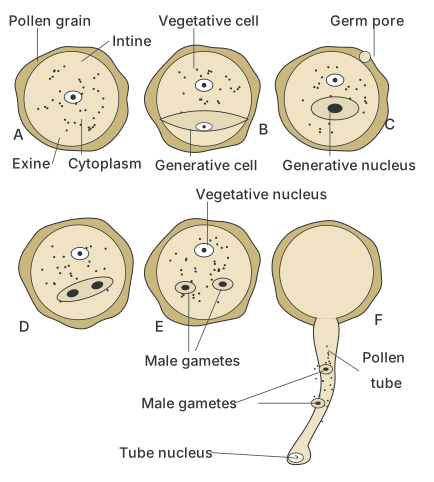
The pollen grain itself represents the very first cell of the male gametophyte generation. Immediately after (or shortly before) its release from the anther, the pollen grain undergoes its first mitotic division, producing two unequal, functionally distinct cells: a larger vegetative cell, rich in stored food reserves and possessing an irregularly shaped nucleus, and a smaller, thin-walled generative cell that comes to lie suspended within the cytoplasm of the vegetative cell.
The generative cell subsequently undergoes a second mitotic division to produce two non-motile male gametes. Depending on the species, this second division may occur either while the pollen grain is still in the anther (so that pollen is shed already at the three-celled stage) or, more commonly in most angiosperms, only after the pollen grain has germinated and the generative cell has begun travelling down the growing pollen tube. In this way the male gametophyte, though drastically reduced compared to the gametophytes of lower plants, still passes through a defined developmental sequence, vegetative cell and generative cell, then generative cell dividing into two male gametes, entirely sheltered within the wall of the pollen grain and, later, the pollen tube.
Drawn by us to help you understand the concept clearly, and verified to make sure it's accurate. For exams, practice from your textbook's own diagram.
What this figure shows. This is a sequential diagram, labelled A through F, tracing the development of the male gametophyte from a single pollen grain. It shows the pollen grain's two-layered wall (exine and intine) with a germ pore, then its cytoplasm dividing by the first mitotic division into a large vegetative cell with its vegetative nucleus and a small generative cell with its generative nucleus, and finally the generative cell's second mitotic division, shown occurring within an emerg …
Always Remember …