Chemistry · Ch 14 — Biomolecules
Denaturation of proteins
Denaturation of proteins
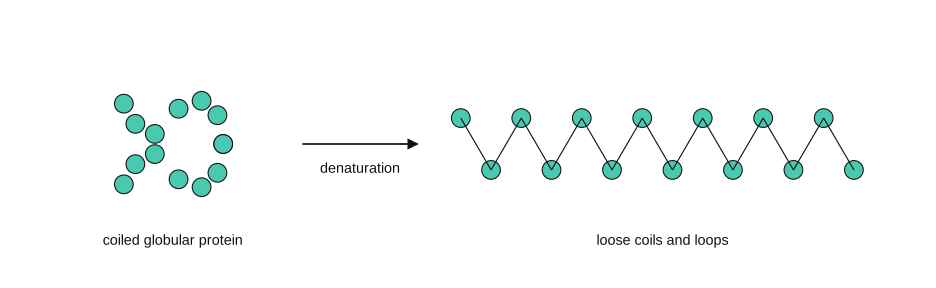
Denaturation is the process by which a protein's carefully folded, specific three-dimensional shape is disrupted and destroyed by an external physical or chemical stress -- commonly high temperature, exposure to acid or base (i.e. a significant pH change from the protein's normal physiological environment), or even mechanical agitation (vigorous shaking or whipping). What denaturation specifically disrupts are the NON-COVALENT interactions responsible for holding the protein's secondary, tertiary or quaternary structure together -- the hydrogen bonds, electrostatic attractions, dipole-dipole attractions and dispersion forces described in sections 14.3.4b-d. Denaturation does NOT break the covalent peptide (amide) bonds that hold the primary structure -- the actual sequence of amino-acid residues -- together; the amino-acid sequence itself survives denaturation completely intact, even though the protein's overall folded shape does not. Because so much of a protein's biological function depends specifically on its correctly-folded three-dimensional shape (recall, for instance, how an enzyme's active site or haemoglobin's four-subunit assembly must have exactly the right geometry to work), disrupting the secondary/tertiary/quaternary structure through denaturation very often results in a substantial change in the protein's physical properties (a classic example being loss of water-solubility, since denaturation typically exposes a globular protein's pr …
Worked out. Globular proteins are typically folded so that hydrophobic (non-polar) side chains sit buried in the interior, away from water, while polar side chains sit on the exposed exterior -- this arrangement is exactly why globular proteins are water soluble in their native state. Denaturation unfolds this arrangement and exposes the previously-buried hydrophobic interior to the surrounding water, which is why a denatured globular protein typically becomes water-insoluble (the same underlying event as egg albumin turning from a soluble, clear liquid into an insolubl …
Drawn by us to help you understand the concept clearly, and verified to make sure it's accurate. For exams, practice from your textbook's own diagram.
What denaturation looks like. Heat, pH change or chemicals break the hydrogen bonds and other interactions holding the folded shape; the compact globular protein opens into loose coils and loops. The peptide (primary) chain itself stays intact — only the higher-order structure is lost, which i …