Chemistry · Ch 14 — Biomolecules
Primary structure of proteins
Primary structure of proteins
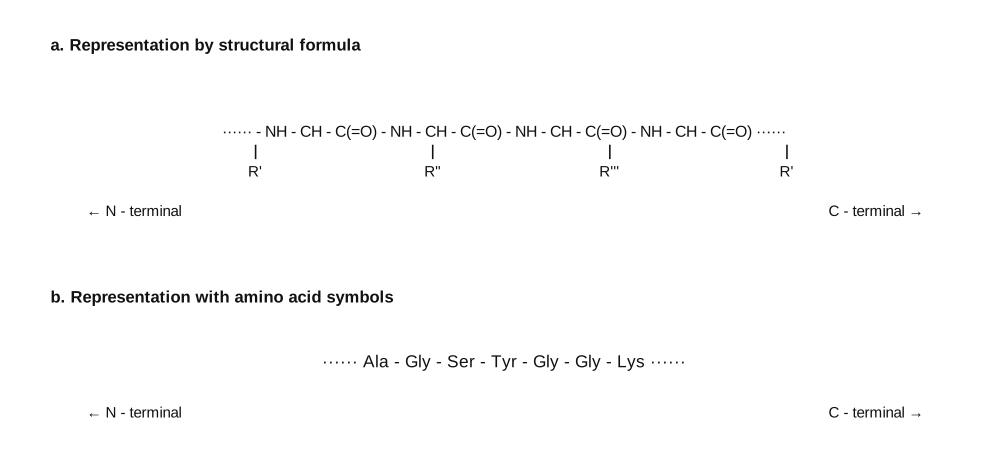
The primary structure of a protein is, most simply, the exact SEQUENCE in which its constituent alpha-amino-acid residues are strung together, one after another, joined by peptide bonds -- it is the most basic and most fundamental level of protein structure, since every higher level (secondary, tertiary, quaternary) ultimately derives from and depends on this sequence. Because each amino acid residue's identity is fixed by which side chain (R group) it carries, even a single substitution -- one residue in the sequence replaced by a different amino acid -- produces a chemically and often functionally DIFFERENT protein altogether (this sequence-sensitivity is, biologically, the molecular basis of how a single-gene mutation can alter or destroy a protein's function). Primary structure is conventionally represented in shorthand by writing out the three-letter symbols of the successive amino-acid residues in their correct sequence, separated by dashes -- and, following the same N-terminal/C-terminal convention introduced in section 14.3.2, the residue at the free-a …
Drawn by us to help you understand the concept clearly, and verified to make sure it's accurate. For exams, practice from your textbook's own diagram.
What this figure shows. Two parallel representations of the same short polypeptide segment. (a) By structural formula: a repeating backbone -NH-CH(R')-CO-NH-CH(R'')-CO-NH-CH(R''')-CO-NH-CH(R'''')-CO-, with each R group (R', R'', R''', R'''') representing a different amino-acid side chain hanging off its own alpha-carbon, the leftmost -NH- marked N-terminal and the rightmost -CO- marked C-terminal. (b) By amino-acid symbols: the equivalent sequence written as Ala-Gly-Ser-Tyr-Gly-Gly-Lys, dash-separated three-letter codes read left (N-terminal, Ala) to right (C-terminal, Lys) -- the standard shorthand notation for primary structur …
Worked out. Worked problem: chymotrypsin, a digestive enzyme, hydrolyses only those amide bonds where the CARBONYL side of the bond comes from phenylalanine, tyrosine or tryptophan. Given the hexapeptide Gly-Tyr-Gly-Ala-Phe-Val, find the peptides smaller than a pentapeptide formed on hydrolysis. Solution: reading the sequence N-terminal (Gly) to C-terminal (Val), the residues whose CARBONYL group faces toward the C-terminal side are Tyr (2nd residue) and Phe (5th residue) -- both cleavage-eligible per chymotrypsin's rule -- so the chain is cut immediately after Tyr and immediately after Phe. This yields three fragments: Gly-Tyr (a dipeptide, from before/at the first cut), Gly-Ala-Phe (a tripeptide, between the two cu …
Worked out. Worked problem: given the tripeptide structure CH3-CH-CO-NH-CH-CO-NH-CH-COOH with NH2 on the first alpha-carbon, CH2OH on the second, and CH2SH on the third, find the three constituent amino acids. Solution: a peptide is broken back into its free amino acids by adding one H2O molecule across each of its (two, for a tripeptide) amide bonds, restoring each residue's own -NH2 and -COOH. This gives: CH3-CH(NH2)-COOH (alanine, from the first residue), H2N-CH(CH2OH)-COOH (serine, from the second residue, whose side chain is -CH2OH) and H2N-CH(CH2SH)-COOH (cysteine, from the third residue, who …