Chemistry · Ch 14 — Biomolecules
α-Amino acids
α-Amino acids
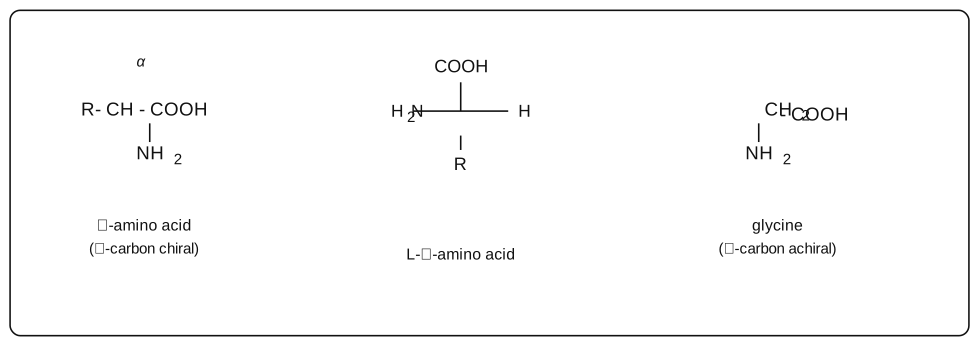
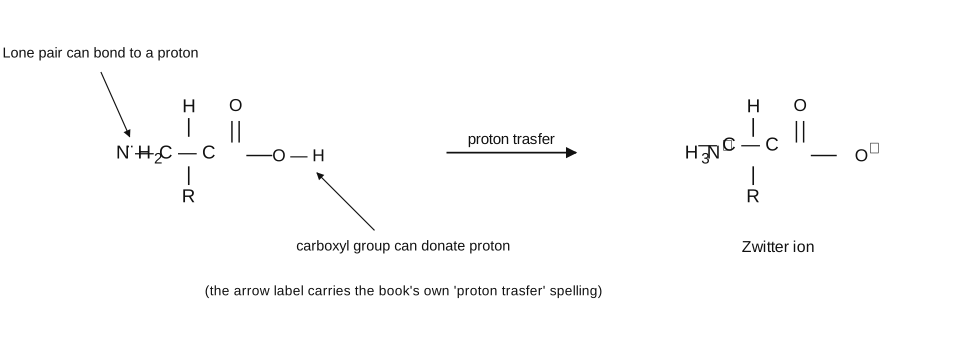
Complete hydrolysis of any protein breaks every peptide linkage in it and yields a mixture of free alpha-amino acids -- the monomer units from which every protein is built. An alpha-amino acid is a carboxylic acid bearing an amino (-NH2) group specifically on its alpha-carbon (the carbon immediately adjacent to the -COOH group), giving the general structure R-CH(NH2)-COOH, where R (the 'side chain') varies from one amino acid to the next and can itself carry additional functional groups. Except for glycine (R = H, whose alpha-carbon happens to bear two identical hydrogen atoms and is therefore NOT a stereocentre, i.e. achiral), the alpha-carbon of every natural amino acid IS chiral, and in every case is found to have the 'L' configuration (assigned, exactly as for sugars, relative to a reference compound -- here by direct analogy with L-glyceraldehyde's Fischer-projection convention) -- natural amino acids are accordingly written L-R-CH(NH2)-COOH. The side chain R determines how each amino acid is further classified: if R itself contains an additional -COOH group, the amino acid is classed as ACIDIC; if R contains an additional amino group (primary, secondary or tertiary), the amino acid is classed as BASIC; and if R contains neither -- no extra acidic or basic functional group -- the amino acid is classed as NEUTRAL. Table 14.1 lists all twenty of the alpha-amino acids commonly found in natural proteins, each with its trivial (common) name, its side-chain R group, and its standard three-letter and one-letter shorthand symbols, along with its neutral/acidic/basic classification. Of these twenty, TEN cannot be synthesised by the human body at all and must be obtained ready-made from the diet -- these are called the essential amino acids, and are marked with an asterisk (*) in Table 14.1 (they include valine, leucine, isoleucine, threonine, methionine, phenylalanine, tryptophan, lysine, arginine and histidine). Structurally, every alpha-amino acid molecule simultaneously carries an acidic functional group (-COOH) and a basic functional group (-NH2) within the same small molecule; an internal (intramolecular) proton transfer from the acidic carboxyl to the basic amino group converts the neutral-looking structure into a dipolar salt called a zwitter ion (-COO- and -NH3+ coexisting, net charge zero) -- it is this internal-salt, zwitterionic structure (rather than an ordinary covalent-molecule structure) that explains why amino acids are unusually high-melting, water-soluble, crystalline solids, quite unlike the simple amines or carboxylic acids of compar …
Drawn by us to help you understand the concept clearly, and verified to make sure it's accurate. For exams, practice from your textbook's own diagram.
What this figure shows. Two general structures side by side: R-CH(NH2)-COOH, labelled 'alpha-amino acid (alpha-carbon chiral)' -- the general case, where R is any side chain other than H; and H2N-CH2-COOH, labelled 'alpha-carbon achiral' -- the special case of glycine, whose alpha-carbon bears two identical hydrogens and so has no chirality. Below these, a Fischer-projection template for an L-alpha-amino acid is shown: COOH at the top, H2N- on the left and H on the right at the alpha-carbon (the defining arrangement of the natural L-series, …
Neutral amino acids: 1. Glycine (Gly, G), R = H-. 2. Alanine (Ala, A), R = CH3-. 3. Valine* (Val, V), R = Me2CH-. 4. Leucine* (Leu, L), R = Me2CH-CH2-. 5. Isoleucine* (Ile, I), R = CH3-CH2-CH(Me)-. 6. Asparagine (Asn, N), R = H2N-CO-CH2-. 7. Glutamine (Gln, Q), R = H2N-CO-CH2-CH2-. 8. Serine (Ser, S), R = HO-CH2-. 9. Threonine* (Thr, T), R = CH3-CHOH-. 10. Cysteine (Cys, C), R = HS-CH2-. 11. Methionine* (Met, M), R = Me-S-CH2-CH2-. 12. Phenylalanine* (Phe, F), R = Ph-CH2-. 13. Tyrosine (Tyr, Y), R = p-HO-C6H4-CH2-. 14. Tryptophan* (Trp, W), R = the indole-ring-CH2- group. 15. Proline (Pro, P), R = the cyclic pyrrolidine ring fused back onto the amino nitrogen (the entire ring forms part of the amino-acid structure, unlike the other 19 which have an open-chain -NH2). Acidic amino acids: 16. Aspartic acid (Asp, D), R = HOOC-CH2-. 17. Glutamic acid (Glu, E), R = HOOC-CH2-CH2-. Basic amino acids: 18. Lysine* (Lys, K), R = H2N-(CH2)4-. 19. Arginine* (Arg, R), R = HN=C(NH2)-NH-(CH2)3-. 20. Histidine* (His, H), R = the imidazole-ring-CH2- group. …
Drawn by us to help you understand the concept clearly, and verified to make sure it's accurate. For exams, practice from your textbook's own diagram.
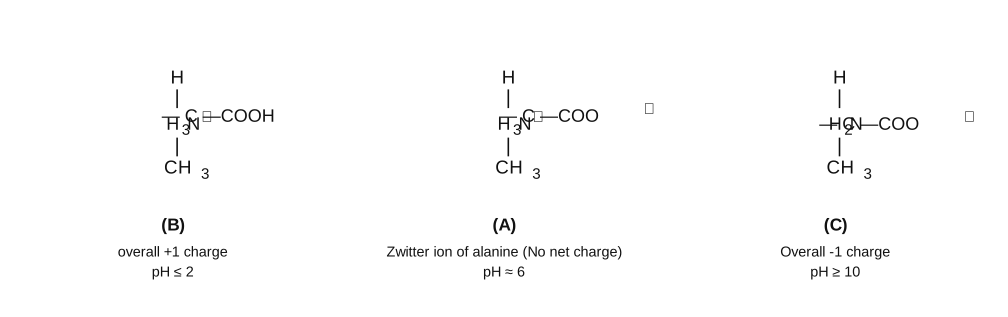
What this figure shows. Three structures of alanine (CH3-CH(NH2)-COOH) drawn as they exist at different pH values. (A) at pH below about 2: fully protonated cation, H3N+-CH(CH3)-COOH, net charge +1. (B), the zwitter ion, at pH around 6 (roughly neutral/physiological conditions): H3N+-CH(CH3)-COO-, no net charge (the -COOH has lost its proton to the -NH2). (C) at pH above about 10: fully deprotonated anion, H2N-CH(CH3)-COO-, net charge -1. This progression -- cation to zwitterion to anion as pH rises -- is general to every amino acid, only the pH values at which each t …
Worked out. At the body's physiological pH of 7.4, neutral alpha-amino acids exist predominantly as their zwitterionic form (protonated -NH3+, deprotonated -COO-, net neutral). Acidic alpha-amino acids (whose R group carries an extra -COOH) exist mainly as anions at this pH, because the extra carboxyl group is also deprotonated. Basic alpha-amino acids (whose R group carries an extra amino group) exist mainly as cations, because the extra amino group is also protonated. These ionic side-chain structures, multiplied across every residue in a polypeptide, are what give whole proteins their overall ionic …
Drawn by us to help you understand the concept clearly, and verified to make sure it's accurate. For exams, practice from your textbook's own diagram.
What this figure shows. Shows the internal acid-base reaction that forms a zwitter ion: the neutral amino-acid structure, drawn with a -COOH group (whose lone -OH proton can be donated) on one carbon and a free -NH2 group (whose lone pair can accept a proton) elsewhere in the molecule, undergoes an internal proton transfer -- the acidic carboxyl proton migrates onto the basic amino nitrogen -- to give the zwitter ion: -COO- (carboxylate anion) and -NH3+ (ammonium cation) coexisting in the same molecule, net charge zero, but now held together as an internal salt rat …