Chemistry · Ch 14 — Biomolecules
Peptide bond and protein
Peptide bond and protein
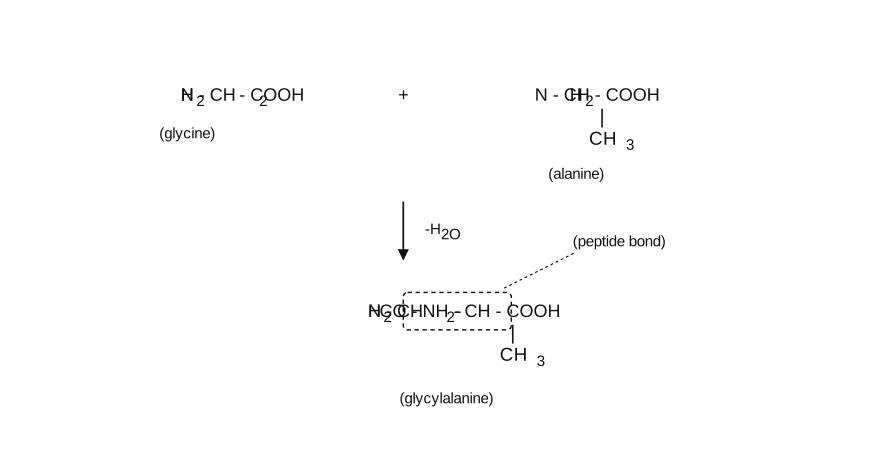
The chemical bond that links one alpha-amino acid to the next, building up the polymer chain of a protein, is called the peptide bond. It forms by a condensation reaction between the -COOH group of one amino acid and the -NH2 group of a second amino acid, with the elimination of one water molecule -- the same fundamental amide-forming reaction studied for simple amides and amines in organic chemistry, here specifically between two amino-acid monomers. Two amino acids joined by a single peptide bond give a dipeptide (for example, glycine plus alanine gives the dipeptide glycylalanine). Adding successive further amino-acid units, one peptide bond at a time, gives a tripeptide (three units), tetrapeptide (four), pentapeptide (five), hexapeptide (six), and so on; once the chain grows beyond ten linked amino-acid units, the general term used is polypeptide. The individual -CHR- structural units contributed by each amino acid, once incorporated into the chain, are referred to as amino acid residues (each residue having lost the specific H and OH that were eliminated as water when its peptide bonds formed). Although the words 'polypeptide' and 'protein' are sometimes used loosely, the working distinction is one of size: proteins are specifically polypeptides containing MORE than about a hundred amino acid residues linked by peptide bonds (though the exact boundary between the two terms is not sharply or universally defined). Every polypeptide chain, however long, has two chemically distinct ends, because the peptide-bond-forming reaction is directional: the end of the chain that still carries a free, unreacted -COOH group is called the C-terminal end, and the end that …
Drawn by us to help you understand the concept clearly, and verified to make sure it's accurate. For exams, practice from your textbook's own diagram.
What this figure shows. Shows glycine, H2N-CH2-COOH, and alanine, H2N-CH(CH3)-COOH, condensing with loss of a water molecule (-H2O) to form the dipeptide glycylalanine, H2N-CH2-CO-NH-CH(CH3)-COOH. The new -CO-NH- linkage formed between glycine's carboxyl carbon and alanine's amino nitrogen is labelled the peptide bond -- chemically identical to what organic chemistry calls a secondary amide linkage. Glycine contributes the N-terminal residue (its free -NH2 remains at the left end) and alanine contributes the C-terminal residue (its free - …