Chemistry · Ch 10 — Halogen Derivatives
Chiral atom and molecular chirality
Chiral atom and molecular chirality
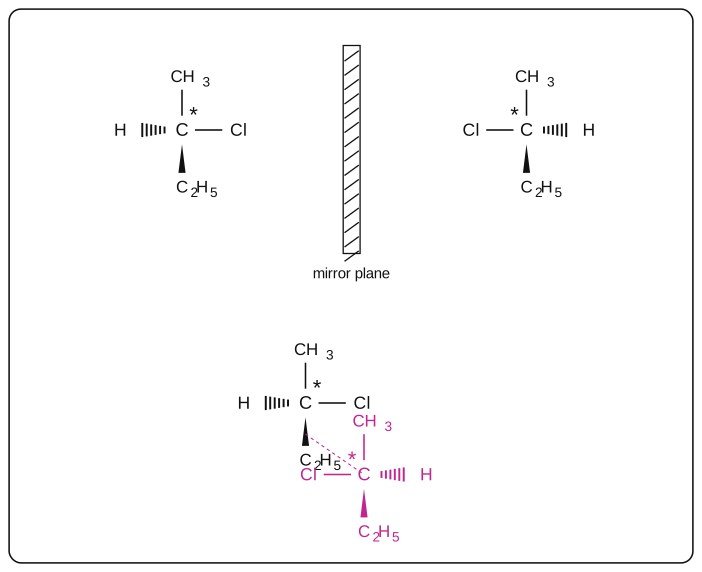
A chiral molecule and its mirror image share the same structural formula and the same molecular formula -- they have exactly the same atoms bonded to exactly the same atoms -- but the spatial arrangement of the four different groups around the chiral atom differs between the two. In other words, a chiral molecule and its mirror image are themselves a pair of stereoisomers of each other (Class 11 Chemistry, Chapter 14). The relationship between a chiral molecule and its mirror image is directly analogous to the relationship between a left hand and a right hand -- each is the mirror image of the other, yet neither can be rotated to lie perfectly on top of the other. This handedness property is called chirality, from the Greek word 'cheir' meaning hand. Fig. 10.1 makes this concrete for 2-chlorobutane: the molecule and its mirror image, however they are rotated in space, cannot be superimposed onto each other, and the 'Try this' activity confirms the same result using physical three-dimensional models. It is worth noting, historically, that the phenomenon of optical isomerism itself was observed experimentally fir …
Drawn by us to help you understand the concept clearly, and verified to make sure it's accurate. For exams, practice from your textbook's own diagram.
What this figure shows. Shows 2-chlorobutane (CH3-*CHCl-CH2CH3) drawn as a 3-D tetrahedral structure at its chiral carbon (marked with an asterisk), with H, CH3, Cl and C2H5 arranged around the central carbon, next to its mirror image produced by reflecting the whole structure across a vertical mirror plane. When an attempt is made to rotate and overlay the two 3-D structures onto each other, the groups do not all line up at once -- however the molecule is turned, at least one pair of groups ends up swapped relative to the original, so the molecule and …