Chemistry · Ch 10 — Halogen Derivatives
Representation of configuration of molecules
Representation of configuration of molecules
Two representations are used to show the configuration of a chiral carbon and the three-dimensional structure of an optical isomer on flat paper: the wedge formula and the Fischer projection formula (also called the cross formula); both are also covered, for a general tetrahedral carbon, in the Class 11 Chemistry textbook, Chapter 14, section 14.2.3. (a) Fischer projection formula: the chiral carbon is placed at the centre of a cross, and by a fixed convention the two bonds drawn along the horizontal arm of the cross are understood to project above the plane of the paper (towards the viewer), while the two bonds drawn along the vertical arm are understood to project below the plane of the paper (away from the viewer) -- Fig. 10.3 shows this for a generic centre bearing I, Br, Cl and H. (b) Wedge formula: here the central tetrahedral carbon is imagined to lie in the plane of the paper itself; since all four of its bonds cannot then also lie flat in that same plane, bonds genuinely in the plane are drawn as ordinary straight lines, a bond projecting above the plane (towards the viewer) is drawn as a solid wedge (or simply a bold line), and a bond projecting below the plane (away from the viewer) is drawn as a broken/hashed wedge (or simply a broken line). The 'Try this' activity at the end o …
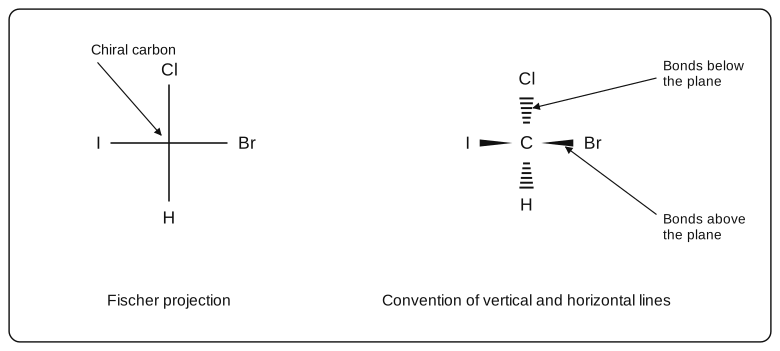
Drawn by us to help you understand the concept clearly, and verified to make sure it's accurate. For exams, practice from your textbook's own diagram.
What this figure shows. Shows how a tetrahedral chiral carbon is converted into a flat cross ('+') diagram, using a generic centre bearing I, Br, Cl and H as the example. The chiral carbon sits at the intersection of a vertical line and a horizontal line. By the convention of the Fischer projection, the two bonds drawn along the HORIZONTAL line are understood to project UP, out of the plane of the paper, towards the viewer, while the two bonds drawn along the VERTICAL line are understood to project DOWN, behind the plane of the paper, away from the viewer. The figure labels each of these four elements explicitly: the chiral carbon at the crossing point, the two …
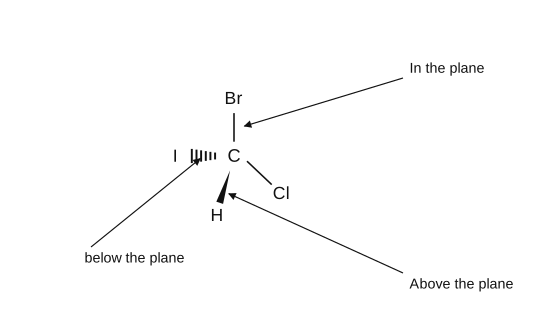
Drawn by us to help you understand the concept clearly, and verified to make sure it's accurate. For exams, practice from your textbook's own diagram.
What this figure shows. Shows the same kind of tetrahedral chiral carbon (bearing I, Br, Cl and H) drawn instead as a wedge-and-dash structure, imagining the central carbon sitting in the plane of the paper. Since all four bonds of a real tetrahedral carbon cannot actually lie flat in one plane, the convention uses three different line styles: bonds that genuinely lie in the plane of the paper are drawn as ordinary straight lines; a bond projecting above (towards the viewer, out of the page) is drawn as a solid wedge (or simply a bold line); and a bond projecting below (away from the viewer, into the page) is drawn as a broken/hashed wedge (or simply a broken line). The figure explicitly labels one bond 'in the plane', …