Chemistry · Ch 8 — Transition and Inner Transition Elements
Atomic and ionic radii
Atomic and ionic radii
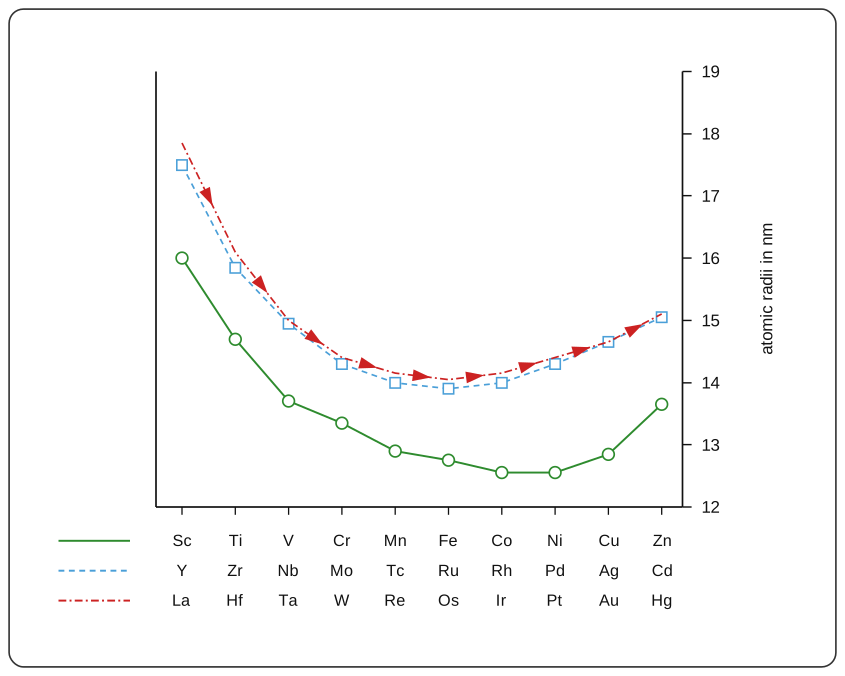
Atomic radii of the elements of the transition series decrease gradually from left to right (Fig. 8.3 and Table 8.5). As we move across a transition series from left to right, the nuclear charge increases by one unit at a time. The last filled electron enters a penultimate (n-1)d subshell. However, d orbitals in an atom are less penetrating, or more diffused, and therefore d electrons offer a smaller screening effect. The result is that the effective nuclear charge also increases as the atomic number increases along a transition series. Hence the atomic radii decrease gradually across a transition series from left to right.
The explanation for the minor variation in atomic radii within a particular transition series is out of the scope of this textbook.
Drawn by us to help you understand the concept clearly, and verified to make sure it's accurate. For exams, practice from your textbook's own diagram.
Fig. 8.3 : Trends in atomic radii of d block elements. All three series shrink from left to right as the growing nuclear charge outpaces the poor screening of the d electrons, pass through a minimum around the Fe-Co-Ni / Ru-Rh-Pd / Os-Ir-Pt columns, then swell slightly at the filled-d end (Zn, Cd, Hg). Notice how the blue 4d and red 5d curves almost coincide - the first glimpse of the lanthanoid contraction met again in 8.12.4. *(The book's own axis prints "atomic radii in nm" with tick values 1 …
Ionic radii of transition elements show the same trend as the atomic radii (Table 8.5).
The elements of the first transition series show variable oxidation states. The trends in ionic radii thus can be studied with (i) elements having the same oxidation state, or (ii) considering various oxidation states of the same element.
- (i) For the same oxidation state, with an increase in nuclear charge a gradual decrease in ionic radii was observed. The trend is pronounced for the divalent ions of the first transition series ( - 82 pm, - 73 pm).
- (ii) The oxidation states of the same element show a difference of one unit, such as , , , and so on. With higher oxidation state the effective nuclear charge also increases and hence a decrease in ionic radii can be observed from to (Table 8.5). Ionic radii of transition elements are smaller than the ionic radii of representative elements of the same period.
Table 8.5 Atomic properties of first transition series elements
| Element (M) | Atomic number (Z) | Density (g/cm³) | Radius M (pm) | Radius (pm) | Radius (pm) | Ionisation enthalpy (kJ/mol) |
|---|---|---|---|---|---|---|
| Sc | 21 | 3.43 | 164 | - | 73 | 631 |
| Ti | 22 | 4.1 | 147 | - | 67 | 656 |
| V | 23 | 6.07 | 135 | 79 | 64 | 650 |