Chemistry · Ch 8 — Transition and Inner Transition Elements
Ionization Enthalpy
Ionization Enthalpy
The ionization enthalpies of transition elements are intermediate between those of s-block and p-block elements. This suggests that transition elements are less electropositive than elements of groups 1 and 2. Depending on the conditions, they form ionic or covalent bonds. Generally, in the lower oxidation states these elements form ionic compounds, while in the higher oxidation states they form covalent compounds.
Ionization enthalpies shown in Table 8.6 reveal that for a given element there is a substantial increase from the first ionization enthalpy to the third ionization enthalpy . As we move across the transition series, slight variation is observed in the successive enthalpies , , of these elements (Table 8.6).
Drawn by us to help you understand the concept clearly, and verified to make sure it's accurate. For exams, practice from your textbook's own diagram.
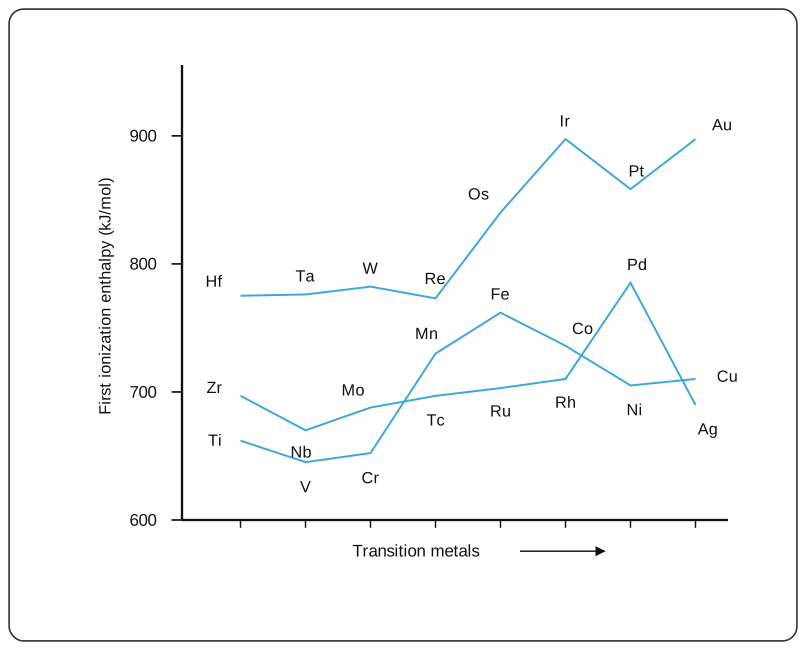
Fig. 8. 4: Trends in first ionisation enthalpies of d block elements (caption spacing as printed). Each series drifts upward with increasing nuclear charge, but irregularly - watch the Pd spike in the 4d row and the dip at Ni. The 5d curve (Hf → Au) rides clearly above the other two: its atoms hold filled 4f orbitals whose poor shielding leaves the valence electrons feeling a much larger effective nuclear charge - the very point 8.6. …
The atoms of elements of the third transition series possess filled 4f- orbitals. 4f orbitals show a poor shielding effect on account of their peculiar diffused shape. As a result, the valence electrons experience greater nuclear attraction, and a greater amount of energy is required to ionize elements of the third transition series. The ionization enthalpies of the elements of the third transition series are therefore much higher than the first and second series (Fig. 8.4).
Table 8.6 Ionisation enthalpies of first transition series elements
| IE ↓ / Element → | Sc | Ti | V | Cr | Mn | Fe | Co | Ni | Cu | Zn |
|---|---|---|---|---|---|---|---|---|---|---|
| 632 | 659 | 650 | 652 | 717 | 762 | 756 | 736 | 744 | 906 | |
| 1245 | 1320 | 1376 | 1635 | 1513 | 1563 | 1647 | 1756 | 1961 | 1736 | |
| 2450 | 2721 | 2873 | 2994 | 3258 | 2963 | 3237 | 3400 | 3560 | 3838 |
(IE = Ionisation Enthalpy in kJ/mol) …