Chemistry · Ch 8 — Transition and Inner Transition Elements
Colour
Colour
A substance appears coloured if it absorbs a portion of visible light. The colour depends upon the wavelength of absorption in the visible region of electromagnetic radiation. The colour wheel below maps each spectral colour to its wavelength range — the observed colour of a compound corresponds to the complementary colour of the light absorbed (the book's own text spells it "complimentary"). That means, if red light is absorbed, then the transmitted light contains an excess of the other colours in the spectrum — in particular blue — so the compound appears blue.
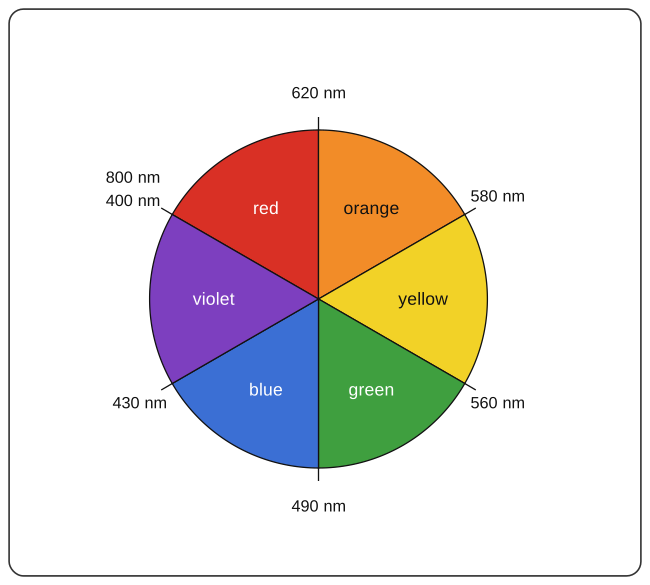
Drawn by us to help you understand the concept clearly, and verified to make sure it's accurate. For exams, practice from your textbook's own diagram.
What this wheel shows (the book prints it without a caption). The six sectors are the visible spectrum bent into a circle: the wavelength callouts mark the sector boundaries - 620 nm (red/orange), 580 nm (orange/yellow), 560 nm (yellow/green), 490 nm (green/blue), 430 nm (blue/violet) - and the 800 nm / 400 nm pair at the red-violet joint marks where the two ends of the visible range meet. A compound that absorbs one sector's light shows the colour sitting opposite on the wheel - its complementary colour. That i …
The ionic and covalent compounds formed by the transition elements are coloured. Transition elements contain unpaired electrons in their d orbitals. When the atoms are free or isolated, the five d orbitals are degenerate — they have the same energy. In complexes, the metal ion is surrounded by solvent molecules or ligands. The surrounding molecules affect the energy of the d orbitals, and their energies are no longer the same [You will learn more about this in Chapter 9]. As the principal quantum number of the 'd' orbitals is the same, the amount of energy required for the transition of an electron from one d orbital to another is quite small. The small energy required for this transition is available by absorption of radiation having a certain wavelength from the visible region. The remaining light is transmitted, and the observed colour of the compound corresponds to the complementary colour of the light absorbed.
The ions having no unpaired electrons are colourless — for example ; . Table 8.8 enlists colours of 3d transition metal ions.
Table 8.8 Colour of 3d transition metal ions
| Ion | Outer electronic configuration | Number of unpaired electrons | Colour |
|---|---|---|---|
| 0 | Colourless | ||
| 1 | Purple | ||
| 0 | Colourless | ||
| 2 | Green | ||
| 3 | violet | ||
| 5 | Light pink | ||
| 4 | Violet | ||
| 4 | Pale green | ||
| 5 | Yellow | ||
| 3 | Pink | ||
| 2 | Green | ||
| 1 | Blue | ||
| 0 | Colourless | ||
| 0 | Colourless |
(the "violet" of Cr³⁺ prints lowercase in the book while the other colour names are capitalised — carried as printed)
Let us see how the colour of the transition metal ion depends upon the ligand and geometry of the complex formed by the metal ion. When cobalt chloride () is dissolved in water, it forms a pink solution of the complex , which has octahedral geometry. But when this solution is treated with concentrated hydrochloric acid, it turns deep blue. This change is due to the formation of another complex, , which has a tetrahedral structure.
Thus the colour of a transition metal ion relates to the
- presence of unpaired d electrons
- d - d transitions
- nature of ligands attached to the metal ion
- geometry of the complex formed by the metal ion …