Physics · Ch 12 — Electromagnetic Induction
Eddy Currents
Eddy Currents
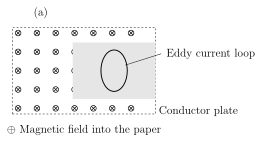
If the conducting LOOP of the previous section is replaced by a solid conducting PLATE, the same relative motion between conductor and field still induces a current -- but now, instead of being confined to one loop-shaped path, the induced current is free to swirl throughout the bulk of the plate in whirlpool-like closed paths, much like eddies in flowing water. Such circulating bulk currents are called eddy currents; although they can be very complex in detail, their overall effect is often approximated by a single equivalent circulating path, and -- exactly as for the loop -- a force must still be done against them to keep the plate moving, so mechanical energy is again converted into heat.
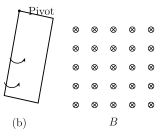
This dissipation is dramatically visible when a conducting plate, pivoted so it can swing like a pendulum, is allowed to swing in and out of a magnetic field region: on each swing, whenever the plate enters or leaves the field, a burst of eddy currents is induced, converting a portion of the pendulum's mechanical (kinetic) energy into heat within the plate. After only a handful of such swings, essentially all of the pendulum's original mechanical energy has been dissipated as heat (warming the plate measurably), and the swinging comes to a stop. …
Drawn by us to help you understand the concept clearly, and verified to make sure it's accurate. For exams, practice from your textbook's own diagram.
What this figure shows. Shows a solid, flat conducting plate (rather than a wire loop) moving with some velocity relative to a region of magnetic field (the field region again marked, e.g. by dashed boundary lines or a shaded zone). Inside the plate, a swirling, closed-loop-like path (or several such paths) is sketched to represent the eddy current that is induced in the bulk of the plate as it moves relative to the field -- unlike the single well-defined path a wire loop would carry, here the induced current is free to circulate throughout the plate's interior in wh …
Drawn by us to help you understand the concept clearly, and verified to make sure it's accurate. For exams, practice from your textbook's own diagram.
What this figure shows. Shows a flat conducting plate mounted on a pivot at its top edge so it can swing freely like a pendulum, drawn at (or swinging through) a region occupied by a magnetic field (e.g. between the pole pieces of a magnet), with a curved dashed arc showing its swing path. The figure sets up the demonstration in which the plate's mechanical (pendulum) energy is progressively converted into heat by eddy currents each time it swings into and out of the field region, causing the swing's amplitude …
Drawn by us to help you understand the concept clearly, and verified to make sure it's accurate. For exams, practice from your textbook's own diagram.
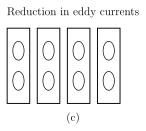
What this figure shows. Shows the same kind of flat conducting plate as in Figs. 12.10(a)/(b), but now with a pattern of narrow slots or slits cut into it (e.g. a comb-like series of parallel cuts from one edge partway across the plate), breaking up the large-area conducting paths that eddy currents would otherwise follow. The figure illustrates the standard practical method (also used in laminated transformer and motor cores) for suppressing unwanted eddy-current heating by introducing discontinuities in the conductor's structure, without needing to change the plate's magnetic or overall electrical p …