Physics · Ch 12 — Electromagnetic Induction
Energy Density of a Magnetic Field
Energy Density of a Magnetic Field
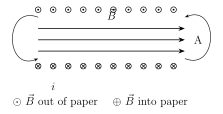
This section derives the general energy-density result explicitly for the case of a long solenoid, where the field is confined (to a good approximation) entirely to the solenoid's interior and is uniform there. Consider a length l near the middle of a solenoid of cross-sectional area A carrying current i: the associated interior volume is , and since essentially the whole magnetic field -- and hence essentially the whole stored energy of that length -- lies within this volume (the field outside a long solenoid being nearly zero), and the field is uniform inside, the energy is uniformly spread through that volume. The energy density is therefore simply .
Substituting (from the previous section) gives . Using the solenoid's inductance-per-unit-length result from Self-Inductance, (n = turns per unit length), this becomes . Finally, since the interior field of a solenoid is , this is exactly -- recovering the general result, but now derived concretely rather than merely asserted, and (crucially) shown to hold regardless of HOW the field was actually produced. …
Drawn by us to help you understand the concept clearly, and verified to make sure it's accurate. For exams, practice from your textbook's own diagram.
What this figure shows. Shows a long solenoid (a tightly-wound helical coil) carrying a steady current i, with parallel, closely-spaced, straight field lines drawn running through its central interior region (indicating a uniform field there), while outside the solenoid -- and especially beyond its ends -- the field lines are shown thinning out and curving away, becoming negligibly weak. A representative length l 'near the middle' of the solenoid is marked, together with its cross-sectional area A, establishing the interior volume used in the energy-density derivation of this section. …
Worked out. A coaxial cable of length l carries a current I down its inner cylindrical conductor (radius a) and back through its outer cylindrical conductor (radius b). By Ampere's law the field between the two conductors is (and zero elsewhere), so the energy density there is . Integrating this density over successive thin cylindrical shells of radius r, thickness dr and length l from r=a to r=b gives the total stored energy ; comparing with gives the cable's self-inductance purely from this energy argument, $L=\frac{\mu_0 l}{2\pi}\ln\lef …