Physics · Ch 8 — Electrostatics
Capacitors in Series
Capacitors in Series
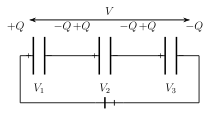
Capacitors are said to be connected in SERIES when they are wired end to end -- the second plate of the first capacitor joined directly to the first plate of the second, and so on down the chain -- such that the SUM of the individual potential differences across every capacitor in the chain equals the single total applied potential difference: for three capacitors in series.
The key physical fact about a series chain is that every capacitor in it carries the SAME MAGNITUDE of charge -- charge is induced in strict sequence down the chain by simple electrostatic induction from one plate to the next, so no capacitor in a series chain can end up with a different charge magnitude from any other. Since each individual capacitor's own potential difference is , the total applied PD becomes .
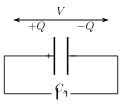
Defining the single equivalent series capacitance as (so the SAME charge and the SAME total voltage characterise the equivalent capacitor as the real chain), substituting gives , and the common factor cancels from every term, leaving for three capacitors -- generalising directly, by the same argument extended to any number of capacitors, to for capacitors in series: the RECIPROCAL of the equivalent series capacitance equals the SUM of the individual reciprocals. A direct mathematical consequence of this reciprocal-addition rule is that is always SMALLER than the smallest individual capacitance in the whole chain -- adding another capacitor in series can only ever shrink the overall equivalent capacitance further, never grow it. If all capacitors happen to be identical, each of value , this simplifies neatly to . …
Drawn by us to help you understand the concept clearly, and verified to make sure it's accurate. For exams, practice from your textbook's own diagram.
What this figure shows. Three capacitors drawn end to end in a single chain, the second plate of wired directly to the first plate of , and the second plate of wired to the first plate of , with the free end of connected to one terminal of the applied source and the free end of connected, via earth, to the other -- the standard series-chain circuit diagram from which the same-charge-on-every-capacitor property and the sum-of …
Drawn by us to help you understand the concept clearly, and verified to make sure it's accurate. For exams, practice from your textbook's own diagram.
What this figure shows. The same three series capacitors from Fig. 8.25, now redrawn together with a single equivalent capacitor shown as a replacement box carrying the identical total charge Q and identical total applied voltage V as the original three-capacitor chain -- the before/after picture used to equate with and derive . …
Worked out. Two standing practical facts about series capacitor combinations, both direct consequences of every capacitor in a series chain carrying the identical charge : a SERIES arrangement is the one to use whenever a high voltage needs to be divided or shared safely across several capacitors, rather than applied fully across any single one; and, since each capacitor's own PD is with the SAME throughout the chain, the capacitor with the SMALLEST capacitance in a series combination always ends up bearing the LARGEST potential difference of any capacitor in that chain -- a fact worth checking against when choosing individual capacit …