Physics · Ch 8 — Electrostatics
Potential Energy of a Dipole in an External Field
Potential Energy of a Dipole in an External Field
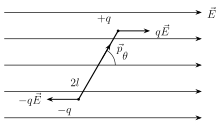
Place a complete electric dipole -- charges and separated by , dipole moment -- inside a UNIFORM external field . Because the two charges are equal and opposite, the NET force on the dipole from a uniform field is always exactly zero; but because the two equal-and-opposite forces act at two DIFFERENT points (the two ends of the dipole, separated by ), they form a COUPLE, producing a net TORQUE , of magnitude , that tends to rotate the dipole toward alignment with the field -- exactly the torque result already derived in Class XI.
Now suppose an external agent applies an equal-and-opposite counter-torque, so the dipole is rotated slowly (no angular acceleration, negligible kinetic energy at every instant) from some starting angle to a new angle . The work done by this external agent, integrating the counter-torque over the angle swept, is -- and, exactly as with any conservative-force system, this work is stored as the dipole's potential energy in its new orientation: .
Since only DIFFERENCES in PE ever matter physically, a convenient zero reference can be chosen; taking (dipole exactly perpendicular to the field, where ) as the zero-PE reference gives the clean, standard result . …
Drawn by us to help you understand the concept clearly, and verified to make sure it's accurate. For exams, practice from your textbook's own diagram.
What this figure shows. A dipole (charges and separated by ) placed in a uniform field of parallel, equally-spaced field lines , with its axis tilted at an angle to the field initially and rotating toward a new angle ; two equal, oppositely directed force arrows, on (along the field) and on (against the field), are drawn acting at the two ends of the dipole, forming the COUPLE (torque ) that both tends to align the dipole with the field and is the torque an external agent must overcome, in the opposite sense, to do the work $W=pE …
Worked out. A dipole of two charges, cm apart, so C m, is placed in a field . (i) Maximum torque occurs at : N m. (ii) Work done rotating from to : J -- exactly the maximum-flip result derived generally in …