Physics · Ch 8 — Electrostatics
Potential Energy of a System of Two Point Charges
Potential Energy of a System of Two Point Charges
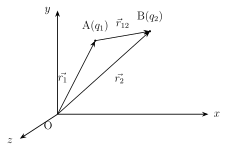
Bring the first charge in from infinity to its final position . Since the second charge is still out at infinity at this stage, there is no field yet to do work against, so this first step costs zero work: . Once in place, produces its own potential everywhere in space, in particular at 's eventual location: .
Now bring the second charge in from infinity to its final position , a distance from . This step requires work against 's own field, equal to (the potential due to at that location) : . …
Drawn by us to help you understand the concept clearly, and verified to make sure it's accurate. For exams, practice from your textbook's own diagram.
What this figure shows. Two point charges and , located at position vectors and measured from a common origin O, joined by a straight line of length (their mutual separation) -- the basic vector geometry used to write the two-charge assembly work as , which becomes the potential energy of the pair once bot …
Worked out. Charges nC C at and nC C at , so m apart. -- negative, as expected for a pair of unlike charges, meaning their own mutual attraction did the work of bringing them to thi …
Worked out. Two equal charges C are brought from infinity (zero PE) to a separation of m. The increase in PE equals the present PE: J -- a large, positive value since both charges are like-signed, illustrating how much work is needed to force two sizeable like charges into close proximity. …