Q.Draw a neat labelled diagram of Ferry's perfectly black body. Compare the rms speed of hydrogen molecules at 227°C with rms speed of oxygen molecule at 127°C. Given that molecular masses of hydrogen and oxygen are 2 and 32 respectively.
You're viewing a preview — the full solution, concept, methods & PYQ mapping are locked.
Start your 14-day free trial to unlock the full solution →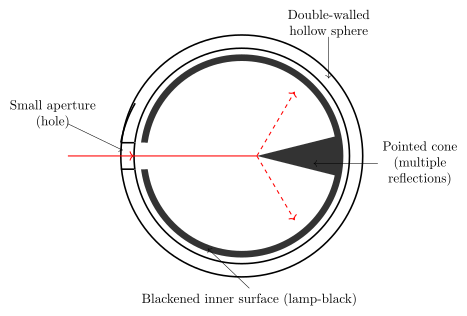
Ferry's black body traps radiation via a small hole in a blackened cavity; rms speed depends on .
Ferry's perfectly black body: a hollow double-walled sphere with the inner surface coated with lamp-black, with a small opening (hole) on one side through which radiation enters. Directly opposite the hole, a conical projection is built into the inner wall. Radiation entering the hole strikes the cone and undergoes multiple internal reflections/absorptions on the blackened inner surface, so that essentially none of it escapes back out through the hole — the hole itself behaves as a near-perfect absorber (and, when the sphere is heated, as a near-perfect emitter), realising an ideal black body.
rms speed comparison: , so …
Unlock everything free for 14 days
- Full step-by-step solutions
- Concept-first explanations
- Methods, shortcuts & mistakes
- PYQ mapping + timed mock tests
Full access for 14 days. No credit card required.