History · Ch 7 — Paths to Modernisation
Aggressive Nationalism
Aggressive Nationalism
The Meiji constitution created a parliament with limited powers, but the real story of early twentieth-century Japan is how those limits were steadily widened in favour of the military. The constitution itself was built on a restricted franchise, and the Diet — the Japanese deliberately used the German word for parliament, reflecting the influence of German legal ideas — had only limited authority. Real power stayed with the leaders who had brought about the imperial restoration, and they went on to establish political parties of their own.
For a brief window, between 1918 and 1931, popularly elected prime ministers were able to form cabinets. After that, they lost this position to national unity cabinets, which were formed across party lines. This shift was not accidental. The emperor was the commander of the armed forces, and from 1890 this position was interpreted to mean that the army and the navy had independent control, free from civilian oversight. In 1899, the prime minister went further and ordered that only serving generals and admirals could become ministers of the army and navy. The military was thus embedded directly into the cabinet, and no civilian government could remove them.
This strengthening of the military was tied directly to the expansion of Japan's colonial empire, and both were driven by a deep fear: that Japan was at the mercy of the Western powers. That fear was deliberately used to silence opposition — to military expansion and to the higher taxes needed to fund the armed forces. Anyone who protested could be painted as endangering the nation.
Not everyone accepted this logic. Tanaka Shozo (1841–1913), the self-taught son of a farmer, rose to become a major political figure. He had participated in the Popular Rights Movement in the 1880s, a movement that demanded constitutional government, and he was elected to the first Diet. His core belief was simple: ordinary people should not be sacrificed for industrial progress. He took up the cause of farmers ruined by the Ashio Mine, which was polluting the Watarase river. The pollution destroyed about 100 square miles of farmland and affected around a thousand families. The agitation he led forced the company to adopt pollution-control measures, and by 1904 harvests had returned to normal. …
Drawn by us to help you understand the concept clearly, and verified to make sure it's accurate. For exams, practice from your NCERT textbook's own diagram.
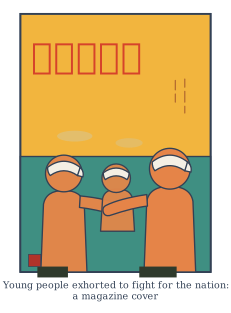
The cover shows a Japanese magazine from the war years, with a central image of young people being urged to fight for the nation. The word "exhorted" matters here — this is not a neutral scene but a piece of propaganda, a direct call to action aimed at the young. The magazine cover is paired with photographs of student-soldiers marching in formation, so the visual message is reinforced by real images of youth already transformed into soldiers.
What the figure teaches is how the state turned nationalism into a mass movement aimed specifically at the young. The Meiji system had built a powerful military with independent control, and by the early twentieth century that military was expanding Japan's colonial empire. But an army needs bodies, and those bodies had to be convinced. The magazine cover is that act of convincing — a deliberate, state-sponsored appeal to young people's sense of duty and patriotism. The photographs of student-soldiers marching show the result: young men, likely still in school or just out of it, drilled into formation, their individuality absorbed into the uniformed collective. …